Showing posts with label Army of the Potomac. Show all posts

Wednesday, April 4, 2012

Entirely Secure

Wherein Lincoln turns to McDowell to defend Washington...again
.............................................................................................................................................

On Tuesday, April 1, 1862, Maj. General George B. McClellan had sailed away from Alexandria en route to the Virginia Peninsula. On Wednesday, April 2, 1862, Secretary of War Edwin M. Stanton moved to banish him from the capital region for good.

Stanton, like Winston Churchill, was a pedantic, obnoxious, arrogant, unlikable, borderline sociopath, without whom the world as we know it today would not exist. Like Churchill, Stanton's highest loyalty was to his own ideas, and the resulting wild shifts in political affiliations led to accusations of opportunism. Both men were beyond stubborn, and held no beliefs loosely, and had become fanatically devoted to ideas they had hatched that proved disastrously wrong. Both also got the most important question of their lifetime right, and their single-minded devotion to seeing it achieved saved democracy for their countries.

For Stanton, that idea was the primacy of the Union, which required the full efforts of a dominant Federal government to establish and sustain. Stanton was a lawyer from Ohio, who had dropped out of Kenyon College when his father died and completed his studies reading with a lawyer in his home town. He was relentless in his cases, and early on earned a reputation for ruthlessness or dedication, depending on which side of the court room one sat. He earned national fame when he defended then-Congressman Daniel Sickles from charges of murder when he shot District of Columbia U.S. Attorney Philip Barton Key (son of the author of the Star Spangled Banner) to death in Lafayette Park. Sumner argued successfully for the first time in an American court room that Sickles had become temporarily insane because of Key's affair with the Congressman's wife (in the opinion of this blogger the defense was a lie; Sickles was permanently insane).

In 1858, Attorney General Jeremiah Black sent Stanton to California, deputized to settle land disputes. Stanton's well-known anti-slavery Democratic politics made him appealing to the Buchanan Administration, which was trying to split the difference between its Northern and Southern wings. His popularity at getting the Democrat Sickles off in what had become a very political celebrity trial made his appointment a victory of sorts for Northern Democrats, who felt they were losing out by Buchanan's gentle treatment of Southerners. But in California, Sickles turned his formidable intellect and pit bull personality on the land disputes and uncovered a massive conspiracy to defraud the Federal government. On top of his celebrity, he had turned out to be useful.

In December 1860, Buchanan's Northern Democrat Secretary of State resigned in protest, because the President had refused to deploy the U.S. Army to defend Federal property in South Carolina after it announced secession. Buchanan quickly asked Black to serve in the position. Black advocated a less confrontational approach: reinforce Fort Sumter, but let the South Carolinians cool down and then reengage diplomatically. Stanton was appointed Attorney General to replace Black.

If Buchanan thought Stanton might support his administration's balanced approach to session, he was disastrously wrong. Stanton instead almost single-handedly dragged Buchanan to condemn secession, and thundered about the need for immediate military action. When it became clear Buchanan would not do so, and that Secretary of War John Floyd was secretly supplying information to the South Carolinians, whipping for secession votes in his home state of Virginia, and making it easy for secessionists to seize arsenals in the South, Stanton decided to begin supplying information to President-elect Lincoln and general-in-chief Winfield Scott. It's largely thanks to Stanton that the Lincoln Administration had even limited ability to respond to the secession crisis when it was sworn in in March.

The new Secretary of War, Simon Cameron, was clearly in way over his head, at best. At worst, he may have been a corrupt war profiteer. Either way, Lincoln asked Stanton to stay on as a special counsel at the War Department. In that role, Stanton befriended fellow Ohio Democrat George McClellan, who had come to the capital after Bull Run to make things right. Or so McClellan thought. Stanton, like the famous paraphrase of Lord Palmerston's remarks to Parliament, had no friends, only interests. When it became clear that Cameron was tragically inept, Stanton made use of McClellan (who at least could recognize good ideas) to push for the organization of an army strong enough to impose Federal will on the rebellious states.

When Lincoln told Cameron he was resigning, Stanton was brought in to root out the corruption at the War Department. With fanatical zeal he turned his brain to ungumming the bureaucracy and creating an efficient machine for the administration of what later generations of Americans would learn to call total war. But with himself in the driver's seat and able to depress the gas pedal fully, McClellan had become the impediment to reinstating the Union as quickly and thoroughly as possible. And so, Edwin Stanton turned his relentless talents towards destroying McClellan.

It was probably Stanton who was responsible for Lincoln's change of heart towards his role as commander-in-chief. During Cameron's time at the War Department, the President had believed war was best left to general-in-chief Scott and his replacement, McClellan. But since January, the President had issued orders for all armies to advance, had forced McClellan to step down as general-in-chief, had created corps for the Army of the Potomac, and had set conditions for McClellan to meet before his plans could receive approval. Stanton had probably convinced him that  the first word of commander-in-chief had real meaning. At the very least, Stanton had empowered him to act on beliefs he had developed himself.

Stanton had also decided to balance McClellan's dominance of the new upper echelon of the Army created by the promotion of his favorites to brigadier generals of U.S. Volunteers, by elevating prominent members of the old pre-war Army. At the operational level, four were now McClellan's corps commanders, much to his irritation. At the national-strategic level, Stanton pulled Adjutant General Lorenzo Thomas out of the dusty corner he had been confined to by McClellan, and reinstated as a major general Ethan Allen Hitchcock, to be a special advisor to the Secretary. Both men had been born around the turn-of-the-century, and both men had had senior roles in the army before the Mexican War. They were perfect for Stanton's scheme of pitting experience against the youthful "genius" of McClellan.

On April 2, Stanton turned to them to exorcise the ghost of McClellan from the capital. He submitted a request to the two men to review five papers he provided and "report to me whether the President's order and instructions have been complied with in respect to the forces to be left for the defense of Washington and its security and at Manassas."

First up was the President's General War Order No. 3, issued on March 8, which forbade shifting the base of operations of the Army of the Potomac until McClellan and all four corps commanders certified Washington was safe. The second document was that certification, with the Fourth Corps' Erasmus Keyes, the Third's Sam Heintzelman, and the First's Irvin McDowell, all further stipulating that if all the forts on the Virginia side of the Potomac were garrisoned, then only 25,000 men would be needed. The Second Corps' Edwin Sumner calculated differently, saying a total force of 40,000 men would be needed, but still agreed the city was safe under McClellan's plan. The unanimous agreement had shocked and irritated Stanton, who believed the capital needed a significantly larger force to defend it.

Third, was Stanton's own concurrence with the plan approved by the corps commanders, further stipulating that not only must Washington be secure, but Manassas Junction must be secured for the duration of the war. It's unclear how much Stanton did this to secure the line of communication that had caused disaster in July 1861 when the Valley Confederates and the Northern Virginia Confederates were able to support each other, and how much Stanton did this to move the goal posts on McClellan. It managed to accomplish both.

Fourth was McClellan's own report written on board the Commodore on April 1 as he was departing. It left under the military governor of Washington, Brig. General James Wadsworth, 18,000 men for the forts and the city, as well as under Maj. General Nathaniel P. Banks 55,456 men for defending the Valley, Warrenton, Manassas, and Charles County on the Lower Potomac.

Finally, the April 2 report from Wadsworth that precipitated Stanton's request from Thomas and Hitchcock, showing 20,000 men under his command, but complaining that he had, in fact, far less, since McClellan had ordered him to send nearly half to places Banks was supposed to defend. Stanton would have had McClellan's report, which Wadsworth did not, and know that the defense scheme called for Banks to replace Wadsworth as soon as he was done finally putting an end to Stonewall Jackson in the Valley, but it was Wadsworth's other charge that the troops under him were untrained and the worst of the regiments brought in during the winter that angered him and gave him an opportunity to eliminate the deliberate, limited war waging McClellan.
I deem it my duty to state that, looking at the numerical strength and character of the force under my command, it is my judgment entirely inadequate and unfit for the important duty to which it assigned. I regard it very improbably that the enemy will assail us at this point, but this belief is based upon the hope that they may be promptly engaged elsewhere and may not learn the number and character of the force left here.
 Hitchcock and Thomas made a reply the very same day. On examining the documents they determined that 55,000 men would be necessary total to accomplish, with 30,000 men manning the forts (every fort, unlike McClellan's scheme to man only the Virginia forts) around Washington and 25,000 in a mobile corps, that could engage launch counterattacks. So far, so good, for McClellan. He even received unexpected support when they declared Stanton's order about Manassas Junction unnecessary, since "as the enemy have destroyed the railroads leading to it it may be fair to assume that they have no intention of returning for the reoccupation of their late position...."

But when comparing Wadsworth's report to McClellan's, Thomas and Hitchcock struck the coup de grace. McClellan had double counted a brigade of Wadsworth's men as defending Washington and defending Manassas Junction. Since the men couldn't be in both places, no matter what their quality, McClellan's report was inaccurate. An argument can be made that the commanding general was exhausted from the long hours loading his army for transport and simply made a mistake, but Stanton was happy to claim perfidy.

Thomas and Hitchcock gave him the conclusion he needed:
In view of the opinion expressed by the council of the commanders of the army corps of the force necessary for the defense of the capital, though not numerically stated, and of the force represented by General McClellan as left for that purpose, we are of opinion that the requirement of the President that this city shall be left entirely secure, not only in the opinion of the General-in-Chief, but that of the commanders of all the army corps also, has not been fully complied with.
It took until April 4 for Stanton to take action, he first had to convince Lincoln to interfere with the plan McClellan had made and that all his corps commanders had approved. But finally the president agreed, and Lorenzo Thomas issued an order by telegraph the day that McDowell's First Corps had been scheduled to board transports in Alexandria: "By direction of the President, Gen. McDowell's army corps has been detached from the force under your immediate command, and the general is ordered to report to the Secretary of War."

It would take several days for the letter Thomas also mailed explaining that the detachment was because of the insufficiency of forces to defend Washington, but by that point McDowell's First Corps had been officially turned into the Department of the Rapphannock, with authority from its namesake river to the Patuxent River in Maryland, and west to the Blue Ridge Mountains, where the new Department of the Shenandoah under Nathaniel Banks picked up. Both former subordinates of McClellan now reported directly to Stanton, and McClellan's authority was at last confined only to the troops within his army.

Sunday, April 1, 2012

The Full Pressure

Wherein McClellan tries to escape Washington
...................................................................................................................................................

On March 31, 1862, the wharfs at Alexandria were a flurry of activity. The largest army that the United States had ever seen had been sailing out of the port for Fort Monroe on the Virginia Peninsula, and the previous two weeks men, animals, and supplies from all over the North had squeezed their way through the narrow streets to board the rickety ships converted from civilian use to transport them.

The man orchestrating it all was Maj. General George B. McClellan, one time general-in-chief of the U.S. Army, now confined only to command the Department of the Potomac. In the months since he returned from his illness, McClellan had become deeply unhappy with Washington, and longed to get away from Secretary of State Edwin Stanton's oppressive scrutiny. Once Stanton and McClellan had mocked Lincoln together, but the Secretary had switched sides and, unlike his predecessor, he knew McClellan all too well. Paranoia was nothing new to McClellan's worldview, he always believed powerful forces were arrayed against him, but with Stanton at the War Department, for once, McClellan was right.

So McClellan was transferring the Army of the Potomac as quickly as he could to get to a place where he was the top officer in the theater (though the commander of Fort Monroe, the elderly Maj. General John Wool, was making even that a complex feat). Over 70,000 men in six divisions of the Army of the Potomac had already left through Alexandria. Two divisions (Fitz John Porter's and Charles Hamilton's) of Brig. General Sam Heintzelman's Third Corps were already fighting on the Virginia Peninsula, as was one (Baldy Smith's) of Brig. General Erasmus Keyes' Fourth Corps. Another of Keyes' divisions (Darius Couch's) was en route, along with the Reserve Division (Andrew Porter), most of the artillery and cavalry, and a division (John Sedgwick's) of Brig. General Edwin Sumner's Second Corps.

That left one division from the Fourth Corps (Silas Casey's), one from the Third Corps (Joe Hooker's), two from the Second Corps (Israel Richardson's and Louis Blenker's), and all three from Brig. General Irvin McDowell's the First Corps (William Franklin's, George McCall's, and Rufus King's). Casey's Division from the Fourth Corps was the next scheduled to depart, and, when it arrived, would make the first complete corps of the Army of the Potomac on the Peninsula, as well as mean McClellan had more divisions on the Peninsula than in Northern Virginia. So the commanding general had decided to depart with it and take command in the field, leaving it to others to embark all three divisions of McDowell's First Corps on April 2, followed by Hooker's division on April 7, and the remaining two divisions of Sumner's Second Corps some time in-between.

He would then have around 150,000 men to march on Richmond, one of the largest field armies in world history in 1862. The previous army marching on fixed positions on the Virginia Peninsula had been the coalition operation under George Washington and the Comte de Rochambeau, who had 5,500 men and 9,500 men, respectively. True, Napoleon had waged the War of the Second Coalition with an army of 200,000 men, but the geographic area he had covered had been several times the size of the Virginia Peninsula. For a modern comparison, at the height of the Iraq War surge in 2007, the United States had deployed 168,000 troops to Iraq, nation-wide, plus about 10,000 coalition troops in an area 160,000 square miles (counting Kuwait, where around 25,000 troops were in reality), which the CIA World Factbook unhelpfully describes as "slightly more than twice the size of Idaho". The entire state of Virginia is only 43,000 square miles, meaning that by the third week of April the Peninsula was going to have a population density close to a modern urban area.

Or that was McClellan's plan. On March 23, Confederate Maj. General Thomas "Stonewall" Jackson had thrown the first wrench in it when he attacked in the Shenandoah Valley, against any reasonable expectation, and diverted McClellan from transferring three brigades from there to Manassas Junction. That had slowed his departure schedule for the Second Corps, but there were plenty of other divisions to load in their place. It took Edwin Stanton to really derail McClellan's plans.

As McClellan readied all his baggage for transport, that blow was delivered by the President, though it is black with Stanton's fingerprints. "This morning I felt constrained to order Blenker's division to Fremont," Lincoln wrote in a note to McClellan.
I write this to assure you that I did so with great pain, understanding that you would wish otherwise. If you could know the full pressure of the case, I am confident you would justify it--even beyond the mere acknowledgement that the commander-in-chief may order what he pleases.
McClellan must have fumed. Fremont was Maj. General John C. Fremont, the Great Pathfinder who had been the first Republican nominee for president. Supporters praised him for winning California during the Mexican War, for treating the rebels with a firm hand, and for taking on the Slave Power in Missouri, by freeing the slaves of rebellious owners. Detractors saw the same events and criticized him for filibustering to interfere with operations the Navy already had well in hand, brutally turning neutrals into Jeff Davis supporters, and acting unconstitutionally based only on the might of the men with guns who surrounded him. Lincoln had sacked Fremont, but the Radical Republicans in Congress, led by the Joint Committee on the Conduct of the War, had come dangerously close to attacking Lincoln himself and the President had made up a new command for Fremont.

Fremont was given the Mountain Department, a newly invented command between the ridge of the Appalachian Mountains and the Virginia [now West Virginia] that Lincoln may have vaguely hoped would lead to an invasion of loyalist East Tennessee. The small number of troops he would lead happened to be the same troops that McClellan had led pre-Bull Run, and his taking command would displace McClellan loyalist Brig. General William Rosecrans. While that pleased the more radical members of Congress, they quickly understood Fremont had been stuck in an out-of-the-way corner and began demanding he be provided with troops. It was probably their ally Stanton that suggested sending Blenker's division, sitting idle at Warrenton Junction.

According to McClellan, writing years later, Lincoln had visited him in Alexandria as much as a week earlier to view the progress of embarkation and to discuss the pressure to transfer Blenker.
A few days before sailing for Fort Monroe I met the President, by his appointment, on a steamer at Alexandria. He informed me that he was most strongly pressed to remove Blenker's German division from my command and assign it to Fremont, who had just been placed in command of the Mountain Department. He suggested several reasons against the proposed removal of the division, to all of which I assented. He then said that he had promised to talk to me about it, that he had fulfilled his promise, and that he would not deprive me of the division.
The reversal on the eve of his departure would turn out to be the first in a litany of wrongs McClellan would level against the Lincoln Administration for the eventual failure of the Peninsula Campaign, and which will still throw Civil War scholars into a tizzy trying to debate McClellan's legacy. At the time, though, McClellan took the news in stride. After stating his regret at the transfer, "first because they are excellent troops" (a controversial statement itself) and second "because I know they are warmly attached to me", McClellan assured Lincoln he understood. "I fully appreciate, however, the circumstances of the case, & hasten to assure you that I cheerfully acquiesce in your decision without any mental reservation."

In his memoirs, he would harshly scold Lincoln, saying "the commander-in-chief has no right to order what he pleases; he can only order what he is convinced is right. And the President had already assured me that he knew this thing to be wrong..." But in his reply at the time, he told Lincoln:
Recognizing implicitly as I ever do the plenitude of your power as Commander in Chief, I cannot but regard the tone of your note as in the highest degree complimentary to me, & as adding one more to the many proofs of personal regard you have so often honored me with.
Again, in his memoirs he warned the result of withdrawing Blenker would be catastrophic:
I replied that I regretted the order and could ill-afford to lose 10,000 troops who had been counted upon in arranging the plan of the campaign. In a conversation the same day I repeated this, and added my regret that any other than military considerations and necessities had been allowed to govern his decision.
And once again, his note to Lincoln said something quite different:
I shall do my best to use all the more activity to make up for the loss of this Division, & beg again to assure you that I will ever do my very best to carry out your views & support your interests in the same frank spirit you have always shown towards me.
Whichever was closer to McClellan's real attitude, he had to make the arrangements. So he sent a message to Blenker's corps commander, Edwin Sumner, who was at Warrenton Junction with Richardson's and Blenker's divisions after chasing the Confederates back to the Rappahannock. Somehow the message got garbled and Sumner went ballistic. The normally reserved officer's reply seethes anger. In its entirety, it read:
I would respectfully ask to be informed what I am to understand by the withdrawal of the two principal divisions [Sedgwick's and Richardson's] from my army corps, and leaving me the German division only, which, in my opinion, is the least effective division in the whole army.
Sumner did not share McClellan's soft spot for the boisterous Eastern European troops (the "German" was often used as something of a epithet for non-Western Europeans, and Sumner certainly meant it that way), who only showed discipline (or were disciplined, for that matter) during one of Louis Blenker's frequent parades. McClellan, who already had his hands full with the administration, was in no mood to deal with Sumner too. He wrote to him directly at ten til 9:00 in the evening, condescendingly explaining everything:
By order of the President Blenker's division is to join General Fremont. I shall replace it by a division under General Mansfield [to be created from troops stationed at Fort Monroe that were not McClellan's to command]. The purpose of withdrawing the two divisions of your corps is to concentrate your corps in the field of active operations under your personal command. You will receive further instructions tomorrow. In the mean time please have Richardson's division ready to move back in the morning.
Sumner temper probably improved when he learned that he was accompanying Richardson to the Peninsula and not Blenker to the Valley and beyond. McClellan's probably did not improve, even as he joined his staff on the steamer Commodore in Alexandria harbor on the morning of April 1. Before he could finally leave he had to settle the defense of Washington, to satisfy the terms the President had set before approving the Peninsula Campaign.

For McClellan it was a toss-up between two political generals to leave in charge of defending the capital. Brig. General James Wadsworth was the military governor of the District of Columbia and Maj. General Nathaniel Banks was the head of the fifth corps of the Army of the Potomac, currently commanding in the Valley. McClellan had more confidence in Banks, who he had worked with over the winter, and left the primary responsibility of defense to him.

Banks had six brigades grouped into two divisions to work with. One brigade, McClellan supposed (prematurely), was already at Warrenton Junction. A second was marching that direction and at White Planes. But McClellan had decided to rob from Wadsworth and ordered him to send a brigade of the troops within the District of Columbia's forts directly to Manassas Junction, and then two more brigade over the course of the next week. That would be nearly all of the (poorly trained) soldiers within the fortification line. Banks should move his remaining division to Staunton at the top of the Upper Valley, to control the fertile farmland down below.

Anticipating those orders going through, McClellan ordered Richardson's division to Alexandria and Blenker's to Strasburg. Then he summarized everything for the War Department. There would be 7,780 men defending Warrenton, 10,859 at Manassas Junction, 35,467 based on Staunton in the Valley, and 1,350 replacing Hooker's Division in Charles County. A total of 55,456 men to defend the capital, plus about 18,000 men, he estimated, under Wadsworth within the fortifications of the District. McClellan probably did not realize how consequential the memo would become.

With everything completed, the steamer carrying McClellan finally pulled away from its moorings.
As soon as possible after reaching Alexandria I got the Commodore under weigh & "put off"--I did not feel safe until I could fairly see Alexandria behind us...I feared that if I remained at Alexandria I would be annoyed very much & perhaps be sent for from Washn. Officially speaking, I feel very glad to get away from that sink of iniquity...
But he had not gotten away. Not in the least.


Print Sources:
  • Sears, 219-223

Thursday, March 29, 2012

Sent to Humbug

Wherein we observe intelligence collection, Civil War style
..................................................................................................................................................

For some of his very finest work, see All Not So Quiet on the Potomac's spectacular accounts of the Pennsylvania Reserves being left out and Alexandria during the boarding of the Army of the Potomac. Seriously, read the Alexandria piece, even if it means you don't read anything below.

Centreville (top) and Manassas Junction (bottom) in March 1862 (Harper's Weekly)
For over two weeks Brig. General James Ewell Brown Stuart--better known as Jeb--had provided invisibility to the Confederate Army of the Potomac under General Joe Johnston. Unlike 2012's March, the weather of 150 years ago had been more typical of the capital region, alternating frenetically between gorgeous, blustery sunshine and miserable, pounding rain. Throughout it, rain or shine, Stuart's Confederate horsemen had screened the army, allowing the Northerners only the ability to know for certain where Johnston was not.

But Stuart was concerned, because while his constant skirmishes with Union cavalry and occasionally infantry was denying information to his enemy, it was also making it impossible for him to gather his own information. Sympathetic citizens of Alexandria had steadily reported that the Northern generalissimo George McClellan (it's unclear whether the Southern leadership had yet confirmed McClellan's demotion) was boarding large numbers of men on transports. It was likely enough--after all they had already launched amphibious attacks that had seized Port Royal, South Carolina and Hatteras Island, North Carolina--but where was this next expedition headed? Pensacola? New Orleans? Galveston? [In fact, all three would be in Union hands by the fall]

Stuart and many of his loyalists would later claim that the famous cavalier predicted McClellan's intention to shift his Union Army of the Potomac to Fort Monroe on the Virginia Peninsula and march on Richmond. But the contemporary record suggests that at best then Stuart kept the supposition close to the chest. More likely, the Confederacy's most famous horseman was preoccupied trying to determine whether or not their Army of the Potomac was marching in force right after his Army of the Potomac. If it was so, then Johnston needed to solidify his new defensive position south of the Rappahannock River and prepare for battle. If not, he could reinforce Stonewall Jackson in the Shenandoah Valley and John Bankhead Magruder at Yorktown, both of whom were under pressure from advancing Union forces.

In other words, Stuart was the eyes and the ears of the army, and his commanding general was counting on him to tell him the location of the Northern army.

***

Edwin Sumner
Things were not quite working out the way "Bull" Sumner had assumed they would after President Abraham Lincoln had made him commander of the Second Corps. He was supposed to be the third most senior commander in the mighty Army of the Potomac, at last awakened from its slumber and marching on Richmond up the Virginia Peninsula in a brilliant flanking maneuver that would catch the Confederates completely by surprise. Sumner had spent over 40 years in the U.S. Army, entirely in field units (and almost exclusively in the cavalry). Fighting and leading men in fights was what he did and did well.

Probably no one was surprised when McClellan had asked Sumner to continue pressing Johnston's retreating army with his two divisions of the Second Corps (the third, under John Sedgwick, was near Harper's Ferry), while the rest of the Army of the Potomac boarded ships to head to the Peninsula. Under orders from the President, McClellan could not begin his Peninsula Campaign until the capital was safe and Manassas Junction occupied, which meant Sumner had to make sure the Confederates were across the easily defensible Rappahannock River. But what it meant was that other officers--Irvin McDowell, the staffer, Sam Heintzelman, the sometimes quartermaster, and Erasmus Keyes, the career brown-noser--would be the first to lead corps on the Peninsula and into the pages of history.

On March 24, the day one of McClellan's favorites, Brig. General William F. "Baldy" Smith, sailed off for the Peninsula from Alexandria, Sumner was camped with the unruly division of German, Polish, and Eastern European immigrants commanded by Luis Blenker at Fairfax Court-House. Sumner was itching to send Blenker's men back to Alexandria to meet up with Sedgwick's and have the preponderance of the Second Corps on the way to Fort Monroe, so he could go too. His final division, that of Brig. General Israel B. Richarson, would probably take a few days longer, since one of its brigades was as far away as Manassas Junction, with the other two at Union Mills Ford [halfway between VA28 and Hemlock Overlook, down Bull Run].

Blenker's division, though, only had to wait as long as it took for a division from the Fifth Corps of Maj. General Nathaniel P. Banks to arrive in Centreville from Winchester. It was to Banks that McClellan intended to leave the responsibility for defending Washington while he took the Army of the Potomac elsewhere, which meant that McClellan viewed fulfilling the President's order to control Manassas Junction as a problem for Banks, primarily. Fortunately, the famous "Stonewall" had proved a push-over, and it was decided that only one brigade would be needed to hold the Valley. Sumner's relief was on the way.

Or had been on the way, at least. In reality, on March 24 while McClellan was assuring his superiors that all was pacified, the Union forces in Winchester were counting bodies and collecting wounded from the largest battle in the east since Bull Run. Jackson had come roaring back the day before in an insane attack on a force twice his size just south of Winchester, in a village called Kernstown. McClellan was aware only that the commander at Winchester had asked for reinforcements and one brigade from the division being sent to Centreville had been ordered back to the Valley.

"On Sunday the enemy, who had returned towards Winchester, were engaged within three miles of that place by General Shields and completely routed..." McClellan wrote to Sumner on March 26, after he was finally briefed on the battle. Details of the battle were confused--in a large part deliberately by Shields, who puffed up the victory he had had no part in while lying wounded in a hospital bed, in order to promote his own legend--and McClellan reported Jackson's losses up to three times the actual number.
The rebels in full retreat. Banks in pursuit. Was last night 5 miles south of Strasburg. It is said that the rebels expect reinforcements near Mount Jackson to the amount of 30,000 men. This is not probably, but it will be well for you to keep well on the lookout in front and on your right, and be cautious, while vigorous.
Sumner probably didn't see it at the time, but he should have had a sinking feeling reading McClellan's communication. All the hallmarks are there: the overblown declaration of victory, the wildly inaccurate troop strengths (even though he doubts it, he passes it on as a possible course of events), the order insisting on caution with a contradictory lip-service to fighting. Perhaps the warrior did question his engineer superior. They would question each other soon enough.

***

"I am much surprised that I have not heard one word from you today," McClellan chided Brig. General Edwin Sumner from his new headquarters at the Virginia Theological Seminary in Alexandria [still on the corner of Quaker Lane and Seminary Road] on March 28.
Unless I have constant information from the commanders of all detachments and corps it is impossible for me to arrange general movements. My instructions to you were to report when you reached Warrenton Junction [Calverton]. I learn from other sources that you reached there at 8:30 am on the 27th, yet I have nothing from you. I must insist upon it that I have full information of everything that transpires.
McClellan had spent nearly every day supervising activity on the wharf at the Alexandria waterfront. His formidable brain had been pushed to its limits the day before when he loaded Darius Couch's division of the Fourth Corps, George Sykes division of regular U.S. Army infantry reserves, two brigades of Sedgwick's division, the reserve artillery, and a large amount of cavalry. It had been a herculean feat of logistics, and he had pulled it off.

It also had been a poor use of his time. As he already had for almost a year, and as he would for the remainder of his time in the army, McClellan had become absorbed in a task that would have better been left to one of his subordinates. Across the river in Washington, would-be usurper Irvin McDowell had the responsibility of securing the theater strategic support needed from the Administration and the Navy to make the Peninsula Campaign succeed. In the Valley, political crony Nathaniel P. Banks was chasing down Jackson, the man who had bloodied McClellan's nose and thrown a wrench in his departure schedule. On the Peninsula, middle-of-the-road Samuel Heintzelman commanded almost double the troops of his Confederate opponents, but was easily losing the fight to keep them from reinforcing behind their strong fortifications.

And somewhere near Warrenton Junction, Edwin Sumner sat with a single division of his corps, chasing the Confederates away from a place they could threaten the capital--the one thing that Lincoln had consistently asked McClellan to do.

McClellan was drafting up plans to load the next division as soon as the transports returned.

***

Sumner had indeed reached Warrenton Junction on March 27, and in addition to McClellan's "other sources" the Confederates knew it. Warrenton Junction was called such because it was where a rail spur leading from Warrenton joined with the main trunk of the Orange and Alexandria Railroad. Control of it would control Warrenton and the approaches to Front Royal and the lower Shenandoah Valley, as well as making Manassas Junction more secure.

It was only a matter of time, Jeb Stuart knew, before the Union forces advanced to Warrenton Junction, regardless of their plans, making it a great place from which to determine just how many forces McClellan was throwing after Johnston. So he stationed the cavalry regiment he himself had raised, the 1st Virginia, there. The short, rumpled, un-soldierlike man who commanded the pickets that would first come into contact with any advancing force was the regiment's adjutant, Lieutenant John Singleton Mosby.
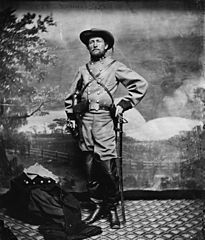
John Singleton Mosby
Mosby was originally from Central Virginia, but he had moved to Albemarle County when young. He was starkly different from his peers, who were mostly West Point educated, or from genteel families. Mosby was a problem child. Always frail and small, he nevertheless regularly picked fights (he insisted to stand up for his or other bullied children's honor) and lost all of them that adults didn't break up first, according to his editor. He managed to attend the University of Virginia, but was expelled when he shot a notorious town bully during one of his many altercations. While in prison for crimes related to the shooting, Mosby kept up a steady correspondence with the prosecutor that had put him away, and, when he was released, was invited to study law under him in Charlottesville. And that's how Mosby became a lawyer.

He met a girl from Tennessee and married her, and the two moved to Bristol, which he figured was a fair compromise between their two states since the line ran down the middle of town, and in which he happened to be one of only three lawyers. After very publicly backing Stephen Douglas in the election of 1860, and starting more than a few feuds with Bristol secessionists, Mosby reversed himself and signed up with William E. "Grumble" Jones' Virginia Volunteers mounted unit as a private. He arrived in time for Manassas, but really shown throughout the winter, when he discovered yet another unpredictable talent: scouting.

It was in this capacity he had met Jeb Stuart. Throughout the winter, the dashing cavalier had taken a shine to the scruffy Virginia lawyer, and instructed Mosby in the art of scouting. Combined with Jones' (who had taken over Stuart's 1st Virginia) sensible cavalry tactics, Mosby was becoming the peculiar blend of military prowess and daring innovator that would eventually make him the most famous partisan of the war.

The little man who loved a fight had been made adjutant by Jones in part to keep Stuart from stealing him for his staff. On March 27, he had volunteered for picket duty--unusual for every other adjutant in the army, but standard for Mosby--and so he and about a dozen men of the 1st Virginia sat on the south bank of Cedar Run, half way between Catlett's Station and Warrenton Junction.

The Virginians were dismounted and behind cover when a dozen or so Union cavalry pickets (probably from the 8th Illinois Cavalry) splashed across Cedar Run. Mosby waited until they dismounted to give their horses a break and wait for the rest of their squadron before ordering his men to open fire. In a panic, the Union men jumped back on their horses and raced across the creek. "We ceased firing, threw up our caps, & indulged in the most boisterous laughter," Mosby told a friend in a letter.

Mosby probably didn't stop laughing, but undoubtedly some of the other Virginians did. Pricked, Sumner deployed his infantry in line in the field on the other side of Cedar Run, including artillery that opened fire on the rest of the 1st Virginia behind Mosby's pickets. Jones had done his job. By deploying his men into their battle lines, Sumner had lost time, time that would be doubled when he had to shift them all back into columns for marching again. In that time, Jones could count their wagons and guns, and Stuart could make decisions about what to do next. The 1st Virginia let Sumner's gunner throw several shells, then rode off south of Warrenton Junction.

Stuart was writing Johnston about his decisions later that evening when Jones arrived and described the skirmish at Cedar Run. Stuart diligently passed it on, along with a more skeptical assessment of a report he had forwarded earlier from a captured drummer boy who said McClellan was planning to move with most of his army to attack Johnston wherever he stood to make a fight south of the Rappahannock.
Colonel Jones' has arrived, but brings nothing but confirmation of previous reports. He says the enemy seemed disposed to make a display, and marched so as to give him a review of 10,000 men at least. The circumstances of the drummer's arrest, since brought to light, throw some suspicion on his information, and it ought therefore to be received with allowance. He may have been sent over to humbug us.
So he could confirm there was at least a division following him, but Stuart still didn't know how many Union troops were behind them.

***

Brig. General Oliver Otis Howard was again the tip of Sumner's spear. A week earlier he had led a reconnaissance (like a scout, but bigger and with the intention of starting a fight) to Gainesville that had ascertained Jackson was not there or coming there (now a more ominous finding, since it meant he was preparing to strike back at Kernstown). When Richardson's division, with Sumner, had arrived in Warrenton Junction the day before after the delay at Cedar Run, Old Bull had asked Howard to lead a large force all the way to the Rappahannock, and ensure that the bridges were burned to keep the Confederates on the south bank.

According to Howard's somewhat self-serving memoirs, he was undermined by a fellow brigade commander, who had been senior than him in the old Army, but had been eclipsed when McClellan plucked the very young Howard up from obscurity to command a brigade.
In the morning General French told Sumner that he ran too great a risk, that my detachment by going so far from support would be captured, and surely that it was not wise to let one like me, with so little experience, go with raw troops so far away from the corps as the Rappahannock. Sumner called me in and said that he feared to let me make the reconnaissance. Instantly I begged him to try me. I showed my night work, my preparation, and my safe plan, and said: "General, you will never regret having trusted me."
In Howard's account, Sumner is passionately won over and declares "go! go!" to him. Sumner and French were both long dead when it was published (French was probably portrayed fairly, but the genteel Sumner probably did not exclaim much of anything outside of battle), but whatever the actual course of events, Howard did go, taking with him the 5th New Hampshire, 81st Pennsylvania, and 61st New York from his own brigade, as well as one additional infantry regiment from Thomas F. Meagher's Irish Brigade, the 8th Illinois Cavalry, and Battery C, of the 4th U.S. Artillery. The biggest problem was that it was almost noon before this large force stepped off.


Howard put out skirmishers in front and on his flank, in textbook fashion, showing off all the wisdom expected of a general who had graduated fourth in his class at West Point. The same year, Jeb Stuart had graduated thirteenth, though, and in textbook fashion he used his cavalry to confound the movements of his good friend from school in the same way Jones had at Cedar Run.
At about 2 miles' distance from this place the scouts of the enemy appeared a mile ahead. As we pressed on they discharged their carbines at my scouts and retired. My scouts and skirmishers returned their fire. Being beyond effective range, no harm was done on either side. As soon as the Parrott guns under Lieutenant Rundell reached a fair position, I had him open fire on about a company of the enemy just in the edge of some woods. They fled toward our left. This operation was repeated constantly during the march. Sometimes one squadron and sometimes as many as three squadrons appeared and disappeared on our front and flanks.
Meanwhile, back at Second Corps headquarters, Sumner was chomping at the bit to advance on the guns he could hear throughout the day. But McClellan had very explicitly forbid him from taking Richardson's division any further than Warrenton Junction, and a combination of the delay in transit of communications and McClellan's preoccupation with loading transports was preventing Old Bull from getting the permission he needed to support Howard. It must have occurred to him that the entire point of creating a corps was to have a force that could sustain itself independently, but McClellan's decision to assign divisions to corps nearly at random had deprived Sumner of a self-sufficient force for the semi-independent mission he had been assigned.
I should have much preferred to advance [on the Rappahannock Bridge] with my whole command... but as your orders of March 24 expressly directs me not to proceed beyond this place with the mass of my command I shall await here your further orders. I can take Warrenton without difficulty. Shall I do so?
Sumner chose to obey, so Howard carried on alone.

***

Jeb Stuart was watching Howard's slow advance from Bealeton Station, only a few miles from where the Orange and Alexandria Railroad crossed the Rappahannock. It was the fall-back position for the 1,100 cavalrymen he had alternating fighting and fleeing Howard's brigade and it contained 300 infantry men from the division of Fauquier County native Brig. General Richard Ewell.
I made disposition for defense, determined not to leave till his approach was so near as to make his intention to march to that point unmistakable. From the open ground about Bealeton, I commanded a fine view of the column advancing slowly, but steadily, using a caution very characteristic of the enemy, and which greatly facilitated a close observation of his movements, which opportunity I did not fail to improve. When within about a mile of Bealeton they formed a line of battle, and having delayed there as much as practicable by a show of resistance, I dispatched the infantry first slowly to the rear and kept part of the cavalry menacing his front, sending Colonel Robertson on the right and Colonel Jones on the left to threaten the enemy's flanks, with orders to carry it as far as compatible with safety, and then retire diagonally toward the railroad bridge.
But Stuart still didn't know if the brigade in front of him where the beginning of an army, or just part of the division Jones had observed across Cedar Run. And once he fell back across the Rappahannock there would be far fewer opportunities for Johnston to plan his defenses before he was threatened by a Union crossing on his flank--such as the one that had almost won the day via the undefended Sudley Ford at Manassas.

Stuart sent for Mosby. As Mosby remembered it long after the war, Stuart had been very formal, perhaps reluctant to send him on a dangerous mission behind enemy lines.
As we met that morning, he said to me very earnestly--he seemed puzzled--"General Johnston wants to know if McClellan's army is following us, or if this is only a feint he is making." Evidently Stuart wanted me to find out for him, but did not like to order me. I saw the opportunity for which I had longed and said in a self-confident tone, "I will find out for you, if you will give me a guide."
Stuart did, along with two additional men for security, and the little scouting party rode north towards Warrenton [along today's US17], to get around Sumner's forces.

***

Howard continued to press on Bealeton throughout the afternoon, fighting his way through the pesky cavalry. At some point during the afternoon, he became aware of the infantry, though his account of their retreat differed from Stuart's.
Here a force of infantry was reported advancing at double-quick. I formed in order of battle; ordered the advanced guard forward into a good position. I soon ascertained that the remnant of the enemy's infantry on this side of the river was running for a train of cars nearer to me than themselves. As soon as possible Lieutenant Rundell fired in the direction of the train. As soon as this train had passed the Rappahannock bridge I heard a heavy explosion, much like the blasting of stone.
Howard moved Rundell's guns forward, protected by the 5th New Hampshire, whose aptly named Colonel Cross would later criticize Howard for not being more aggressive before the bridge was blown, saying "This was the instant we should have pushed on. If we had done so and made a vigorous attack, we might, with small loss, have cut off a train of cars and five or six hundred of the enemy." Rundell's guns engaged in a sharp exchange of fire with Ewell's batteries on the other side of the river, but the fighting was done for the day. The Confederates were across the Rappahannock, and the Second Corps' mission was complete. Howard moved all but a few of his men beyond cannon range and let them bed down for the night.

Not long after midnight, a messenger from Howard reached Sumner and gave him a full explanation of the day. Delighted, Sumner sat down and wrote McClellan's headquarters immediately. In his hurry, he failed to pass on the intelligence Howard had provided, and had to follow up with a 2:00 am addendum that two of Ewell's brigades occupied the south bank of the Rappahannock.

Dawn brought a return of bad weather and a return to marching for Howard's men, this time back to Warrenton Junction. But first, he dispatched scouts from his cavalry to check the other river crossings in the vicinity and ensure that they too were destroyed (they were, and what was left of the railroad to Warrenton Junction Howard's cavalry destroyed themselves). Sumner, meanwhile, again petitioned McClellan to let him advance on Warrenton itself, and this time managed to at least draw a curt reply from the adjutant that the commanding general would "in the course of the day instruct you on your dispatch."

The course of the day, though, brought no orders about Warrenton. Instead, McClellan instructed Sumner to send Blenker's division back to Manassas Junction in preparation for moving to the Peninsula, as well as instructions for handing over protection of the junction and the railroad to the one brigade from Banks' command (a second had been also ordered back to Winchester after the full extent of Kernstown became clear). Only at 9:00 pm did McClellan finally assent to the no-brainer mission of seizing Warrenton, and only then with the stipulation that it occur on March 30.

Still, northern Virginia was clear, and Sumner was clear to go to the Peninsula.

***

Mosby returned on the morning of March 29 through a fog and a steady drizzle, with a tale that delighted Stuart that he recounted again for his memoirs.
As we were behind the enemy, we soon discovered that an isolated body was following Johnston, and that it kept up no line of communication with Washington. It was clear that the movement was a mask to create a diversion and cover some operation. Of course, I was proud to have made the discovery, and I rode nearly all night to report it to Stuart. When we got near the river, we halted at a farmhouse, for there was danger of being shot by our own pickets if we attempted to cross the river in the dark. As soon as it was daylight, I started, leaving my companions asleep... I went on at a gallop and found Stuart with General Ewell... I told Stuart that there was no support behind the force in front and that it was falling back... In the rapture of the moment Stuart told me I could get any reward I wanted. His report confirms this statement about the information that was obtained--but I got no reward.
Howard had left the bulk of the 8th Illinois Cavalry behind as a screen for his brigade returning to Warrenton Junction. Excited by Mosby's news, Stuart ordered his horsemen forward to chase after Howard's, but only the 1st Virginia managed to catch up with the enemy, Mosby among them despite his adventurous night. Stuart explained to Johnston:
Believing the enemy to be already in retreat, I ordered all the cavalry to horse and proceeded immediately to follow in pursuit. Colonel Jones, First Virginia Cavalry, led the way and pressed the pursuit with great vigor and success--capturing about 25 officers and men, mostly cavalry, and wounding several--to the near vicinity of Warrenton Junction, where the enemy was encamped for the night.
Stuart was always a generous superior, and seemed to take a special pleasure in praising his subordinates--officer and enlisted alike--in his reports, an honor that would help them gain promotion and rewards. But the praise in Stuart's report of the actions in the retreat to the Rappahannock are extreme, with 16 different individuals listed. The cavalier is clearly delighted at Mosby's unraveling of the intelligence puzzle that had plagued him to find that Sumner wasn't backed up by McClellan's army, mentioning him and his guide by name:
Adjutant Mosby and Principal Musician David Drake, of the First Virginia Cavalry, volunteered to perform the most hazardous service, and accomplished it in the most satisfactory and creditable manner. They are worthy of promotion and should be so rewarded.
Johnston was undoubtedly pleased too. But answering one question only gave rise to another. Where was McClellan going, if not across the Rappahannock?


Print Sources
  • Ramage, 43-45.
  • Beatie, 211-214.

Wednesday, March 21, 2012

The Left Behind

Wherein not every general is off to a new adventure
............................................................................................................................................

On March 17, the Third Division of the Third Corps became the first part of the Army of the Potomac to load on transports and depart for a grand campaign to capture Richmond. The First Division, Third Corps was scheduled to follow it in just a few days, when the transports returned, and begin expanding the beachhead on the Virginia Peninsula so that Maj. General George McClellan could land his army of over 150,000 men--an army twice the size of the one Napoleon had commanded for his great victory at Austerlitz.

But it was more than just transports that delayed McClellan's relocation of his base of operations (the place from which an army in the field supplies and sustains itself). President Abraham Lincoln had dictated that McClellan could not make the move without guaranteeing the safety of the capital, and so McClellan had dispatched the corps commander he had the most confidence in to ensure the Confederates were really gone.

Alexander and Duffey's handiwork, March 1862. The former bridge over Bull Run on Warrenton Turnpike
The Confederate Army of the Potomac has abandoned their lines at Centreville with a rapidity that had surprised McClellan (as well as Jefferson Davis). On their way out they had systematically destroyed every bridge they could find to make them difficult to follow. Lt. Colonel Porter Alexander, though technically the ordnance chief for the army, used his engineering expertise to blow the stone bridge on the Warrenton Turnpike that Shanks Evans had done so much to defend in July 1861. Writing about it years later as Ambassador to Nicuragua, he recalled the work he and the similarly multi-talented George Duffey performed nostalgically:
I was directed to blow up the old Stone Bridge--an arch of about 20 feet--when all had crossed, & Maj. Duffey & I mined the abutments & loaded them, & then the major remained & fired the mines at the proper time. I have always wanted to revisit that spot, which was quite a pretty one in those days, but I never had the chance, though I went across Sudley Ford, only two or three miles off, in Sept. '62. I will probably never see it again, but if any of my kids, or kid's kids, ever travel that Warrenton Pike across Bull Run they may imagine Maj. Duffey & myself, on a raft underneath the bridge mining holes in the abutments, & loading them with 500 lbs. of gunpowder & fixing fuses on hanging planks to blow up both sides simultaneously.

Saturday, March 17, 2012

A Dazzling Spectacle

Wherein the first division leaves Alexandria for Fort Monroe
...............................................................................................................................................

"The morning of the 17th of March dawned bright and beautiful, with just enough coolness in the air to give vigor and make it a luxury to breathe the exhilarating atmosphere," the history of the 63rd Pennsylvania Infantry Regiment poetically recorded when it was published by their heirs over half a century after March 17, 1862. The log of their fellow Keystone Staters in the 3rd Pennsylvania Cavalry corroborates their memory, but with a somewhat more jaundiced take on the crisp spring weather of the DC metro area: "Weather changeable, grounds drying rapidly."

1860 property boundaries superimposed on modern street map
The 63rd Pennsylvania woke up that morning in Camp Johnston, on the property of George Mason, today the location of the Route 1 Chuck-E-Cheese's. Mason was from the the same clan that had bred the Father of the Bill of Rights (unfortunately, since they all seem to be named George, your intrepid blogger cannot identify the precise relationship), and was an ardent secessionist who hadn't fled with his family quite fast enough and consequently ended up under house arrest by Union cavalry. The Pennsylvanians had spent the winter there, helping to construct nearby Fort Lyon (on the heights of Huntington, very close to today's Metro station) and gleefully customizing the property of their unwilling host to fit their needs.

The 63rd was led by a Mexican War veteran, and regular Army captain, Alexander Hays, who had quickly been readmitted to, and then immediately granted leave from Andrew Porter's 16th Infantry Regiment to take up a colonelcy in the Pennsylvania militia. His father had been a congressman and Pennsylvania militia general and still had enough sway in Pennsylvania politics to get Governor Andrew Curtin to notice his son. He was also, like his men, from Allegheny County in West Pennsylvania, and so not part of the glut of Philadelphia-based Pennsylvania men that filled Washington in early 1862.

The 63rd joined several other West Pennsylvania regiments in the brigade of Brigadier General Charles Davis Jameson, a Maine native who had lost the 1860 election for governor, and became one of the many Democratic political generals in the Army of the Potomac. It's not clear whether Jameson was one of McClellan's hand-picked men, but considering he had led the 2nd Maine at Bull Run as part of a brigade that McClellan generally disliked it appears unlikely that he was.

Thursday, March 8, 2012

Not Much Choice Between Them

Wherein corps and cracks are formed
..................................................................................................................................


After the Two Weeks That Changed The War the two Armies of the Potomac began moving. Ron over at All Not So Quiet Along the Potomac has done some great stuff about the Confederate preparation and subsequent departure from Northern Virginia, which I will not attempt to duplicate, so make sure you stop over and read it.


 On March 8, 1862, Abraham Lincoln and his new Secretary of War, Edwin Stanton, made a momentous decision--they would overrule McClellan's armies and establish four corps d'armee. French for "body of the army", the grouping of divisions in "corps" had been popularized by the phenomenal success of Napoleon. The units were designed to be armies fully capable of operating independently, but which worked in conjunction within the same theater. But since the 14 divisions of the Army of the Potomac were each larger than any American army previously in existence, the idea was anathema to many Northern leaders.

As usual, the general-in-chief, Maj. General George B. McClellan, lay at the center of what had become a controversial discussion fueled by the Joint Committee for the Conduct of the War. In McClellan's earliest days in Washington, he had stated his intention to form his army into corps. But as part of his systematic effort to remake the U.S. Army in his own image, he had held off on grouping the divisions into corps without explanation. In the meantime, the Joint Committee had caught corps fever, and on February 25 at 8:00 pm, had met with Lincoln in the White House to urge their creation. According to the Committee's report published in 1863:
They made known to the President that, having examined many of the highest military officers of the army, their statements of the necessity of dividing the great army of the Potomac into corps d'armie [sic] had impressed the committee with the belief that it was essential that such a division of that army should be made...The President observed that he had never considered the organization of this army into army corps so essential as the committee seemed to represent it to be; still he had long been in favor of such an organization. General McClellan, however, did not seem to think it so essential, though he had at times expressed himself as favorable to it. The committee informed the President that the Secretary of War had authorized them to say to him that he deemed such an organization necessary.

Friday, March 2, 2012

Two Weeks That Changed the War

Wherein operations along the Potomac begin McClellan's downfall
...............................................................................................................................

At the beginning of this week we looked at the first of two weeks that changed the American Civil War. The fall of Ft. Donelson on the Cumberland River to the obscure Brig. General Ulysses S. Grant had become a challenge to the general-in-chief of the Northern armies, Maj. General George B. McClellan. As Brig. General George Meade, commanding a brigade in McCall's Division (the Pennsylvania Reserves) put it on February 23 in a letter to his wife: "I fear the victories in the Southwest are going to be injurious to McClellan, by enabling his enemies to say, 'Why cannot you do in Virginia what has been done in Tennessee?'"

In the week that followed he had no choice but to begin an offensive motion with his Army of the Potomac, despite his long-laid plans to move it to the Rappahannock River and march on Richmond. The results of that decision changed the war.

February 24, Monday

Don Carlos Buell
The soldiers of Brig. General Don Carlos Buell reached the northern banks of the Cumberland River and looked across into an abandoned Nashville. McClellan's protege would occupy the city, despite the efforts of his (nominal) immediate superior Maj. General Henry Halleck to get Grant there first. Telegraphing his headquarters in St. Louis from Washington, McClellan told Halleck to "cooperate with [Buell] to the full extent of your power, to secure Nashville beyond a doubt." He said he would order Buell to next seize the nearby railroad junction and then "the next move should be either a direct march in force upon the rear of Memphis or else first upon the communications and rear of Columbus."

He may have gotten Columbia's name wrong, but McClellan's orders set in motion the movement of armies that led to Shiloh, what would be the bloodiest single day in American history until McClellan himself surpassed it at Antietam, and the bloodiest multi-day battle in American history until Gettysburg. The ferociousness of the battle would play a significant role in undermining McClellan's plans for what would become the Peninsula Campaign.

Wednesday, November 9, 2011

Gradually Carried Into Effect

Wherein we take stock of the belligerents at an early turning point
.....................................................................................................................................

November 1861 saw the realization of plans for change in both Northern and Southern armies that had been percolating since July, changes that when completed over the winter would shape the next two years of warfare. The most immediately obvious was the removal of Bvt. Lt. General Winfield Scott in favor of Maj. General George McClellan as general-in-chief of the U.S. Army and thus the Northern war effort, but changes in the South had equal impact.

McClellan had already put an indelible touch on the North's Army of the Potomac through his careful shepherding of young officers of his own military and social persuasions through the process of nomination to and confirmation of the grade of brigadier general of U.S. Volunteers. These were men that believed in a professional, European-style army, were socially and politically conservative, and for the most part had not been senior officers in the pre-war Army (and therefore had not been hand-picked already by Winfield Scott).

Among the division commanders, the senior leadership of McClellan's new army after his own staff, five of the 11 commanders named by November 9 could safely be called McClellan's men: William Franklin, Fitz John Porter, Charles P. Stone, Don Carlos Buell, and "Baldy" Smith. Only Irvin McDowell was truly Scott's man, though Sam Heintzelman was also from the Old Army leadership promoted by Scott. Nathaniel Banks, Louis Blenker, George McCall, and Joe Hooker were the President's political picks.

Among the 32 brigades commanded by those generals collectively, 15 were led by men who can safely be called McClellanites, with a few more sympathizers additionally. Strategically, McClellan tended to group the brigades of his people together under a divisional commanders that were also his people. McClellan's appears to have already been thinking of divisions as "trustworthy" and "suspected", a separation that would grow in his mind until it became a major problem in the spring.

Much is made about the impact of political generals on the Army of the Potomac, but that may be a function of how many McClellanites served in the army that were around to complain about them for years after the war. Of the three subsequent commanders of the army, two would be fully disciples of McClellan and two would also be ousted by coups engineered by senior leadership cabals consisting of McClellan disciples. Long after he ceased commanding the army, the men that McClellan had put into command positions by Fall 1861 would direct the course of battles and campaigns.

Tuesday, November 1, 2011

A Life So Grand

In which Winfield Scott is at last deposed
........................................................................................................................................

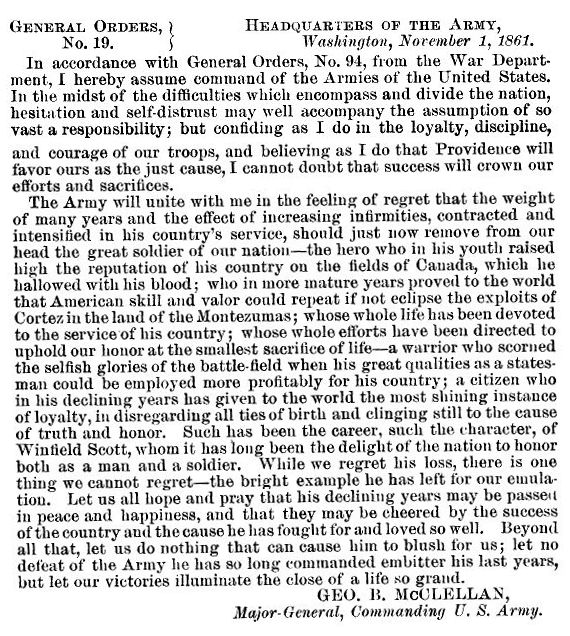
On November 1, the long war that had burned since the end of July at last came to a close. Maj. General George Brinton McClellan became the U.S. Army's general-in-chief. McClellan and the army's outgoing general-in-chief, Bvt. Lt. General Winfield Scott had been at each others' throats for months. Back during the summer Scott had asked the President to put him on the retired list to try to force him to reign in the ambitious young McClellan, who was circumventing Scott to talk strategy with Cabinet members directly and who refused to give Scott any details about his army. Lincoln had ignored Scott's retirement gambit after only a minor rebuke of McClellan, and the campaign had simmered. Then Scott had tried to catch McClellan disobeying a lawful order, a scheme in which the younger man happily obliged, but Secretary of War Simon Cameron had done nothing to punish him. So Scott had renewed his request to be placed on the retired list and on October 31, the president had finally complied. By having his name added to the retired list, Scott would receive a full pension, but be ineligible to command troops any longer. Characteristically, Lincoln informed Scott that his suggestion was accepted gently, telling him he would still call on him for advice, but not too often so he could properly enjoy his retirement.

Friday, October 28, 2011

Miserable Marksmen

Wherein Hooker is sent to end the "blockade" of Washington
...............................................................................................................................................

Scene of Northern ships running the gauntlet on the Lower Potomac, from Harper's Weekly

Brig. General Joe Hooker must have been gratified. After months of trying to join the army despite an old grudge held by general-in-chief Winfield Scott, followed by months of parades and organizing under the finicky eye of the Union Army of the Potomac's George McClellan, he had finally embarked on some real soldiering. His division had been tasked with defending a mighty bend of the Potomac River, stretching clockwise from Port Tobacco to Pomonkey Creek, on the Maryland side.

McClellan's primary concern was the battery at Evansport [Quantico] and its companion across Quantico Creek at Shipping Point, that had recently shut down river traffic to the capital. The channel of the Potomac at that point in the river winds close to the Virginia side, which put any ships sailing for Georgetown or Alexandria City right under the guns of the Confederates, including, according to the historian of the 1st Massachusetts, a state-of-the-art 7-inch Blakely muzzle-loading rifled cannon purchased from England. The weapon could fire a 120-pound projectile with stunning accuracy, assuming its operators could use it correctly. In the opinion of the New Englanders, they weren't:
High hills on the Maryland side afforded the troops an excellent observatory wherefrom to watch the firing; and, as the rebels, it seemed, had plenty of powder and ball to expend, twenty-four hours seldom passed but they afforded observers an opportunity to observe what miserable marksmen they were.

Wednesday, October 12, 2011

On the Eve of Battle

Wherein George Meade prepares himself and his family for a Confederate attack
..........................................................................................................................................

October 12, 1861 was a fairly quiet day in the Confederate Army of the Potomac. The promotions to major general had come in for James Longstreet and T.J. Jackson (who was being called "Stonewall" in the popular press after the story about his defense of Henry Hill had spread over the summer), who were assigned to G.T. Beauregard's First Corps and G.W. Smith's Second Corps, respectively. It would be a few more days before they were given multiple brigades to make up their divisions. At least in Longstreet's case, it would only be two brigades, preserving hope that the plan of creating multiple divisions under major generals might continue despite provisional President Jefferson Davis' recent attempts to kill it once and for all (Jackson's subordinates are not recorded in the Official Records, if they were even made).

But in the Union Army of the Potomac, things were aflutter. "I am at this moment looking after the enemy," its commander, Maj. General George B. McClellan wrote to his wife, Mary Ellen. He splurged to send the message by telegram, because that morning he had received a telegram from her announcing she had given birth to the couples fifth (and, as it turned out, final) child, Mary. "I thank God you are safe," McClellan had told her, before his words about seeing to an enemy attack. Despite being sure he would be "in the saddle all day" he encouraged her to telegraph him throughout the day with updates of her status.

McClellan had been at the camp of Fitz John Porter, in what is now Rosslyn, when he received word that the enemy was advancing on the divisions of Brig. Generals W.F. "Baldy" Smith at Lewinsville, Virginia and George McCall at Langley, Virginia. General Joe Johnston, as we have seen, had no intention of an offensive operation, but since Manassas he and his subordinates had actively deceived McClellan about their true intentions. Beauregard especially enjoyed dabbling in these schemes and had a willing partner in his signals and ordnance chief Porter Alexander. In an undated plot implied by Beauregard's biographer to be in August and by Alexander to be in the early fall (perhaps after the Evansport battery opened) the two took advantage of new technology Alexander had wheedled out of Richmond to unhinge the whole Union command structure. As Alexander recalled:
I had my signal stations scattered about on the high places, & of course under orders to report promptly all unusual occurrences. One night, I remember, about bedtime receiving a report that one or two or possibly more rockets had been seen over the Federal lines. I took the report to Gen. Beauregard & he asked me if I had rockets. I said yes, every station was provided, on which he told me to have every station send up one & during the night to have one or two more demonstrations of them. It took very few minutes to send the orders everywhere, & we soon had rockets apparently answering each other for a long distance right & left, & couriers were sent to shoot others, later, at other points. The next papers from the North brought the story above referred to It was said McClellan complained to Lincoln that only he and Gen. Scott knew of his plans, & yet they were allowed to become known to some one who must have betrayed us.

Friday, October 7, 2011

After the Stampede

A boring day leading an army
..................................................................................................................................

With history of warfare, it's easy to write about the fighting, the things before the fighting that led to it, and the things after that resulted from it. But real-time life in warfare is full of insignificant events that appear monumental, and significant events that go unnoticed. Both occurred in the first week of October.

"I have not written you since the few lines the day we expected to have a fight," Brig. General George Meade wrote to his wife on October 6 from his new camp in present-day McLean, referring to his last letter dashed off at 3:00 pm on September 30. "The stampede lasted for thirty-six hours." In his characteristic fashion, the mild cynic related to her the rumor going through the Union Army of the Potomac that its commander, Maj. General George McClellan, had planned a trap that would be slammed shut by the Pennsylvania Reserves, the informal name for the division to which Meade's brigade of four regiments belonged. "There is no doubt [the Confederates] were appraised of it, though McClellan asserts he did not tell even the generals who were to share in it till the very moment of action, and he is now convinced it is impossible to do or attempt anything without their knowing it."
At the present all is quiet, the enemy having withdrawn to his old lines at Manassas [Meade was off, they had only retired to Fairfax Court-House]. His threatening Washington was a bravado, hoping to draw McClellan out. Failing in this, he has fallen back, thinking we would rush after him, and thus give them a chance to get us at a disadvantage. They are, as Woodbury said, great on strategy, but I guess they will find after awhile that our movements are not to be governed by theirs, and that McClellan is not going to move until he is ready, and then not in the direction they want him.

Friday, September 16, 2011

By Command of Lieutenant-General Scott

Wherein the old boy gets his second wind
........................................................................................................................

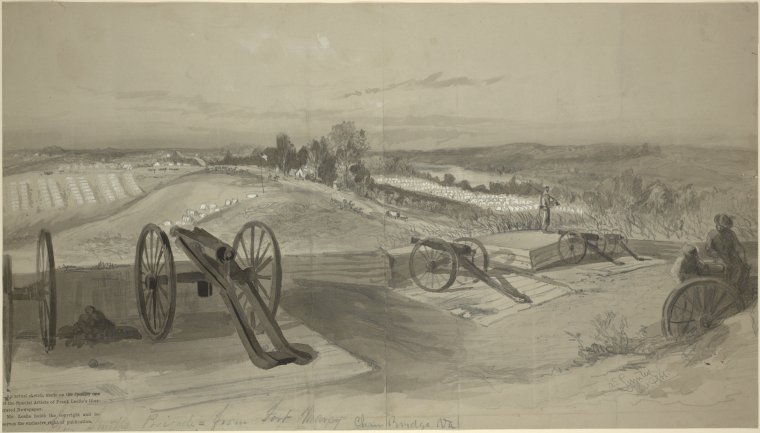
View from Ft. Marcy, completed in late September 1861 by W.F. "Baldy" Smith's brigade


On September 16, George McClellan got an order transmitted by Lt. Colonel Edward Townsend, chief of staff for the general-in-chief of the U.S. Army, Winfield Scott.
The commanding general of the Army of the Potomac will cause the position, state, and number of troops under him to be reported at once to general headquarters, by divisions, brigades, and independent regiments or detachments, which general report will be followed by reports of new troops as they arrive, with the dispositions made of them, together with all the material changes which may take place in said army.
"By command of Lieutenant-General Scott," Townsend helpfully signed it, opting for a more military valediction than his typical "your obedient servant". Winfield Scott was at last striking back.

Almost since McClellan had arrived in Washington (and certainly since Scott had poo-pooed his intelligence that an attack by over 100,000 Confederates was imminent), the junior general had attempted to circumvent the elderly general-in-chief. He had decided that Scott had become too senile or too stuck in his ways to take the bold actions needed to save the Union. And Scott was affecting a cadre of senior officers from the old Army. Only by breaking the stranglehold of the same military leaders that had let the South secede, take Federal property, and win at Bull Run and Wilson's Creek, could McClellan save the Union.

Sunday, September 4, 2011

Aiming Too High

In which the troops no one wanted are bombarded at Great Falls
..........................................................................................................................

Governor Andrew Curtin (Matthew Brady)
At approximately 8:30 in the morning of September 4, the attack came. Confederate cannon opened up on the 7th Pennsylvania Reserves stationed at Great Falls, just like Colonel Elisha B. Harvey had been warned.

Harvey had been preparing for the attack since August 24, when a message from the commanding officer of the Army of the Potomac, Major General George McClellan, had been transmitted to his brigade commander that a Confederate attack was imminent at Great Falls. The general - Brigadier General George A. McCall - had immediately sent Harvey to Great Falls with his regiment of infantry, a company of cavalry and a few artillery pieces to make sure a crossing couldn't occur without him knowing about it. Since then, Harvey had waited for the attack to begin.

McCall was part of a cordon McClellan had established along the Potomac River, reaching from Washington City to the division of Major General Nathaniel P. Banks at Harper's Ferry. Fittingly, the general commanding the most upstream brigade of the cordon was Charles P. Stone, the beleaguered then-colonel who had tried to cover the entire length of that distance during the Rockville Expedition with less than an eighth of the soldiers now assigned to the task. Back in Poolesville, Stone now only had to cover the distance from Point of Rocks down to Seneca Mills. To the east, the cordon was connected to the defenses of Alexandria County by a brigade under Brigadier General William Farrar Smith, better known as "Baldy" Smith, headquartered at the Chain Bridge.