Showing posts with label D. Hunter. Show all posts

Friday, September 16, 2011

By Command of Lieutenant-General Scott

Wherein the old boy gets his second wind
........................................................................................................................
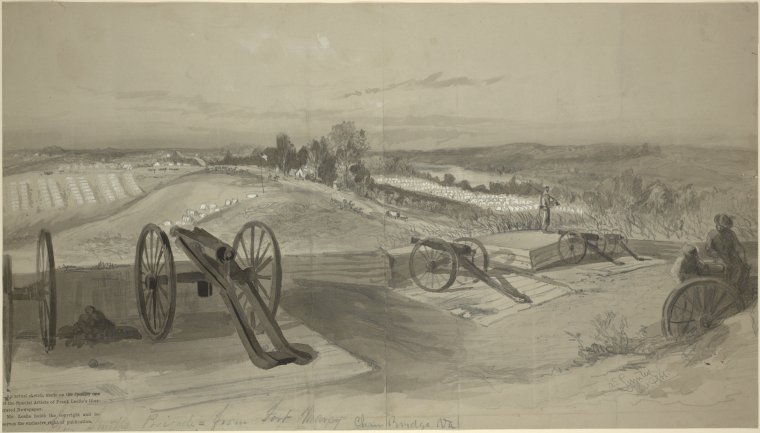
View from Ft. Marcy, completed in late September 1861 by W.F. "Baldy" Smith's brigade


On September 16, George McClellan got an order transmitted by Lt. Colonel Edward Townsend, chief of staff for the general-in-chief of the U.S. Army, Winfield Scott.
The commanding general of the Army of the Potomac will cause the position, state, and number of troops under him to be reported at once to general headquarters, by divisions, brigades, and independent regiments or detachments, which general report will be followed by reports of new troops as they arrive, with the dispositions made of them, together with all the material changes which may take place in said army.
"By command of Lieutenant-General Scott," Townsend helpfully signed it, opting for a more military valediction than his typical "your obedient servant". Winfield Scott was at last striking back.

Almost since McClellan had arrived in Washington (and certainly since Scott had poo-pooed his intelligence that an attack by over 100,000 Confederates was imminent), the junior general had attempted to circumvent the elderly general-in-chief. He had decided that Scott had become too senile or too stuck in his ways to take the bold actions needed to save the Union. And Scott was affecting a cadre of senior officers from the old Army. Only by breaking the stranglehold of the same military leaders that had let the South secede, take Federal property, and win at Bull Run and Wilson's Creek, could McClellan save the Union.

Sunday, July 31, 2011

Jockeying For Position

In which new stars appear and Hooker does what Hooker does
............................................................................................................................................

Grade insignia (yellow indicates cavalry). Volunteers
and regular army wear the same insignia
Since the secession of South Carolina seven months before military men throughout the North had been attempting to get a high-ranking position in the war. While rank was equally important to Southerners, the North already had an army, making competition for leadership slots tougher than in the South (though no more vicious). Most of these men had been junior officers during the Mexican War, and some had acquired a taste for combat that no civilian pursuit could satisfy, while others saw the leaders of the Mexican War rise to fame and fortune based on their service (two became Presidents of the United States), and still others believed in the Union fervently enough to shed their blood for it. Most were motivated by a combination of some or all of these things.

In the aftermath of the defeat at Bull Run, the opportunities for high command became greater. The influx of three-year regiments and the determination to field a larger army around Washington created a higher demand for general officers, and the passage of a law establishing a corps of U.S. Volunteers (USV) to supplement the U.S. Army (USA) also allowed Lincoln to appoint as many officers as he needed. Starting on Wednesday, July 31, the floodgates of USV promotions opened as the White House finalized its consultations with the War Department and sent a large list of nominations to the Senate.

Saturday, July 16, 2011

Marching on Manassas

McDowell's map of Northern Virginia from July 1861 (LOC)
"McDowell marched on the afternoon of July 16th, the men carrying three days’ rations in their haversacks," recounted James B. Fry, the assistant adjutant general and chief of staff for the Army of Northeast Virginia. "Provision wagons were to follow from Alexandria the next day." As the top staffer for Brigadier General Irvin McDowell, leader of the army sent by the Federal Government to crush the rebels around Manassas Junction, Fry would barely have slept the night before as he ensured every one of the five division commanders perfectly understood how their men were to get to the rally point at Centreville.

"One day... we received our first order to march to a field of battle," remembered Francis Fiske, the lieutenant colonel (thus second in command) of the 2nd New Hampshire Infantry Regiment in Ambrose Burnside's brigade. Orders traveled from Fry who interpreted McDowell's will, to Second Division commander Colonel David Hunter, whose staff interpreted it into new orders suitable to get his two brigades moving. Those orders then reached Burnside and his Second Brigade, whose staff further refined them for the four regiments. One of these regiments was the 2nd New Hampshire, whose colonel, Gilman Marston, then had his staff further refine them for his companies (as a former Congressman, Marston probably had aides that were volunteers, but the poorer or less famous colonels wrote the next set of orders themselves). Lt. Colonel Fiske received the orders with the company commanders and other officers of his regiment.