Showing posts with label New York Times. Show all posts

Monday, December 12, 2011

The Defenses of Washington

In which we begin taking a closer look at how the war changed the city
.....................................................................................................................................

This is the first in an occasional series on the Defenses of Washington. Future posts in the series will focus on the neighborhood of the fort or forts covered and how they have changed since their founding. This one just covers the state of the defense of Washington in December 1861. Think of it like a pilot for a spin-off series that takes place in the old series, like that time Edith Bunker had to say goodbye to Louise. That's right, this post is spawning The Jeffersons. Alright, back to moving on up.

In early December George McClellan's wife and newborn daughter had arrived in Washington, ending the steady supply of incriminating letters from Little Mac for the winter. It almost gives the impression that he had given up on internal feuding. But on December 4, something he read in the New York Times prompted a letter to the Secretary of War that still suggests his wife's arrival had done nothing to ease his squabbling nature.

As we have seen, cavalry patrols were almost constant in December, despite the common myth that all was quiet. But both armies were also hard at work trying to get their command structure, defenses, and logistics in order -- a daunting task considering that prior to July 1861, the largest American military force ever assembled had been Winfield Scott's 30,000 man army that marched on Mexico City. Both armies were larger than that by themselves, McClellan's over twice as large.

An American experiencing the war real-time, would have followed each of these story lines in the newspaper as often as possible, hoping that attention would be rewarded when one of those threads led to something of significance. Though the New York Times of 1861 was only a minor newspaper, the Grey Lady's importance today allows the 2011 reader to browse its full archives of the war. So we can read the paper on any given day just as a reader 150 years ago would have.

In this case, on December 4, a reader of the Times interested in the war around Washington would have found these articles: a small item that the loyalist Virginians meeting in Wheeling to plan the separation of their counties from their mother state had changed their preferred name from "Kanawha" to "Western Virginia"; an account of the second day of Congress in the new session and the reception Lincoln's State of the Union message received; a report by the Secretary of the Navy, including information on the Potomac Flotilla; a report on movements of New York regiments, including a (as it turned out erroneous) report on the departure of the Irish Brigade from Washington; an analysis piece on the importance of new types of pontoon bridges to the army; and a piece trying to read in to the departure of Charles P. Stone from his division across from Leesburg for several days (the paper failed to guess that McClellan was assigning him the responsibility of reopening the Canal as far as Harper's Ferry).

But it was none of these that upset McClellan. In a furiously written letter of December 9 to Secretary of War Simon Cameron, he explained:
I have the honor to enclose herewith a copy of the N.Y. Times of Dec. 4, 1861, containing as you will see a map of our works on the other side of the Potomac, & a statement of the composition of the Divisions in that same locality.

Wednesday, October 26, 2011

Stars, Falling and Rising

Wherein an extinguished political career helps launch a newspaper's
......................................................................................................................................
Ad for Baker's Philadelphia funeral march,
November 7, 1861


The newspaper of record in Washington City in 1861 was the Evening Star, sometimes called the Washington Star outside of the city, a name it wouldn't take officially until 1970s and would keep until it closed in 1981. Its presses and building (and the contracts of many of its staff, including Mary McGrory, Howard Kurtz, Fred Hiatt, and Jonathan Yardley, as well as rights to those soap comics that still run) were purchased by the Washington Post. The building at the corner of 11th and Pennsylvania now houses Fogo de Chao, among other tenants, but the paper's original 1861 building stood across Pennsylvania Avenue. The paper was small and new then, it had only been in operation for ten years, but the boom in population in Civil War Washington would build the paper, and the evolving, sensational news surrounding Ball's Bluff and the death of sitting U.S. Senator Edward Baker would be part of what caused the paper's circulation to explode.

On October 23, the paper reprinted George McClellan's General Orders No. 31 commemorating Baker, and added its own report, which would subsequently be forwarded by newspapermen around the country:
The remains of the late gallant Col. E.B. Baker have not yet reached Washington.  They are to be taken to the residence of Major J.W. Webb, at the corner of Fourteenth and H streets--No. 363.  We learn incidentally that his body was pierced with six balls, either of which would probably have been fatal; thus showing that his person on the field was a shining mark indeed. On leaving his quarters at his friend, Major Webb's for the field of his death, he remarked to that gentleman that he expected to be in action in less than forty-eight hours, and felt that he should lose his life; closing the conversation with a request that Major W. should send for his body if his presentment proved true.

Tuesday, June 14, 2011

Flag Day Sesquicentennial

Adam Goodheart over at Disunion (New York Times) has a great piece today on the first flag day, which occurred 150 years ago today in Connecticut. Check it out.

Sunday, June 12, 2011

A Veritable Will-of-the-Wisp

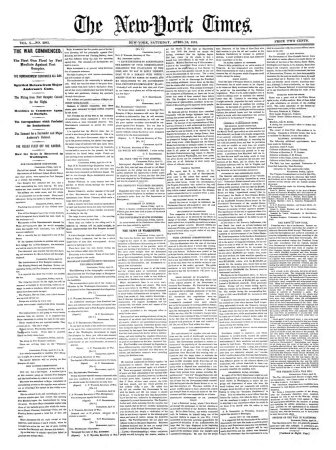
The New York Times reporting Fort Sumter's attack
"The business of punishing the rebels has been much retarded by the difficulty of catching them," the New York Times editorialized on June 2, 1861. The upstart paper had been founded ten years before as a Whig Party paper and transferred its allegiance to the Republican Party when the Whigs folded, but its editor and founder, Henry J. Raymond, had a problem - it was hard to out-Republican his top rival, Horace P. Greeley of the world-revered New York Tribune. Raymond had first worked for Greeley, then left the Tribune in order to run for New York lieutenant governor, defeating none other than Greeley in the Whig primary, and triggering the collapse of the New York Whig machine. Throughout the war, Raymond determined to make his paper the most loyal Republican paper in the nation, exploiting the political gap caused by Greeley's initial support for a more conservative Lincoln rival (it would pay off in 1864, when he would be named the second ever Republican National Committee Chair, though it would be another two decades before is paper challenged the Tribune).

Raymond also wasn't above a little melodrama to attract readers, much like today's New York Post. And his paper's most recent obsession was with G.T. Beauregard. "All who are of any importance of prominence have kept out of the way," the June 2 editorial penned by Raymond continued about the missing Confederate leaders. "Beauregard vanished immediately after the last shot had been fired into the burning Sumter."