Showing posts with label Phil Kearny. Show all posts

Sunday, March 11, 2012

One of the Greatest Victories of the War

Wherein Centreville is captured without very much blood
.........................................................................................................................................
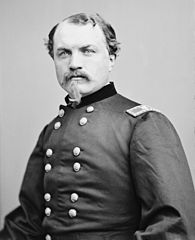
William W. Averell
The morning of March 11, 1862 dawned "clear and mild", according to the daily log kept by Colonel William Averell's 3rd Pennsylvania Cavalry. "Beautiful day," it recorded, but perhaps the most beautiful thing about it for the Keystone State men is that they were camped inside the rebel fortifications at Centreville.

Since March 9, the day after Lincoln's order assigning corps commanders to the Army of the Potomac, Maj. General George B. McClellan's army had been on the move, slowly at first, but gaining speed. Averell's Pennsylvanians had been at the front of that movement.

Company F, which had been part of the tangle with the North Carolina cavalry on the road to Hunter's Mill back in November, had a new captain on March 9, George Johnson, formerly second lieutenant of Company L. Averell had spent the winter as a holy terror to his officers, most of whom he found deficient, to either provoke them to improve their abilities or to drive them from the service. Johnson's predecessor had not passed the test, but the young second lieutenant had been impressive enough to win a double promotion.

The day of his promotion, Captain Johnson was put through the nerve-wracking ordeal of an inspection. Whether Johnson was beside himself or cool and collected, he was responsible not only for making sure all his men turned up in perfect uniform, but then performed the drills asked of them. The inspector was Brig. General Fitz John Porter, leader of one of McClellan's infantry divisions and a known protege of the general-in-chief. Fortunately, it went well:
The review and inspection ended, the officers were summoned in front of the Colonel's quarters. General Porter addressed the officers briefly, congratulated them upon the fine appearance of the troops, and gave utterance to his feelings in remarks of a most flattering character.

Sunday, December 4, 2011

Old Ravensworth

In which a skirmish occurs near Burke
....................................................................................................................................

A quick programming note: the internet has been almost unusable at home (it's Comcastic!) and work has kept me from having much time to write anyway, so we've missed several events in the area. Most importantly, in the "now" of 150 years ago, Congress was back in session. Disunion turned to Ted Widmore to not embarrass itself too badly and cover the event.

As November turned to December, the agitated calm that had characterized the relationship between the two armies continued unabated. On December 2 and December 4 two more skirmishes broke out in the no-man's land between the two armies, an arc of territory that ran from Dranesville on the Potomac, down to Vienna, on to Burke's Station, then Springfield Station, and finally followed the course of Pohick Creek back to the Potomac [the mouth of which is today at Ft. Belvoir].

For approximately five miles on either side of that line, cavalry patrols roamed. After that, the pickets of both armies were stationed, ready to run or ride back to the main armies if a sizable force appeared. Both sides' leaders assumed that any day a massive army would drive them in for a major attack, and both sides' leaders knew they wouldn't be ready for an attack until the spring. So the fighting was confined to cavalry patrols riding until they found the enemy's pickets, charging, then returning to their lines with prisoners to try to collect intelligence.

Central to this campaign of pickets and patrols were the fields of old Ravensworth. In 1650, Virginia's colonial governor (Sir William Berkeley) had made a land grant to Colonel William Fitzhugh, a wealthy Englishman, of a massive internal tract of land in the little settled tributaries of the Potomac. Today, this area is North Springfield, Annandale, Burke, and the surrounding area. Fitzhugh called this estate Ravensworth, after his family estate in England, but it would be another twenty years before he ever saw it. Even then, Fitzhugh preferred to live in King George County, though with the money he was making cultivating tobacco at Ravensworth, he was able to become one of the richest and most influential men in America. The road his property managers built to roll his tobacco hogsheads down to Accotink Creek is a link to this history. Today it is Rolling Road, evolved from the Ravensworth Rolling Road.

Saturday, October 15, 2011

Recs: The Pickets Unusually Vigilant

The best pieces I read this week
..........................................................................................................................................

Harper's Weekly cartoon from October 14 referring to Rose O'Neal Greenhow and her fellow female spies

October 15, 1861 was most significant to the war along the Potomac because of a seemingly minor event. General G.T. Beauregard at last put the finishing touches on his grandiose official report of the Battle of Manassas and mailed it to General Samuel Cooper. The Confederate commander had not spared Richmond from any of his characteristic purple prose and had also taken the opportunity to grind a few axes, for instance beginning not with the lead up to the battle, but with his own account of the rejection of his strategic proposals by the very people he was submitting his report to. The minute he signed his name to it, it became a time bomb ticking down to detonation.