Tuesday, June 26, 2012

The Whole Matter Is With General Banks

In which rival strategic visions lead to the arrival of John Pope, good for no one
.....................................................................................................................................................

June 26 is best known as Robert E. Lee's first offensive with the Army of Northern Virginia, and the second day of the Seven Days, the spectacular offensive that reversed the war's strategic situation and began the legend of Lee. But for Maj. General Irvin McDowell, lately commanding the Department of the Rappahannock, it was another day when his dreams of rehabilitation and glorious military command were yanked from him.

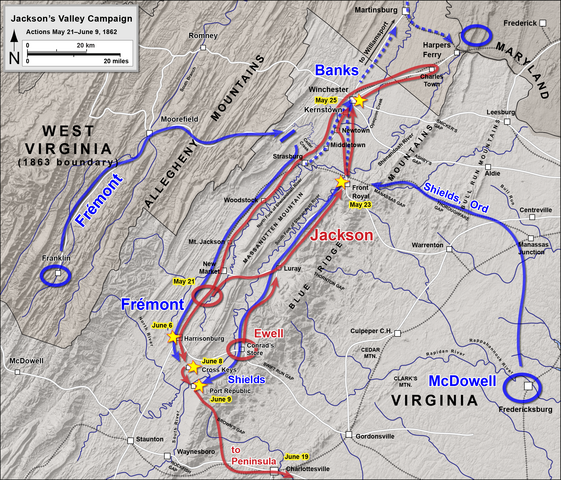
The Confederate Maj. General Thomas "Stonewall" Jackson and his second-in-command, Maj. General Dick Ewell, had over the month of May upended all the carefully restored order from the banks of the Potomac to the Allegheny Mountains with a campaign that had made fools of the Union commanders he faced (all that had saved their careers thus far was that the size of Jackson's army remained greatly exaggerated). McDowell, with authority over all of northern Virginia, but only west to the Blue Ridge Mountains, had initially resisted having men from his department dragged into the affair, then pledged to solve the problem the other generals couldn't, then when it appeared clear the situation had been defused again tried to extricate his command from it. Jackson's twin victories at Cross Keys and Port Republic only further cemented in McDowell's mind that his men should never have been involved.

Where McDowell's men belonged, in McDowell's mind was not Front Royal, not Manassas Junction, not even Fredericksburg, but outside Richmond with the rest of the Army of the Potomac, from which his command had been carved. That's where the war was being one, he believed, and that's where he had the chance to redeem his name from the shame of the battle at Bull Run, which was really the fault of his subordinate commanders' inability to execute his plan. The nonsense with Jackson stood between McDowell and getting to Richmond.

McDowell had sent two divisions to the Valley, his First Division under Maj. General James Shields, and his Second Division under the temporary command of Brig. General James Ricketts after its former commander was transferred out West to remove him from his feud with McDowell. It was half of Shields' division that had been defeated by Jackson at Port Republic, but nonetheless McDowell was urging their return to Falmouth the day after the battle. From his headquarters in Manassas Junction he practically begged the commander of the Department of the Shenandoah, Maj. General Nathaniel Banks, to resume responsibility for the Valley. In McDowell's mind he had bailed out Banks, so Banks owed it to him to quickly relieve his men.

Banks had other ideas, though. While McDowell thought the Jackson calamity had occurred because the borders of the departments had been drawn in a way that seemed to give him some responsibility for the Valley, Banks believed it had happened because McDowell had taken away almost all of his troops, leaving him with only two brigades to defend a vitally important area. Both were right, in a way. The real problem was without an overall commander with a broad view of the situation, the individual commanders had set conflicting plans of operation into motion. McDowell could not march to reinforce McClellan while Banks also had sufficient forces to protect against a Confederate army moving up the Valley to threaten Maryland. One of the safety of Washington, the reinforcement of McClellan, or the Confederate army had to be eliminated before the others could happen.

There was a third person involved in the affair, Maj. General John Fremont, commander of the Mountain Department. Fremont had also been ordered into the Valley to bail out Banks, and his and McDowell's forces were supposed to have worked together to cut off Jackson and destroy his army. But McDowell had let Jackson get by him and followed him to Cross Keys, where he had been defeated.

Sunday, June 10, 2012

Made to Pay

The exciting conclusion of Jackson's Valley Campaign minus Jackson or the Valley
........................................................................................................................................

In case you missed it, on Tuesday we looked at how Jackson's capture of Front Royal in mid-May postponed McDowell's planned march on Richmond. On Thursday, we saw the resulting race to Front Royal when Jackson continued marching north, in hopes of trapping him in the Lower Valley and eliminating his command.


On the evening of June 10, Colonel Edmund Schriver, chief of staff for the Department of the Rapphannock, and sitting in Front Royal as Maj. General Irvin McDowell's eyes and ears, ruefully forwarded a "sorry picture of Shields' division" in the form of a report from its head, Maj. General James Shields in Luray. That town, Schriver told his boss, was "filled with so-called sick officers and men, who, it is said, will never be of use again."
In any calculations you may take as to numbers do not rely on more than half what the returns call for. I do not think any of our army will be fit to take the field unless King's division, in less than a fortnight. Horses are used up as well as the men. The want of discipline and ignorance of the plainest duties are distressing. There is nothing but confusion and disorder.
Just two weeks earlier James Shields had told Schriver, "I will clear the valley of the Shenandoah of the enemy as far as I advance." Now it seemed like his men would never march again. In between they had met Maj. General Thomas "Stonewall" Jackson, who in the second part of his stunning Valley Campaign, had incapacitated two more Union forces and saved Richmond for the Confederacy.

As in our two previous posts, however, our story doesn't lie in the Valley, but east of the Blue Ridge in the Piedmont where McDowell's army in the Department of the Rapphannock had put its plans to march on Richmond on hold, to make an all-out rush for the Shenandoah Valley and Jackson. On May 31, it looked like they were well on their way to accomplishing their goal of trapping his army between Union reinforcements based around Harper's Ferry and a combined army of McDowell's men and men from the Mountain Department at Front Royal and Strasburg.

Shields, McDowell's star division commander, had two of his brigades already at Front Royal and two more that would arrive before the night was out. To the west on the Manassas Gap Railroad, another division under Maj. General Edward O.C. Ord had advanced to about Thoroughfare Gap, but damage to the railroad by Confederate cavalry near Front Royal and a train wreck near McDowell's headquarters at Rectortown was slowing them down. Further south, the division of Rufus King was at Catlett's Station, and could make use of the O&A Railroad to get to Manassas Junction and switch to the Manassas Gap line. The problem for McDowell was feeding so many men and horses.

"Fremont has not yet reached Strasburg, and I fear he will not reach it in time." Shields had told McDowell and McDowell had relayed to Secretary of War Edwin Stanton, "Ord's division should be pushed forward, but with supplies, or it will starve here without them."

Fremont was supposed to have marched from the west side of the Allegheny Mountains to Harrisonburg, but had decided instead to cross further north directly at Strasburg. Throughout the race of Shields to get to the Valley, the Lincoln Administration had taken for granted that Fremont's men would get their first--for one, they had much less ground to cover--but instead Shields sat in Front Royal and Strasburg sat empty. McDowell was pleased in his morning telegram to Staunton to note that his men had arrived on hour before Lincoln's proscribed time.

Thursday, June 7, 2012

Nothing But A Panic

Wherein the race to cut off Jackson is on
................................................................................................................................................

In case you missed it, check out Tuesday's post on the beginning of Jackson's Valley Campaign, as viewed from the Piedmont. In short: McClellan counted on the forts surrounding Washington to defend the city, but the Lincoln Administration wasn't so sure, so it kept McDowell behind. After months of waiting, McDowell was ready to go to Richmond, but on the day he was supposed to kick off, Jackson surprised and captured Front Royal. McDowell's orders to march were cancelled by the President himself.

"This is a crushing blow to us," Maj. General Irvin McDowell telegraphed Edwin Stanton on the evening of May 24 from his headquarters at Falmouth.

On orders from the Secretary of War, the commander of the Department of the Rapphannock was preparing to depart to meet Secretary of the Treasury Salmon P. Chase at Aquia Creek Landing at midnight for full oral orders from the President. Chase had been sent for two reasons: first, Stanton was preoccupied with theater-strategic concerns because Jackson's offensive threatened three different too-narrowly-drawn departments; and second, as a fellow Ohioan Chase had been McDowell's patron in the capital in the spring of 1861 and helped get him his star(s) in the first place. Since McClellan looked like he would be at the gates of Richmond within the week, Chase might help soothe McDowell's agony at being excluded from the grand campaign to conclude the war.

Lincoln was certainly bending over backwards to ease McDowell's disappointment. At 8:00 pm, two hours after McDowell's crushing blow telegram had been received, the President himself, not the Secretary of War, telegraphed a reply.
I am highly gratified by your alacrity in obeying my order. The change was as painful to me as it can possibly be to you or to any one. Everything now depends upon the celerity and vigor of your movement.
Confederate Maj. General Thomas "Stonewall" Jackson was loose somewhere north of Front Royal with between 7,000 and 10,000 men from his division and that of Maj. General Dick Ewell, and the main Union defender, Maj. General Nathaniel P. Banks, was at least as far north as Winchester, with the remains of only two brigades amounting to, at most, 4,000 men. McDowell was supposed to send two divisions of his department (about 20,000 out of over 40,000 men) to Front Royal as fast as possible, while Maj. General John C. Fremont of the Mountain Department sent as many of his as he could spare to Staunton.

At 9:30 pm, Lincoln received another bitter, but this time more loquacious, reply from McDowell.
I obeyed your order immediately, for it was positive and urgent, and perhaps as a subordinate there I ought to stop; but I trust I may be allowed to say something in relation to the subject, especially in view of your remark that everything now depends upon the celerity and vigor of my movements. I beg to say that cooperation between General Fremont and myself to cut Jackson and Ewell there is not to be counted upon, even if it is not a practical impossibility.
McDowell had tried to explain his objections to Stanton earlier in the day and now he tried again with Lincoln. "I am entirely beyond helping distance of General Banks," he protested, "no celerity or vigor will avail so far as he is concerned."
Next, that by a glance at the map it will be seen that the line of retreat of the enemy's forces up the valley is shorter than mine to go against him. It will take a week or ten days for the force to get to the valley by the route which will give it food and forage, and by that time the enemy will have retired. I shall gain nothing for you there, and shall lose much for you here.

"It is therefore not only on personal grounds that I have a heavy heart in the matter," McDowell unburdened himself, "but that I feel it throws us all back, and from Richmond north we shall have all our large masses paralyzed, and shall have to repeat what we have just accomplished."

He would send Maj. General James Shields with his division, ironically just from the Valley after a laborious march, in the morning and follow with another division in the afternoon. But first he promised to see Chase and "express myself more fully to him."

Tuesday, June 5, 2012

A Crushing Blow

Wherein Jackson's Piedmont Campaign kicks off
..................................................................................................................................................

This Saturday marks the 150th Anniversary of the stunning conclusion of Jackson's Valley Campaign, an epic feat of operational warfare genius that can only be rivaled in American history by Patton's Winter '44-'45 campaigns and Washington's New Jersey campaign (with the caveat that tactically, Jackson was by far the inferior of either). Last month, we took time to examine why there was a Valley Campaign, noting the failures of Union intelligence gathering and analysis and the failures of Union planning and organization that allowed Jackson to perfectly exploit his foes.

While less exciting, Jackson's campaign was paradigm-changing for concepts of security around Washington, DC. Over the course of three weeks in early summer the plan for defending the nation's capital shifted from one based on stationary fortification to one based on a campaigning army, and in doing so sealed the fate of George McClellan. In that sense, Jackson also achieved the primary objective of warfare in the mind of a 4th Century BC Chinese strategist he had never heard of: disrupt your enemy's strategy.

While it is most exciting to study the operational masterpiece from the viewpoint of the man who commanded both sides and the men who marched themselves ragged, to appreciate the deep strategic significance it is best to look at the story from the perspective of those in the Piedmont of Virginia, specifically one sitting on the banks of the Rappahannock River. There, in Falmouth, was the headquarters of the Department of the Rapphannock, commanded by Maj. General Irvin McDowell, rehabilitated loser of Bull Run.

The Lincoln Administration had quietly--almost apologetically--stood by McDowell the turmoil of the post-disaster outrage, and, in the Spring, rewarded him with promotion to major general of volunteers, making him one of the most senior generals in the Army. They believed McDowell had been a victim of circumstances, irrational public zeal, and poor subordinates, and retained Winfield Scott's initial high confidence of his abilities--a great deal more confidence, in fact, than they had in Maj. General George McClellan, who was leading the marquee army for Union, the Army of the Potomac, in a march on Richmond up the Virginia Peninsula from Fort Monroe.

McDowell should have been leading the First Corps of the Army of the Potomac under McClellan's supervision, but, at the last minute, the Lincoln Administration had withheld him until the defense of the capital was settled. McClellan's scheme for defense relied on an impenetrable system of forts that he had constructed over the winter that had turned the District of Columbia into the most fortified city on earth. A small mobile corps was to operate in the area, making sure that any enemy couldn't get too comfortable in Northern Virginia again, but it was the futility of attacking the string of fortifications that McClellan counted on to convince strategists in Richmond that their men were better used in different theaters.

But McClellan had violated his own strategy in the opinion of the Administration, particularly Secretary of War Edwin Stanton. An analysis conducted by two veteran generals at Stanton's request found that McClellan had shortchanged the defenses and the mobile corps in manpower and so McDowell's corps had been retained until the problem could be corrected. To better maintain control over the capital's defense, Stanton had created new Departments over which McClellan had no authority for McDowell and other commanders in the Shenandoah, the western Virginia mountains, the District, and Maryland.

Friday, May 18, 2012

Why Was There A Valley Campaign?

In which we look at Northern organization and strategy
..................................................................................................................................................

This is the second in a two part post on Northern mistakes in the first month of May.

Last week we looked at how mistakes in intelligence gathering and analysis led leaders of the Northern war effort to coalesce behind a likely enemy course of action that ended up being drastically different from the one actually pursued by their Southern opponents. But history is full of poor intelligence gathering and analysis that nevertheless ends in victory. So this week, we'll look at the mistakes those same leaders made in their own planning--mistakes that allowed Stonewall Jackson to execute his brilliant Valley Campaign.

Central to our discussion is what are known in modern military doctrine as the "levels of war." The concept goes back to ancient times, when it was recognized that some leaders needed to tell individuals where to stand and who to fight, while others needed to decide where the battle should occur. The "general" officer was created precisely to make those sorts of general decisions. By the time of the American Civil War, it was already long understood that even among general officers there were further levels of responsibility, with some moving groups of men in the field, and some deciding where to move armies several months hence. Today, we recognize roughly four levels of war: national-strategic, theater-strategic, operational, and tactical.

Prior to the American Civil War, there had never been a clear delineation of responsibility for military strategy in the United States--who to put where and when, in order to win a war. At the highest level, which we would call today "National-Strategic" and some 1862 contemporaries would have called "Grand Strategy", control depended on the personality of the Secretary of War. More aggressive secretaries would locate and direct men and materiel themselves, while secretaries selected more for their politics than their smarts would defer to the senior general in the U.S. Army, which, after 1841, meant Winfield Scott. But there was no clearly expressed distinction between the responsibilities of the general-in-chief and the Secretary.

Friday, May 11, 2012

Why Was There A Valley Campaign?

Wherein we examine failures of intelligence
.............................................................................................................................................

The first of two posts on mistakes by the North the first week of May 1862.

May 8, 1862, was the date of the Battle of McDowell, the beginning of Stonewall Jackson's legendary Valley Campaign. Much has justly been written about Jackson's operational-level brilliance and an equal amount has unjustly been written about his rather mundane tactics. Only in recent years, have reevaluations of the campaign been conducted, most notably in Peter Cozzens fantastic Shenandoah 1862 which acknowledges the immense personal cost to the soldiers of Jackson's army and, in the words of the friend who gifted the book to me, "bothers to examine the Yankee sources."

The Valley, though technically in the Potomac watershed, has simply been beyond the capacity of your blogger to post on, which means the area that drains directly into the Shenandoah has usually been beyond the scope of this blog. But Jackson's campaign deeply threatened the area we usually cover, and ended up being the strategic center of gravity for the entire Virginia theater. Without Jackson's operation, Joe Johnston, hundreds of miles away on the Virginia Peninsula, would have been unable to fend of McClellan's army, and Richmond would have been scrambling to find defenders in fall 1862 instead of Washington.

Edwin Stanton
It was largely planning mistakes made in Washington at the strategic level from May 8 to May 17 that allowed Jackson to conduct his famous campaign. This post focuses on the first part of those mistakes, the failure in intelligence collection and analysis.

With the demotion of McClellan in March, Secretary of War Edwin Stanton became the Administration's principle war planner. Unlike his predecessor, Simon Cameron, Stanton believed the Secretary should be active in decisions about the prosecution of the war, rather than only concerned with supplying and administering the armies. Stanton signaled this when he added Peter H. Watson as a second Assistant Secretary of War as a condition of joining the Administration himself. Watson was appointed to straighten out and manage the contracts the Department made to supply the army, which was usually a tightly held responsibility of the Secretary in order to bestow political favors.

Sunday, May 6, 2012

Before It's Too Late

Wherein the end of the war is imminent
.........................................................................................................................................

On May 6, 1862 nowhere was the imminent Union victory in the Civil War more apparent than in Northern Virginia, and no one in Northern Virginia was working harder to put the final nail in the Confederacy than the man who had botched up the whole thing ten months earlier. Maj. General Irvin McDowell, commander of the Department of the Rappahannock was working night and day to repair both the historic Potomac Path [U.S. 1] and the Fredericksburg and Richmond Railroad to allow a full advance towards Richmond.

McDowell can be forgiven for being swept up into the prevailing opinion that the end of the war was months away. In the West, several armies had been united under the command of Maj. General Henry Halleck in what we would call an "Army Group" today, with the purpose of capturing Confederate strongholds on the Mississippi and, by controlling the continent's great river, slicing the Southern nation in half and crushing their internal economy. Halleck's armies were drawing tight around Corinth, the key to defending Memphis, and General P.G.T. Beauregard, in command by accident after the death of the preferred Albert Sidney Johnston, appeared out-manned, out-gunned, and out-generaled.

At the other end of the Mississippi, Tennessee native and loyal Unionist Commodore David Farragut had completed a daring operation in cooperation with Maj. General Benjamin Butler and captured New Orleans, providing an ideal harbor for the Gulf Blockade Squadron as well as closing the best blockade-running port for cotton transited south from the cotton-growing Confederate heartland. With major Northern armies present in Pensacola, Port Royal, and Roanoke, too, the South was being dissected.

And in Virginia, McClellan was finally on the move. By May 6, word had arrived that the siege at Yorktown on the Virginia Peninsula was over, and McClellan was on the heels of Joe Johnston's army as it bolted back towards Richmond. Lincoln and his Secretaries of War, Navy, and the Treasury had taken the revenue cutter Miami the evening of May 5 to Fort Monroe to view the collapse of the major army defending Richmond personally. While they did so, Johnston had made a stand at Williamsburg, where after a brutal day of fighting for Joe Hooker's division, the Army of the Potomac had triumphed [Johnston's army had belatedly and at last assumed its famous name, the Army of Northern Virginia].