Showing posts with label Burnside. Show all posts

Friday, February 17, 2012

Indisposed to Make It

Wherein Hooker and McClellan don't really help each other
......................................................................................................................

The noose was beginning to tighten around Maj. General George B. McClellan, general-in-chief of the U.S. Army, and commander of the Army of the Potomac. President Abraham Lincoln had clearly become unhappy with the course of the war, appointing a new Secretary of War, Edwin Stanton, and using his commander-in-chief powers to issue a general order for all armies to begin operations by February 22. McClellan was uncertain if Lincoln himself--who McClellan called "the original gorilla" in private, a nickname invented by Stanton a few months before he joined the administration--was the source of the pressure, or if he was responding to the Radical Republicans in Congress, who had convened the Joint Committee on the Conduct of the War to drum out "traitors" from the war effort, a word they considered synonymous with "Democrats". They had already claimed their first victim, Charles P. Stone, who was imprisoned without charge in Fort Lafayette in New York Harbor, but McClellan knew that he was their real target.

In his own Army, there were generals conspiring to replace him. Brig. General Irvin McDowell, who had appeared to see his career as a commander of troops crushed with the loss at Bull Run, was experiencing a resurgence thanks to his willingness to tell the Joint Committee and Lincoln his proposal for a repeat attack on Manassas Junction. Another division commander, Brig. General Samuel Heintzelman, appeared to be in league with McDowell, ordering reconnaissances along his proposed lines of attack. On the distant right, the senior division commander, Maj. General Nathaniel P. Banks, was requesting McClellan allow him to march his division from Frederick, Maryland, to Winchester, Virginia, almost daily, insisting he could bounce the Confederate force under "Stonewall" Jackson out of the Shenandoah Valley with virtually no losses. To the right of Banks, Brig. General Frederick Lander had been making similar requests with such impertinence that McClellan ordered Banks (through whom his messages were routed) to tell him that the general-in-chief "might comment very severely on the tone of his dispatches, but abstain[s]."

And worst of all for McClellan, other generals were winning successes that he didn't seem able to convince Lincoln were thanks to McClellan's leadership in Washington. His old friend Ambrose Burnside had seized Roanoke Island in North Carolina, providing another base from which to threaten Gosport Shipyard [Norfolk Naval Shipyard], the home port for the new ironclad the Confederates had built out of the scuttled remains of the U.S.S. Merrimack. McClellan might have been due some credit for that operation, but the success in Tennessee against Fort Henry and Fort Donelson by troops under the ultimate command of McClellan's top rival, Maj. General Henry Halleck, looked ominous for Little Mack's tenure.

McClellan had to somehow satisfy Lincoln's insistence, without sacrificing his grand scheme to transport the Army of the Potomac to the Rappahannock and march on Richmond directly. He would need at least a month for the troop ships from Burnside's expeditions to return in order to ferry another army. For McClellan, Joe Hooker provided the solution.

Sunday, January 15, 2012

McClellan's Winter Offensive

Wherein Little Mac strikes back against his enemies
.....................................................................................................................................

Long Bridge [14th Street Bridge] across the Potomac
"Your Excellency," Maj. General George B. McClellan, general-in-chief of the U.S. Army, wrote President Abraham Lincoln on the morning of January 15, 1862, "I am so much better this morning that I am going before the Joint Committee. If I escape alive I will report when I get through."

McClellan was in the midst of a campaign to reassert his authority. Three weeks earlier, he had fallen sick, usually reported as typhoid fever. It couldn't have happened at a less convenient time, for the general. In mid-December there had already been grumbling about the lack of movement by the massive army he had assembled along the Potomac, and the disaster at Ball's Bluff and the winter campaign of Stonewall Jackson in the Shenandoah Valley had stirred up the embers from the pre-Bull Run fire for rapid advance. Without McClellan's boundless energy for political wrangling to quash it, the fire had blazed up fiercer than ever in Washington, fueled by frustrated officers who had been slighted by McClellan's remaking of the army hierarchy.

The Joint Committee for the Conduct of the War was certainly the most prominent organ of dissent. Committee Chair Senator Benjamin Wade (R-OH) and member Senator Zachariah Chandler (R-MI) had interviewed almost all of McClellan's division commanders (the exceptions: Banks and Hooker, furthest away from Washington), attempting to establish a case that McClellan could attack at any time, and simply wasn't. Both men and a growing number of the so-called "Radical" wing of the Republican Party were becoming more and more convinced that this was because of treasonous beliefs among the conservative West Point officers in charge of the war effort.

Sunday, August 14, 2011

Hell Reigns

In which three Union regiments try to end the war
.......................................................................................................................................
Return of the 69th New York Militia from the Seat of War

 "Hell reigns in the 13th today, and has all day," wrote Samuel Partridge to a friend. Partridge was a young man in Company F of the 13th New York, who had fought at Bull Run as part of Cump Sherman's brigade.He was only a private on August 14, but he would rise to the rank of lieutenant as the regiment's adjutant and quartermaster by the time it finally went home in two years -- and that was the problem.

Company F, like all but three of the 13th New York's companies, was raised in Rochester. The men had pledged two years of service to the State of New York under its militia law, but under Federal law the Lincoln administration could only accept their service for 90 days. The 13th New York marched to Washington and were sent to Fort Corcoran, in present-day Rosslyn, and began a very unhappy period under then-Colonel Sherman.

Saturday, August 6, 2011

Preventing Crime and Mock Auctions

In which we wish the MPDC a happy anniversary
.................................................................................................................................

MPDC Crest,
based on the 1861 badge
When Abraham Lincoln stepped off the train into the nation's capital the city was different. First of all, stately Union Station wouldn't be completed until 1908. Lincoln arrived in the middle of the night at the old Baltimore & Ohio rail station in the same location. Lincoln was there early to prepare for his inauguration on the West Front of the U.S. Capitol without a complete dome, facing a quarter-built Washington Monument at the end of the rather scrubby National Mall (the land that is now the Reflecting Pool and the Lincoln Memorial wouldn't be reclaimed from the Potomac River until the end of the 19th Century). After he was sworn in he would travel back to the the Executive Mansion ("White House" was just a popular nickname that wouldn't become official until 1911), avoiding B Street, next to the stinking, festering canal, not much used except as a garbage dump (today both are incorporated into Constitution Avenue).

A great deal of the Washington we know today has its roots in the transformation unleashed by the American Civil War, and on August 6, 1861, on the last day of session before August recess, Congress authorized a little transformation that helped make DC what it is today -- it authorized the Metropolitan Police Department of the District of Columbia, the first District-wide, non-Congressional authority.

Friday, August 5, 2011

Rec'd: Spartan Feats I Trust You to Notice

In which we revisit the best articles I read this week
.............................................................................................................................................


Links shortly, but first:

Today in history there was a skirmish at Point of Rocks, MD. The Baltimore American had a reporter on hand to report the story of the 28th New York Regiment and the Loudoun Cavalry under Captain W.W. Meade. The cavalry was officially Company K, of the 6th Virginia Cavalry, and was on loan to Colonel Eppa Hunton to help guard the Potomac crossings. The 28th New York had been part of Robert Patterson's Army of the Shenandoah that missed Manassas, and was now stationed at Point of Rocks to make sure Patterson's replacement, Major General Nathaniel P. Banks, wasn't surprised.

A company of New Yorkers under the second-in-command crossed the river the night of August 4 to scout out the
Confederate position and Meade's cavalry chased them off. Both groups did exactly what they were supposed to: the New Yorkers advancing  until they were stopped by the enemy, and the Virginians making sure they saw no more than cavalry. The message to Banks would be the Confederates are here in force, but it is not clear what force.

For our illustrious journalist, though, there were only statistics to send back. He was a pretty good reporter or the regiments colonel, Dudley Donnelly, had a keen sense of PR, because the message sent back to the editors in Baltimore is pretty thorough. But he must have felt something was missing, because he went ahead and submitted a copy of an official report from a skirmish several days earlier at Edwards' Ferry to fill out his report, since Lt. Colonel Brown's wouldn't be ready for at least twenty-four hours. For fun, I'm running his correspondence down the side-bar instead of the usual Harper's Weekly political cartoon (they're not that good this week).

And now, the links!

The National Postal Museum got in the spirit with a piece on Confederate postal systems.

Civil War Visions has an excerpt from a letter from U.S. Grant ("Sam", of course) to his father on being promoted as part of the gang of U.S. Volunteer generals I blogged about the other day.

I fear I've been neglecting the Southern army with all the crazy that McClellan foists upon the capital, but All Not So Quite Along the Potomac writes a better post on James Longstreet's brigade after the battle of Manassas anyway.

If you want a Civil War date, I recommend checking out the Civil War wine tour. I'm not sure the quality of their history, but the wines aren't bad at all!

The Smithsonian has put together a remarkable cross-section of how West Point graduates dealt with choosing between states they regarded as their home and the oaths they swore.

Bull Runnings has the transcript of a letter from the wife of a private in Ambrose Burnside's 1st Rhode Island Regiment that formed part of his brigade at Manassas. The soldier was wounded and captured there, and died in Richmond on August 2.

Finally, G.T. Beauregard's complaining to everybody he could reach about his shortage of supplies at Manassas Junction finally triggered a snide response from provisional President Jefferson Davis on August 4. The American Civil War has us covered with a transcript.

Sunday, July 31, 2011

Jockeying For Position

In which new stars appear and Hooker does what Hooker does
............................................................................................................................................

Grade insignia (yellow indicates cavalry). Volunteers
and regular army wear the same insignia
Since the secession of South Carolina seven months before military men throughout the North had been attempting to get a high-ranking position in the war. While rank was equally important to Southerners, the North already had an army, making competition for leadership slots tougher than in the South (though no more vicious). Most of these men had been junior officers during the Mexican War, and some had acquired a taste for combat that no civilian pursuit could satisfy, while others saw the leaders of the Mexican War rise to fame and fortune based on their service (two became Presidents of the United States), and still others believed in the Union fervently enough to shed their blood for it. Most were motivated by a combination of some or all of these things.

In the aftermath of the defeat at Bull Run, the opportunities for high command became greater. The influx of three-year regiments and the determination to field a larger army around Washington created a higher demand for general officers, and the passage of a law establishing a corps of U.S. Volunteers (USV) to supplement the U.S. Army (USA) also allowed Lincoln to appoint as many officers as he needed. Starting on Wednesday, July 31, the floodgates of USV promotions opened as the White House finalized its consultations with the War Department and sent a large list of nominations to the Senate.

Wednesday, July 27, 2011

McClellan Comes to Town

Wherein we get to know one of the best known generals of all time
............................................................................................................................................

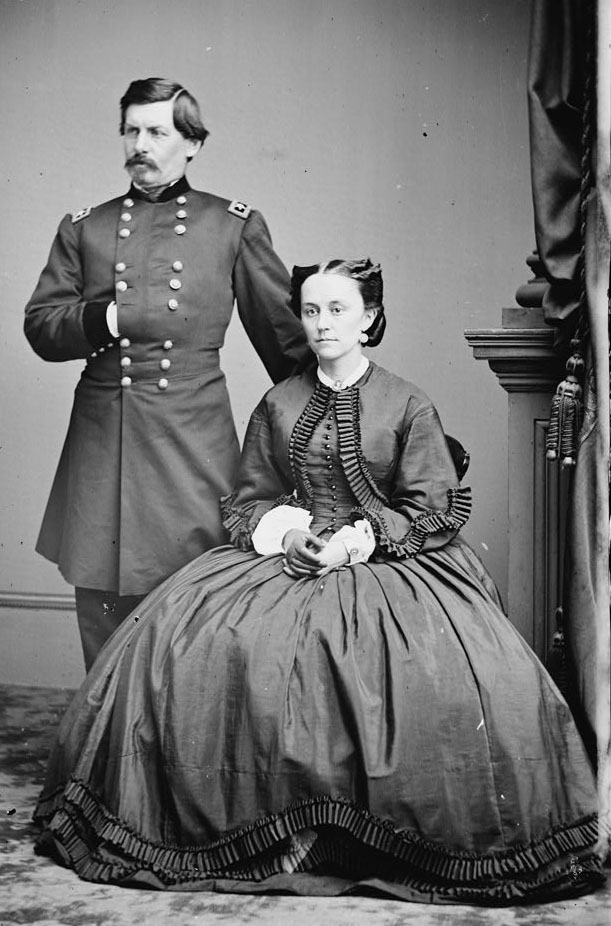
George and Ellen McClellan
Some names are associated indelibly with the Civil War in popular conception: Lincoln, Lee, Grant, Sherman, Stonewall. Each has their supporters and detractors, usually along geographic lines. But one name earns near universal scorn: McClellan. The great villain of countless Lincoln stories, fired twice for gross incompetence (not actually true, the first time he remained in charge of the Army of the Potomac but half the army was transferred to the Army of Virginia) only to reappear as the Apollo Creed presidential opponent in 1864 who wanted to throw in the towel on the war (also untrue, McClellan repudiated his party's peace platform) only to be defeated by the plucky Lincoln at the last minute.

It's hard for us today to remember that on July 27, 1861 people felt much different about the man. The New York Herald editorialized about George Brinton McClellan the following morning:
There is a charm in this name which will yet work as a talisman upon the American heart... This appointment is highly important. The man seems to have loomed up in the moment of need when he was most wanted. We did not know the best man before, but events have displayed his ability and brought him to light. It is so in all revolutionary convulsions—the best men are thrown on the surface... 

But a new era has opened upon us. We have been awakened from a dream of fancied conquest without the necessary preparation to achieve it. A man has arisen equal to the times. Like the legions of France under Napoleon, the troops of the American republic under McClellan will be invincible, and the shameful rout of Bull Run will be forgotten in the glory of his victories.
[NewsInHistory.com has this and a number of other amusingly breathless exhortations of McClellan]

Monday, July 25, 2011

Starting Anew

In which U.S. leaders decide to get back on the horse
...........................................................................................................................

Burnside (center) and the leadership of the 1st Rhode Island, back home
On July 25, Colonel Ambrose Burnside reluctantly formed up the 1st Rhode Island and prepared to lead them out of Washington for the last time. Because Burnside had pulled them back to Matthew's Hill to rearm rather than send them up Henry Hill, the regiment was in considerably better condition than most in the army. Burnside reported 13 killed, 39 wounded, and 39 missing. But their 90 days of Federal service had been reached, so it was back to Rhode Island, where the men would return to their homes and Colonel Burnside would again become a private citizen.

They left behind a capital trying to get back on track after the shock of their defeat on the hills overlooking Bull Run. The attempts to reconstitute the Northern war effort began immediately as the first troops stumbled through the terrible storm back to their fortified positions, but on the 25th it finally began coalescing into something like concrete changes.

Sunday, July 24, 2011

Rec'd: Col. Burnside and Col. Corcoran on Disunion

The folks at Disunion have some of their own aftermath of the battle posts going on now, including two concerning our own dramatis personae, Ambrose Burnside and Cump Sherman. First, a story of the capture of Robert Holloway, Burnside's valet. Second, a story about Private Conant of the 11th Massachusetts (Franklin's brigade, Heintzelman's division) captured on Henry Hill, that briefly mentions Colonel Corcoran of the 69th New York Militia, part of Sherman's brigade, who Conant shared a train with in traveling from Manassas Junction to Richmond and prison.

Thursday, July 21, 2011

5:00 pm: Bridge down on Cub Run, mass panic

Blackburn Ford
The offensive against Richardson was resumed, this time with only Longstreet and Bonham. Richardson offered no resistance, following the army wide order to retreat. Longstreet sent word back to Johnston to send them reinforcements as fast as he could, so they could reach Centreville before the bulk of McDowell’s army and capture them.

Sudley Ford
One of or both of Porter and Burnside commanded the last troops over Sudley Ford, trying to stave off J.E.B. Stuart’s cavalry. It’s widely agreed that the last unit over the ford was the battalion of regulars from Porter’s brigade, but both commanders claimed to have been leading them.

Regardless, the real delay for Stuart was the huge number of prisoners he had captured that bogged down his cavalry.

Warrenton Turnpike
With all his concern for clearing the bridge, Bayard had not made plans to blow it up to stop the Confederate pursuit. Porter Alexander witnessed the chaos as Northern soldiers, officers, and VIP civilians mixed together in flight.
As I got near the head of the rear regiment I saw a very fine looking sergeant major come out of the woods on the left with a small man in citizen’s dress & take him before the colonel at the head of the regiment… as I approached… he had drawn his revolver and was trying to shoot the little citizen who was dodging behind the big sergeant major as… [the colonel was] swearing with a fluency that would have been creditable to a wagon master. “You s. of a b.! [sic] You came to see the fun did you? God damn your dirty soul! I’ll show you.”
Alexander stepped in and reminded the colonel of Beauregard’s orders not to shoot prisoner, to which the irate man replied that his prisoner was a member of Congress, come to watch the battle. The crisis was averted only when the colonel gave up his prey to Alexander upon learning that there might be a senator nearby.

Fry later insisted that the retreat had not been disorganized up to that point:
There was no panic, in the ordinary meaning of the word, until the retiring soldiers, guns, wagons, congressmen, and carriages were fired upon, on the road east of Bull Run. Then the panic began, and the bridge over Cub Run being rendered impassable for vehicles by a wagon that was upset upon it, utter confusion set in: pleasure-carriages, gun-carriages, and ammunition wagons which could not be put across the Run were abandoned and blocked the way, and stragglers broke and threw aside their muskets and cut horses from then- harness and rode off upon them.
Key to People and Sources

4:30 pm: The retreat begins

Henry Hill
Watching from Matthew’s Hill, Fry recorded,
Until then they had fought wonderfully well for raw troops. There were no fresh forces on the field to support or encourage them, and the men seemed to be seized simultaneously by the conviction that it was no use to do anything more and they might as well start home. Cohesion was lost, the organizations with some exceptions being disintegrated, and the men quietly walked off. There was no special excitement except that arising from the frantic efforts of officers to stop men who paid little or no attention to anything that was said. On the high ground by the Matthews house, about where Evans had taken position in the morning to check Burnside, McDowell and his staff, aided by other officers, made a desperate but futile effort to arrest the masses and form them into line. There, I went to Arnold’s battery as it came by, and advised that he unlimber and make a stand as a rallying-point, which he did, saying he was in fair condition and ready to fight as long as there was any fighting to be done. But all efforts failed. The stragglers moved past the guns, in spite of all that could be done, and, as stated in his report, Arnold at my direction joined Sykes’s battalion of infantry of Porter’s brigade and Palmer’s battalion of cavalry, all of the regular army, to cover the rear, as the men trooped back in great disorder across Bull Run.
Burnside rode forward to find the 2nd New Hampshire. In Fiske’s account, he encouraged them to hurry up, lest they be surrounded by surging Confederates, but the regiment refused to run. In Burnside’s he found them cowering and clueless about imminent capture and rescued them. Both claimed that about half the brigade reformed on Matthew’s Hill and asked McDowell to keep fighting, but were denied.

Henry Hill
Flush with victory, Beauregard was coordinating the chase of fleeing Union soldiers when he was interrupted with news of a surprising guest. Jefferson Davis had ridden the train from Richmond as soon as he received first reports. He was shocked when he rode from Manassas Junction, assuming a terrible defeat because of the huge number of Confederates fleeing the battlefield.

Blackburn Ford
Both armies seemed to have lost their stomach and called off the impending clash at the Ford.

Key to People and Places

1:00 pm: The struggle for Henry Hill

Programming note: Over the next three hours things become very confusing in the mayhem on top of Henry Hill. Specific times for events vary wildly as does the sequence. I’ll post on the hour rather than half hour and in a slightly different style than the narrative so far.
Blackburn Ford
Longstreet’s staffers completed their reconnaissance of the batteries of Richardson that were still intermittently raining down shot on them. Unaware of the details of the action on Henry Hill, Longstreet recommended attacking them and beginning the attack on Centreville.

Portici
Johnston pulled reinforcements from every corner of the battlefield. Early’s brigade had spent the morning marching from one point to another in the vacillations of Beauregard about his Centreville plan, meaning they had no specific position to defend. At Mitchell’s Ford, Bonham was asked to send two regiments, and Cocke had to give up another battalion of men. And, in a stroke of luck, he received word that his final brigade had just arrived by train at Manassas Junction. Johnston wastes no time and orders them to march immediately sown the Sudley Road to Henry Hill.

Matthew’s Hill
James Fry had been sent by McDowell back from Henry Hill to again urge Tyler to hurry up and deploy his third brigade, which was still on the other side of Bull Run unknown to just about everyone. Now Fry could not find McDowell and so fell back to near the Warrenton Turnpike, where Chief Engineer Bayard was concerned about the Stone Bridge. The regiments of the 8th South Carolina had fallen back from it, but it was entirely undefended and still covered by abatis, tree branches stacked close together to make it difficult to move. He was trying to find some specialized soldiers called pioneers that still had their axes to clear the way.

While Burnside’s brigade watched from Matthew’s Hill, the 2nd New Hampshire (as the closest regiment on hand) was asked for to fill a hole of a regiment that had collapsed.
Just as we were about to start, Colonel Marston came up mounted, with his shoulder bandaged, and said, “Now we New Hampshire boys will have a chance to show what stuff we are made of.” He was received with cheers, and accompanied us until repeated entreaties not to take the risk of aggravating his wound induced him to return; but he left the inspiration of his presence with us.
Henry Hill
Charles Griffin had been ordered by Heintzelman to move his battery of cannons to a place where they could tear apart the Confederate line based on Jackson. Along with another of Heintzelman’s batteries, the West Point artillery drug their guns down Sudley Road and set themselves up at roughly a 90 degree angle from the Confederates and no more than 200 yards distance. They opened fire at point blank range with devastating effect. Heintzelman and two regiments of infantry went with them.

At some point during this hour, Mrs. Judith Henry, an elderly widow living in a house on top of the hill that bore her name was killed by artillery fire. She was bed-ridden and very unwell and refused to leave her home as soldiers approached. Her daughter and a slave hid themselves in the fire place and lived.

Key to People and Places

Noon: 2nd Div (US) pursues Confederates, meets a Stone Wall

Matthew’s Hill
With the Confederates pushed back over the Warrenton Turnpike, and Heintzelman’s Third Division chasing them and two brigades of Tyler’s First Division joining them, it seemed unlikely that Hampton’s Legion could hold out long. McDowell had stationed himself on Matthew’s Hill, watching and directing the action with his chief of staff, James Fry. In short order, they were met by Colonel Cump Sherman from the First Division, asking where his brigade might be of most use (McDowell sent him against Hampton’s Legion), and Colonel Ambrose Burnside asking to pull his men out of the battle to rearm and rest, since (he smugly noted) they had done the bulk of the fighting in the victory (Fry said: “McDowell, in the excitement of the occasion, gave reluctant assent…”).

Burnside’s men backed away from the confusion, replaced by some of Porter’s brigade and some of Sherman’s brigade, and walked up Matthew’s Hill to behind the artillery pounding away at Henry Hill where they waited for more ammunition to be brought to them. Fiske, now in command of the 2nd New Hampshire with his colonel wounded, wrote:

A cheer came from away off to the right, and was taken up by us and rolled along to the extreme left. McDowell rode down our front announcing that we had won a glorious victory. One of our men near me said, pointing to some columns of dust over the trees to the south of us and moving toward us, “It seems to me, Colonel, that if we have whipped them, that dust ought to be moving the other way…”

McDowell ordered Heintzelman to aggressively position his Third Division along the Sudley Road south of the Warrenton Turnpike, which would be full of men from Porter’s brigade and Tyler’s division to form a massive L that would push the Confederate army in on itself until it collapsed.

Henry Hill
Johnston and Beauregard arrived to a scene of chaos on Henry Hill. The brigades of Bee, Bartow, and Evans were no more than an armed mob, their commanding officers abandoning all pretenses to structure and gathering knots of men to lead on charges. Hampton’s legion was now surrounded on three sides and as they watched began to crumble. At some point over the next hour Bartow would be dead, but the situation was too chaotic to identify when.

It was a desperate situation and a dramatic legend was born of it. As with all legends, there are multiple versions and few verifiable facts. At some point in the mayhem, Barnard Bee compared the unmoving line of Colonel Thomas Jackson to a stone wall. In some accounts, when all seems lost he cries out “Look boys, there stands Jackson like a stone wall. Rally around the Virginians!” In others, he is cursing the general who rather than come to the aid of his men is “standing there like a bloody stone wall.” And it’s also possible that Bee never said anything at all about stone walls. In the following hour he would be shot through the abdomen and over 24 hours slowly and painfully bleed to death in a Confederate hospital before the story would begin to be told.

But what Beauregard and Johnston saw was enough to make the legend credible. The colonel in the dingy blue VMI uniform had his men standing stock still while the wave of Northerners rushed towards them, holding their fire until they couldn’t miss and stunning the advancing army. Beauregard quickly had the remainder of Hampton’s Legion fall in beside Jackson’s brigade and then he and Johnston rode their horses around fleeing men, pushing them back into a battle line on the far end of Henry Hill.

Key People and Sources

11:00 am: Col Evans (CS) reinforced on Matthew's Hill

Matthew’s Hill
Shanks Evans finally won a battle within the battle he had been waging. On top of Henry Hill, Barnard Bee had been insisting Evans fall back to his position, while Evans had been insisting that Bee bring his and part of Bartow’s brigade to Matthew’s Hill to drive the Union men back to Sudley Ford before more of them arrived.

Bee had been partially convinced because the rest of Bartow’s brigade, a mixed-arms regiment called Hampton’s Legion, and the beginning of Jackson’s brigade were finally arriving at Henry Hill. But he had also been persuaded when it became clear that Burnside had finally gotten his brigade together, with all four regiments now in line and punishing Evans’ small command.

Bee brought his men down just as the Tigers made a daring gambit. Evans wrote: “The fire was warmly kept up until the enemy seemed to fall back. Major Wheat [the Tigers’ commander] then made a charge with his whole battalion.” It was a cover-up for a foolish attack that gave Burnside the upper hand. Wheat was shot through both lungs (he would live, amazingly) and a huge number of his Tigers were knocked out of the battle.

As the new Confederates rushed into battle so did new Union men. Porter’s 27th New York fell into line to the right of Burnside’s 71st New York, extending the line to the south, parallel to Sudley Road. In front of them the gray uniformed 8th New York came hurrying to join up in their line – except it wasn’t the 8th New York. In a mistake that would famously be repeated over and over they were Confederates and they opened fire on the stunned New Yorkers.

Yorkshire
Johnston recorded in his official report:
…I waited with General Beauregard near the center the full development of the enemy’s designs. About 11 o’clock the violence of the firing on the left indicated a battle, and the march of a large body of troops from the enemy’s center towards the conflict was shown by clouds of dust. I was thus convinced that his great effort was to be made with his right. I stated that conviction to General Beauregard, and the absolute necessity of immediately strengthening our left as much as possible
After the war Johnston would describe his words urging Beauregard to take the attack on the left seriously more bluntly: “The battle is there. I am going.” A startled Beauregard scrambled to issue orders to reinforce Henry Hill and follow Johnston there.

Key People and Sources

10:30 am: BG Beauregard (CS) makes a decision

Yorkshire
Beauregard and Johnston were handed another disturbing message from Porter Alexander. To the west he had seen a large dust cloud, like one thrown up by a column of troops. Johnston’s army hadn’t all arrived, but most were coming by train. But it also could be the army of Maj. General Robert Patterson, duped by Johnston in Winchester. It wouldn’t arrive fast enough to decide the current battle, but if the Confederates successfully defeated McDowell at Centreville, they would find themselves between two armies.

The arrival of Dick Ewell at headquarters further exacerbated the issue. Most of his brigade had crossed Bull Run and he was waiting for the promised further orders to begin the attack on Centreville. Beauregard waffled as Johnston became more disturbed. Finally, the Louisianan decided to delay the attack and recall the brigades north of the river.

Writing in 1863, Beauregard described his situation:
I thus had suddenly or on the spur of the moment to change my whole plan of battle, with troops which had never yet fought and could scarcely maneuver. My heart for a moment failed me!... But I soon rallied, and I then solemnly pledged my life that I would that day conquer or die!
Matthew’s Hill
While Beauregard vacillated, the fight was thickening to the north. While the 2nd New Hampshire bumbled (made worse when Colonel Marston was shot in the shoulder and had to be carried off on a stretcher), Burnside hurried forward his own 1st Rhode Island Militia to support their sister regiment, which was wavering. In short order Colonel Slocum was hit by musketballs in his ankle and skull, and a cannonball smashed his leg. His men did not have time to remove him from the field the fighting was becoming so desperate and if the damage to his brain did not kill him outright, then he shortly bled to death.

Burnside rode to the other brigade commander, Andrew Porter, and begged him for the use of his battalion of regular U.S. Army soldiers. Porter agreed and Burnside rode up and down their column, urging them to jog briskly down Sudley Road to keep the Rhode Island men from being overwhelmed.

Stone Bridge
Daniel Tyler decided not to cross the First Division over Stone Bridge after all. He could hear the firing of the fight on Matthew’s Hill, but still believed there was probably a large number of Confederates in front of him, and after being chastised so severely for the fight at Blackburn Ford on July 18, was not about to charge the bridge head on. Instead he sent Schenck down river to look for a ford (he would find none, Cocke had them all guarded) and Sherman upriver to look for one. He had just the spot in mind already.
Early in the day, when reconnoitering the ground, I had seen a horseman descend from a bluff in our front, cross the stream, and show himself in the open field, and, inferring we could cross over at the same point, I sent forward a company as skirmishers, and followed with the whole brigade, the New York Sixty-ninth leading. We found no difficulty in crossing over, and met no opposition in ascending the steep bluff opposite with our infantry, but it was impassable to the artillery… Captain Ayers [therefore] did not cross Bull Run, but remained with the remainder of your division.
Key People and Sources

10:00 am: Battling on Matthew's Hill

Matthew’s Hill
The 2nd Rhode Island had calmed down a bit and driven the Tigers back down to the bottom of Matthew’s Hill. With six guns now set up at the top of the hill, they were beginning to make progress in answering Evans’ two guns, and the four guns being set up now by Bee on Henry Hill. Burnside had ridden to the front and ordered the 71st New York and the 2nd New Hampshire from his brigade to set up on a ridge to the west of Sudley Road, while he hurried his own 1st Rhode Island and the other brigade from the Second Division forward to flank Evans. He hoped to extend the battle line in such a way that Evans would be forced to put his back to Bull Run, the optimal position for when the First Division of Daniel Tyler charged across Stone Bridge.

But the order proved beyond the capabilities of the inexperienced officers and men of the 2nd New Hampshire, who hadn’t had the nearly three months of experience the 71st New York had. “The movement to our position was a mistake,” Fiske admitted, “Caused by the confusion of staff officers of different generals, whom we were unable to distinguish, and who had not had time to learn to distinguish regiments of different brigades.” He continued:
On our way, two companies, by the mistake of another aide not on the staff of our brigade, were separated from the regiment, and it was only be the active exertions of our own officers that we were brought back again… We passed some caissons [storage lockers for cannons]; just before we reached them a cannon shot off a hind leg of each of the two wheel horses. I had already seen men wounded and killed, but no such pitiful sight to me as that of those poor horses.
Key to People and Sources

9:30 am: First volleys on Matthew's Hill

Matthew’s Hill
Col. John Slocum led the 2nd Rhode Island down the Sudley Road [VA 234]. It was stretched out in its full battle line, with a company of skirmishers spread out about a hundred yards in front of it to avoid any surprises. Behind it was a batter of artillery, looking for a good place to unlimber (set up to fire). At his side rode Col. David Hunter, commander of the Second Division. Closer to the ford, Burnside tried to hurry the rest of the brigade across the ford and into position.

The 2nd Rhode Island’s skirmishers reached the crest of Matthew’s Hill and all hell broke loose. A volley of musket fire from the Louisiana Tigers and the 4th South Carolina shot tore the air beside them. Slocum hurriedly ordered the rest of the regiment to the crest of the hill where it could fire down on the Confederates and move the artillery where it could back up the infantry.

Hunter was hit by a musket ball and was evacuated back to Sudley Ford. He told Burnside as he left to take command.

Key to People and Sources:
http://livinginthepastdc.blogspot.com/2011/07/live-blogging-150th-anniversary-of.html

9:00 am: 2nd Div (US) attack begins from Sudley Ford

Stone Bridge
Shortly before 9:00 am, a horseman thundered up to Evans’ headquarters at top speed. According to some accounts the general was already beginning his strange habit of distributing whiskey to men who were hurt or needed some courage (and to himself) from a barrel on the back of one of his aides. The horseman was from one of Evans’ two companies of cavalry that he had stretched all the way to Sudley Ford to warn him of anyone was coming that way. He reported that the cavalry had been chased off by Union cavalry, a sign that someone was coming that direction.

At that moment a note was handed to him from the Stone Bridge signal station. It was the message from Alexander. “Look out for your left. You are flanked.” Evans dashed off a quick note to Cocke that he was leaving only a few companies of the 4th South Carolina as a distraction at Stone Bridge and hurried the rest of the regiment and the Tigers three-quarters of a mile west towards a ravine next to Buck Hill, just north of the Warrenton Turnpike. He sent another message to Bee, just arriving at Henry Hill, that he needed reinforcements immediately.

Sudley Ford
Burnside’s lead regiments collapsed in gratitude for a quick break when they reached Sudley Ford. While Burnside ate a quick bite of food, the Second Division’s commander, David Hunter, chatted to him about their plan. Only the 2nd Rhode Island had fully arrived, two hours late and exhausted. Burnside encouraged them to begin crossing so as not to hold up the line.

They were interrupted by a furious McDowell, who had ridden to the front of the line personally to see what was occurring.
On reaching the ford at Sudley Springs, I found part of the leading brigade of Hunter’s division (Burnside’s) had crossed, but the men were slow in getting over, stopping to drink. As at this time the clouds of dust from the direction of Manassas indicated the immediate approach of a large force [Bee and Bartow], and fearing it might come down on the head of the column before the division could all get over and sustain it, orders were sent back to the heads of the regiments to break from the column, and come forward separately as fast as possible.
Rather than march down the road, McDowell was ordering the men to form up for battle and expect to cross the ford in a fight. His chief of staff, Bvt. Captain James Fry, described McDowell’s arrival at Sudley Ford differently:
He gazed silently and with evident pride upon the gay regiments as they filed briskly but quietly past in the freshness of the early morning, and then, remarking to his staff, “Gentlemen, that is a big force,” he mounted and moved forward to the field by way of Sudley Springs.
Whether either or both accounts actually occurred, the decision to prepare for battle was made. One of the aides sent riding at top speed by the order approached Lt. Colonel Fiske of the 2nd New Hampshire further down the farm path. “An officer from the front came galloping back and asked for Colonel Marston. ‘Tell him to have his men ready, for we shall soon meet the enemy in large force,’ he shouted, and continued on his way to other regiments.”

Key to People and Sources

8:00 am: US offensive delayed

Stone Bridge

While Long Tom and the rest of the artillery pounded the Confederates at Stone Bridge, Schenck worked his brigade closer to their position for an attack, little-by-little. They slowly crept into a hollow that runs parallel to the Warrenton Turnpike. It was protected from the Confederate artillery that Evans had placed so it could fire straight down the length of the bridge, annihilating anyone crossing it, and the Confederate artillery of Colonel Cocke which was firing down on Tyler’s division from the hills above the bridge.

Farm Path to Sudley Ford
Somebody had made a serious mistake. The path had been considerably longer than six miles (it would end up over 12) and Burnside’s brigade should have crossed Sudley Ford an hour ago. They had emerged from the woods into a clear plain and the sun was beginning to make the men hot.

Key to People and Sources

7:00 am: Borey reinforces the left

Yorkshire

Back at his headquarters from Mitchell’s Ford, Beauregard decided to send the brigade of Bernard Bee and part of the one of Francis Bartow to Henry Hill, in order to back up his left flank in case the attack on Evans turned out to be more serious than he thought.

The Farm Path to Sudley Ford

Burnside’s men continued to march down the farm path, following the plan to make the attack on Stone Bridge more serious. But at this point it had become obvious that a major mistake had been made. The path had narrowed to barely a trail, making the movement of artillery difficult.

With sounds of battle now drifting from Stone Bridge, Lt. Colonel Fiske remembered that in the 2nd New Hampshire “men ceased speaking and without orders closed their ranks, and only the sullen rumble of the artillery wheels was to be heard; the influence of our peaceful surroundings was gone, and men were reminded that the time which was to test their manhood had come.”

Key to People and Sources