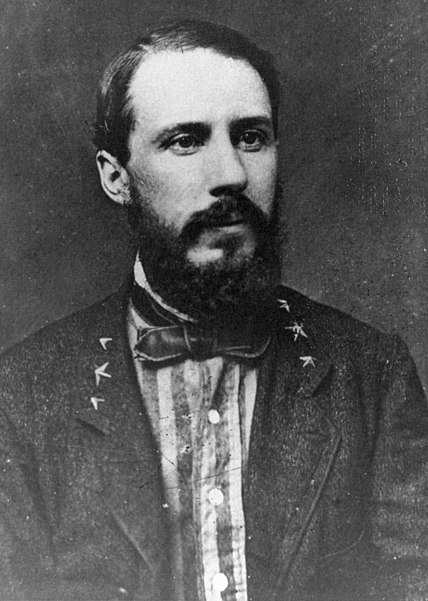
Showing posts with label E.P. Alexander. Show all posts

Wednesday, October 12, 2011

On the Eve of Battle

Wherein George Meade prepares himself and his family for a Confederate attack
..........................................................................................................................................

October 12, 1861 was a fairly quiet day in the Confederate Army of the Potomac. The promotions to major general had come in for James Longstreet and T.J. Jackson (who was being called "Stonewall" in the popular press after the story about his defense of Henry Hill had spread over the summer), who were assigned to G.T. Beauregard's First Corps and G.W. Smith's Second Corps, respectively. It would be a few more days before they were given multiple brigades to make up their divisions. At least in Longstreet's case, it would only be two brigades, preserving hope that the plan of creating multiple divisions under major generals might continue despite provisional President Jefferson Davis' recent attempts to kill it once and for all (Jackson's subordinates are not recorded in the Official Records, if they were even made).

But in the Union Army of the Potomac, things were aflutter. "I am at this moment looking after the enemy," its commander, Maj. General George B. McClellan wrote to his wife, Mary Ellen. He splurged to send the message by telegram, because that morning he had received a telegram from her announcing she had given birth to the couples fifth (and, as it turned out, final) child, Mary. "I thank God you are safe," McClellan had told her, before his words about seeing to an enemy attack. Despite being sure he would be "in the saddle all day" he encouraged her to telegraph him throughout the day with updates of her status.

McClellan had been at the camp of Fitz John Porter, in what is now Rosslyn, when he received word that the enemy was advancing on the divisions of Brig. Generals W.F. "Baldy" Smith at Lewinsville, Virginia and George McCall at Langley, Virginia. General Joe Johnston, as we have seen, had no intention of an offensive operation, but since Manassas he and his subordinates had actively deceived McClellan about their true intentions. Beauregard especially enjoyed dabbling in these schemes and had a willing partner in his signals and ordnance chief Porter Alexander. In an undated plot implied by Beauregard's biographer to be in August and by Alexander to be in the early fall (perhaps after the Evansport battery opened) the two took advantage of new technology Alexander had wheedled out of Richmond to unhinge the whole Union command structure. As Alexander recalled:
I had my signal stations scattered about on the high places, & of course under orders to report promptly all unusual occurrences. One night, I remember, about bedtime receiving a report that one or two or possibly more rockets had been seen over the Federal lines. I took the report to Gen. Beauregard & he asked me if I had rockets. I said yes, every station was provided, on which he told me to have every station send up one & during the night to have one or two more demonstrations of them. It took very few minutes to send the orders everywhere, & we soon had rockets apparently answering each other for a long distance right & left, & couriers were sent to shoot others, later, at other points. The next papers from the North brought the story above referred to It was said McClellan complained to Lincoln that only he and Gen. Scott knew of his plans, & yet they were allowed to become known to some one who must have betrayed us.

Saturday, October 8, 2011

The Confederate Blockade of Washington

Wherein guns at Quantico cut off shipping and hunt spies
..............................................................................................................................

Theophilus Holmes
By Fall 1861, the U.S. Navy was already beginning to establish an effective blockade of the South, though it still had a ways to go before it would match general-in-chief Winfield Scott's vision of cutting off outside commerce to the South. But the South was also hard at work to cut off the Washington from the rest of the world. The raids against the B&O Railroad west of the capital are still fairly well known, as is the fear of partisan activity on the stretch to Baltimore, but the Confederate blockade of the river is less well known.

The town of Evansport at the mouth of Quantico Creek had been a native village known as Pamacocack when Captain John Smith landed there about a year after the settlement of Jamestown. Today, it is the town of Quantico, entirely surrounded by the Marine Base. In 1861, as Evansport, it was a community looking for a rebirth from gold mines in nearby Independent Hill, after the tobacco that it had become prosperous shipping down Quantico Creek to the Potomac in the 18th Century had caused massive soil erosion that silted up the 19th Century waterway.

Wednesday, September 28, 2011

Important and Exciting Work

Porter Alexander and the phony phony war.
..........................................................................................................................


Ron at All Not So Quiet Along the Potomac has been chronicling Confederate activities and has another great post up about Joe Johnston's correspondence with new Secretary of War Judah P. Benjamin on September 26 that is the beginning of the South's evacuation of the advanced line within sight of Washington. Please check it out. I offer the following post as a compliment to the narrative he is building.

Historians tend to refer to August and September 1861 as a "phony war" or a period of quiet, but it was nothing like that for Porter Alexander and the rest of the staff officers who worked ceaselessly to prepare the two armies for their next bloody encounter. When we last saw the major, he was touring the carnage of the Manassas battlefield. His hastily trained signal corps had played as central a role in winning the battle as Thomas Jackson's stand on Henry Hill, and the head of the Confederate Army of the Potomac, G.T. Beauregard, recognized it.

The day following the battle, Beauregard asked Alexander to become his new chief of ordnance, his own having been placed in charge of a brigade of Georgians (taking the spot that would have gone to the mortally wounded Francis Bartow). A few days later, Beauregard's army was officially merged with Joe Johnston's army, and Johnston asked Alexander to continue on as the chief of ordnance, since his own had been killed on Henry Hill. Alexander eagerly agreed, and was allowed to continue to live and eat at Beauregard's headquarters, which (at least initially) was closer to Washington than Johnston's. He recounted decades later:
My duties as chief of ordnance were to keep the whole army always supplied with arms and ammunition--infantry, artillery, & cavalry. It does not sound like very much to do, but there was an infinity of detail about it & I had to organize a complete system. First I had to issue blanks to every organization in the army for each one to report what arms it had & what it needed. Then I had to organize a store house for general supplies of this kind at the R.R. station & see that each organization of the army also had a train of wagons sufficient to carry a supply for at least one battle. Then I had to have weekly returns to my office from every regiment & battery & wagon train to have my eye, as it were, on the business everywhere & see what changes were taking place & that everything was as it should be.

Thursday, July 21, 2011

Epilogue

Epilogue

The Victors
Porter Alexander rode the battlefield that he had only seen from a distance.
Across the Pike I noticed a well marked row of the enemy’s dead showing where a regiment had fought. I noticed on their accoutrements that they were the 2nd Vermont. As I rode by one of the “Louisiana Tigers” of Wheat’s battalion was going from man to man stooping over each one. He had doubtless caught on to the fact that dead men’s pockets sometimes had money, watches, & other valuables in them, but he had the decency to pretend that he was searching their cap boxes for caps as I came near him. I knew he was lying, but I said nothing.
Afterwards, he was asked to guide Johnston back to Manassas Junction for the evening, but was quickly joined by Beauregard and Davis.

They returned to the army headquarters and feasted on whatever leftovers they could find. The President was ecstatic at their victory and hoped to follow up with a march on Washington the next day (which would be impossible with heavy rain the next day and the Union army still in Martinsburg). Johnston good-naturedly gave Beauregard complete credit for the victory, and Davis sat down at the kitchen table and wrote out a commission for the Cajun to full general, the only recorded instance of a battlefield promotion in the American Civil War.

The Vanquished
Fry summarized his commanding officer and their army:
McDowell in person reached Centreville before sunset, and found there Miles’s division with Richardson’s brigade and 3 regiments of Runyon’s division, and Hunt’s, Tidball’s, Ayres’s, and Greene’s batteries and 1 or 2 fragments of batteries, making about 20 guns. It was a formidable force, but there was a lack of food and the mass of the army was completely demoralized… McDowell consulted the division and brigade commanders who were at hand upon the question of making a stand or retreating. The verdict was in favor of the latter, but a decision of officers one way or the other was of no moment; the men had already decided for themselves and were streaming away to the rear, in spite of all that could be done. They had no interest or treasure in Centreville, and their hearts were not there. Their tents, provisions, baggage, and letters from home were upon the banks of the Potomac, and no power could have stopped them short of the camps they had left less than a week before.
McDowell spent the night in Fairfax Court House, sending telegram accounts to Winfield Scott, who tried to reinstall hope in the army by bravely saying “We are not discouraged.”
McDowell was so tired that while sitting on the ground writing a dispatch he fell asleep, pencil in hand, in the middle of a sentence. His adjutant-general [Fry himself] aroused him; the dispatch was finished, and the weary ride to the Potomac resumed. When the unfortunate commander dismounted at Arlington next forenoon in a soaking rain, after 32 hours in the saddle, his disastrous campaign of 6 days was closed.
  Hope everyone enjoyed.

5:00 pm: Bridge down on Cub Run, mass panic

Blackburn Ford
The offensive against Richardson was resumed, this time with only Longstreet and Bonham. Richardson offered no resistance, following the army wide order to retreat. Longstreet sent word back to Johnston to send them reinforcements as fast as he could, so they could reach Centreville before the bulk of McDowell’s army and capture them.

Sudley Ford
One of or both of Porter and Burnside commanded the last troops over Sudley Ford, trying to stave off J.E.B. Stuart’s cavalry. It’s widely agreed that the last unit over the ford was the battalion of regulars from Porter’s brigade, but both commanders claimed to have been leading them.

Regardless, the real delay for Stuart was the huge number of prisoners he had captured that bogged down his cavalry.

Warrenton Turnpike
With all his concern for clearing the bridge, Bayard had not made plans to blow it up to stop the Confederate pursuit. Porter Alexander witnessed the chaos as Northern soldiers, officers, and VIP civilians mixed together in flight.
As I got near the head of the rear regiment I saw a very fine looking sergeant major come out of the woods on the left with a small man in citizen’s dress & take him before the colonel at the head of the regiment… as I approached… he had drawn his revolver and was trying to shoot the little citizen who was dodging behind the big sergeant major as… [the colonel was] swearing with a fluency that would have been creditable to a wagon master. “You s. of a b.! [sic] You came to see the fun did you? God damn your dirty soul! I’ll show you.”
Alexander stepped in and reminded the colonel of Beauregard’s orders not to shoot prisoner, to which the irate man replied that his prisoner was a member of Congress, come to watch the battle. The crisis was averted only when the colonel gave up his prey to Alexander upon learning that there might be a senator nearby.

Fry later insisted that the retreat had not been disorganized up to that point:
There was no panic, in the ordinary meaning of the word, until the retiring soldiers, guns, wagons, congressmen, and carriages were fired upon, on the road east of Bull Run. Then the panic began, and the bridge over Cub Run being rendered impassable for vehicles by a wagon that was upset upon it, utter confusion set in: pleasure-carriages, gun-carriages, and ammunition wagons which could not be put across the Run were abandoned and blocked the way, and stragglers broke and threw aside their muskets and cut horses from then- harness and rode off upon them.
Key to People and Sources

9:00 am: 2nd Div (US) attack begins from Sudley Ford

Stone Bridge
Shortly before 9:00 am, a horseman thundered up to Evans’ headquarters at top speed. According to some accounts the general was already beginning his strange habit of distributing whiskey to men who were hurt or needed some courage (and to himself) from a barrel on the back of one of his aides. The horseman was from one of Evans’ two companies of cavalry that he had stretched all the way to Sudley Ford to warn him of anyone was coming that way. He reported that the cavalry had been chased off by Union cavalry, a sign that someone was coming that direction.

At that moment a note was handed to him from the Stone Bridge signal station. It was the message from Alexander. “Look out for your left. You are flanked.” Evans dashed off a quick note to Cocke that he was leaving only a few companies of the 4th South Carolina as a distraction at Stone Bridge and hurried the rest of the regiment and the Tigers three-quarters of a mile west towards a ravine next to Buck Hill, just north of the Warrenton Turnpike. He sent another message to Bee, just arriving at Henry Hill, that he needed reinforcements immediately.

Sudley Ford
Burnside’s lead regiments collapsed in gratitude for a quick break when they reached Sudley Ford. While Burnside ate a quick bite of food, the Second Division’s commander, David Hunter, chatted to him about their plan. Only the 2nd Rhode Island had fully arrived, two hours late and exhausted. Burnside encouraged them to begin crossing so as not to hold up the line.

They were interrupted by a furious McDowell, who had ridden to the front of the line personally to see what was occurring.
On reaching the ford at Sudley Springs, I found part of the leading brigade of Hunter’s division (Burnside’s) had crossed, but the men were slow in getting over, stopping to drink. As at this time the clouds of dust from the direction of Manassas indicated the immediate approach of a large force [Bee and Bartow], and fearing it might come down on the head of the column before the division could all get over and sustain it, orders were sent back to the heads of the regiments to break from the column, and come forward separately as fast as possible.
Rather than march down the road, McDowell was ordering the men to form up for battle and expect to cross the ford in a fight. His chief of staff, Bvt. Captain James Fry, described McDowell’s arrival at Sudley Ford differently:
He gazed silently and with evident pride upon the gay regiments as they filed briskly but quietly past in the freshness of the early morning, and then, remarking to his staff, “Gentlemen, that is a big force,” he mounted and moved forward to the field by way of Sudley Springs.
Whether either or both accounts actually occurred, the decision to prepare for battle was made. One of the aides sent riding at top speed by the order approached Lt. Colonel Fiske of the 2nd New Hampshire further down the farm path. “An officer from the front came galloping back and asked for Colonel Marston. ‘Tell him to have his men ready, for we shall soon meet the enemy in large force,’ he shouted, and continued on his way to other regiments.”

Key to People and Sources

8:30 am: Alexander spots the flanking column

Wilcoxen Hill
Porter Alexander had spent the morning so far exchanging wig-wag messages with the other observation stations. He had handpicked each station’s location, so that from his he could see all of them, had trained each man in the use of using the flags to send messages, and written the codes they would be using to communicate what they could see. Given the activity at Stone Bridge, he was spending most of his time training his spyglass in that direction.
While looking at them…[at] 8:30 am suddenly a little flash of light in the same field of view, but far beyond them [the station] caught my eye. I was looking to the west and the sun was low in the east, & this flash was the reflection from the brass of a cannon… It was about 8 miles from me in an air line & was but a feint gleam, indescribably quick, but I had a fine glass & well trained eyes, & I knew at once what it was. And careful observation also detected the glitter of bayonets all along a road crossing a valley…
Alexander sent a signal to Evans via the Stone Bridge station and sent a runner off with a note to Beauregard.


Key to People and Sources:
http://livinginthepastdc.blogspot.com/2011/07/live-blogging-150th-anniversary-of.html

6:30 am: 1st Div (US) attack on Stone Bridge begins

Stone Bridge
Tyler’s artillery, including Long Tom, opened fire on the Confederates in Evans’ small command guarding the Stone Bridge. The officer in charge of the massive 30-pounder Parrott remembered training his big gun on a “house across Bull Run at about a mile and a half range” hoping it was a headquarters. It was a signaling station set up by Porter Alexander, in fact, to relay observations from one end of the army to the other with wig-wag signals. “The shot went through the tent, but hurt nobody,” Alexander wrote.

On the Confederate side of Bull Run, Evans sent the battalion of Louisianans – na’er-do-wells from the docks who called themselves the “Tigers” – to join Sloan’s South Carolinians guarding upriver from the bridge.

Key to People and Sources


Wednesday, July 20, 2011

Attacking the Left

Wherein two generals make plans to swap places
................................................................................................................................................

While Brigadier General Irvin McDowell, commanding the Army of Northeastern Virginia on behalf of the Federal government and the Unionist states, professionally prepared his study of bypassing the Confederate defensive position on Bull Run, the Confederate position was being reinforced. Brigadier General Thomas J. Jackson had started the reinforcements after dark on the night of the 19th, bringing just under 2,500 men to add to the total. Throughout the night parts of two more brigades arrived by train at Manassas Junction, and at noon, the commander of the Army of the Shenandoah himself, Brigadier General Joseph E. Johnston.

Joseph Eggleston Johnston
Porter Alexander, Chief Engineer for the Confederate Army of the Potomac defending Manassas Junction, remembered his first look at Johnston years later:
I think [he] was more the soldier in looks, carriage, and manner than any of our other generals... His pictures, which are common, give an excellent idea of his strong and intellectual face. He was of a medium stature but of most extraordinary strength, vigor, and quickness.
Like many of his peers, Johnston was a decorated hero of the Mexican War, leading his men over the wall at Chapultepec (without their guide, Joe Hooker), getting wounded time and again in battle (Winfield Scott had once quipped, "Johnston is a great soldier, but he had an unfortunate knack of getting himself shot in nearly every engagement."). He had also been the first West Point graduate to attain the rank of general in the U.S. Army, being appointed Brigadier General as Quartermaster of the U.S. Army, but held the rank only a short time before resigning to follow Virginia to the Confederacy. He was the highest ranking officer to do so.

Monday, July 18, 2011

Setting the Stage

Union guard at Centreville, 1861
Shortly before midnight, Brigadier General Milledge Bonham roused his brigade and prepared them to march from Centreville. By the first minutes of July 18, the weary men who had retreated from Fairfax Court House the night before were back on the road, marching down the Centreville Road (VA 28) to join the rest of their Confederate companions at a defensive position set on Bull Run.

Bonham's retreat was part of a consolidation of Confederate forces to defend Manassas Junction. That morning, Colonel Eppa Hunton's 8th Virginia Infantry abandoned Leesburg and began a three day march to join the army. Brigadier General Theophilus Holmes received orders to leave a minimal defense at Aquia Creek and join Beauregard as well. But together only a few thousand men would be added from these forces, the real coup was in the lower Shenandoah Valley, where the Union army under Major General Robert Patterson had inexplicably pulled back almost to the Potomac River the day before. Confederate Brigadier General Joesph E. Johnston took the opportunity to send his cavalry as close to Patterson as possible so as to block his scouts. With this screen in place, he began loading his infantry into box cars at Winchester for transport to Manassas Junction.

Thursday, June 30, 2011

Porter Alexander Fights for the Confederacy

Porter Alexander as a Confederate colonel
"I can't fix the exact date of my going to Manassas, but it was about July 1st," wrote the former Confederate officer Edward Porter Alexander (who never used his first name) in the final years of the 19th Century. Alexander was in Nicaragua at the time, the personal representative of U.S. President Grover Cleveland to help settle a border dispute between that country and Costa Rica, in hopes that the United States could then finance the construction of a canal across Central America. He would fail to achieve a strong enough accord to make the dream come true, and it would be left to another presidential administration to build a canal in a different spot, but Porter Alexander succeeded in fulfilling the wishes of his family to setting down his memories of the Civil War.

Alexander's memoir was supposed to have remained a family account, specifically for his beloved daughter, but out of it grew another book, Military Memoirs, published in 1907 as a treatment of the same topic from a military perspective. Unlike the high romance (or schmaltz) of other accounts of the South's most famous army Alexander's contemporaries were writing, he turned a cold, professional eye on its operations, offering praise where earned, and criticism where deserved, even for the already sainted Robert E. Lee. The result was a classic for serious military students, who came to regard Alexander as one of the foremost authorities on the operations of the Confederate army.