
Wherein Jackson's Piedmont Campaign kicks off
..................................................................................................................................................
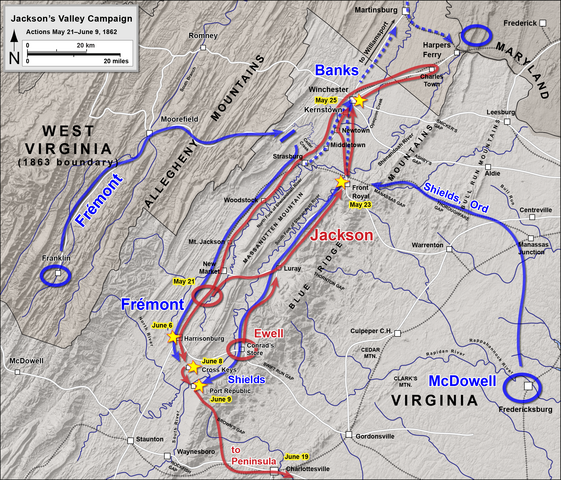
While less exciting, Jackson's campaign was paradigm-changing for concepts of security around Washington, DC. Over the course of three weeks in early summer the plan for defending the nation's capital shifted from one based on stationary fortification to one based on a campaigning army, and in doing so sealed the fate of George McClellan. In that sense, Jackson also achieved the primary objective of warfare in the mind of a 4th Century BC Chinese strategist he had never heard of: disrupt your enemy's strategy.
While it is most exciting to study the operational masterpiece from the viewpoint of the man who commanded both sides and the men who marched themselves ragged, to appreciate the deep strategic significance it is best to look at the story from the perspective of those in the Piedmont of Virginia, specifically one sitting on the banks of the Rappahannock River. There, in Falmouth, was the headquarters of the Department of the Rapphannock, commanded by Maj. General Irvin McDowell, rehabilitated loser of Bull Run.
The Lincoln Administration had quietly--almost apologetically--stood by McDowell the turmoil of the post-disaster outrage, and, in the Spring, rewarded him with promotion to major general of volunteers, making him one of the most senior generals in the Army. They believed McDowell had been a victim of circumstances, irrational public zeal, and poor subordinates, and retained Winfield Scott's initial high confidence of his abilities--a great deal more confidence, in fact, than they had in Maj. General George McClellan, who was leading the marquee army for Union, the Army of the Potomac, in a march on Richmond up the Virginia Peninsula from Fort Monroe.
McDowell should have been leading the First Corps of the Army of the Potomac under McClellan's supervision, but, at the last minute, the Lincoln Administration had withheld him until the defense of the capital was settled. McClellan's scheme for defense relied on an impenetrable system of forts that he had constructed over the winter that had turned the District of Columbia into the most fortified city on earth. A small mobile corps was to operate in the area, making sure that any enemy couldn't get too comfortable in Northern Virginia again, but it was the futility of attacking the string of fortifications that McClellan counted on to convince strategists in Richmond that their men were better used in different theaters.
But McClellan had violated his own strategy in the opinion of the Administration, particularly Secretary of War Edwin Stanton. An analysis conducted by two veteran generals at Stanton's request found that McClellan had shortchanged the defenses and the mobile corps in manpower and so McDowell's corps had been retained until the problem could be corrected. To better maintain control over the capital's defense, Stanton had created new Departments over which McClellan had no authority for McDowell and other commanders in the Shenandoah, the western Virginia mountains, the District, and Maryland.

