Showing posts with label Meade. Show all posts

Sunday, May 6, 2012

Before It's Too Late

Wherein the end of the war is imminent
.........................................................................................................................................

On May 6, 1862 nowhere was the imminent Union victory in the Civil War more apparent than in Northern Virginia, and no one in Northern Virginia was working harder to put the final nail in the Confederacy than the man who had botched up the whole thing ten months earlier. Maj. General Irvin McDowell, commander of the Department of the Rappahannock was working night and day to repair both the historic Potomac Path [U.S. 1] and the Fredericksburg and Richmond Railroad to allow a full advance towards Richmond.

McDowell can be forgiven for being swept up into the prevailing opinion that the end of the war was months away. In the West, several armies had been united under the command of Maj. General Henry Halleck in what we would call an "Army Group" today, with the purpose of capturing Confederate strongholds on the Mississippi and, by controlling the continent's great river, slicing the Southern nation in half and crushing their internal economy. Halleck's armies were drawing tight around Corinth, the key to defending Memphis, and General P.G.T. Beauregard, in command by accident after the death of the preferred Albert Sidney Johnston, appeared out-manned, out-gunned, and out-generaled.

At the other end of the Mississippi, Tennessee native and loyal Unionist Commodore David Farragut had completed a daring operation in cooperation with Maj. General Benjamin Butler and captured New Orleans, providing an ideal harbor for the Gulf Blockade Squadron as well as closing the best blockade-running port for cotton transited south from the cotton-growing Confederate heartland. With major Northern armies present in Pensacola, Port Royal, and Roanoke, too, the South was being dissected.

And in Virginia, McClellan was finally on the move. By May 6, word had arrived that the siege at Yorktown on the Virginia Peninsula was over, and McClellan was on the heels of Joe Johnston's army as it bolted back towards Richmond. Lincoln and his Secretaries of War, Navy, and the Treasury had taken the revenue cutter Miami the evening of May 5 to Fort Monroe to view the collapse of the major army defending Richmond personally. While they did so, Johnston had made a stand at Williamsburg, where after a brutal day of fighting for Joe Hooker's division, the Army of the Potomac had triumphed [Johnston's army had belatedly and at last assumed its famous name, the Army of Northern Virginia].

Monday, April 23, 2012

Aquia Creek

Wherein we learn the strategic value of a forgotten tributary
...................................................................................................................................................

On April 20, 1862, the Revenue Cutter Miami sat in Aquia Creek. The Miami was a sleek, 150 foot craft with a schooner-rigged screw-driven steamship that looked like a glamorous luxury yacht. She was. The Revenue Service (one of the forerunners of today's Coast Guard) had purchased her in January from Arthur Leary, owner of one of the largest lines of merchant vessels in the world (briefly in business with Sir Edward Cunard, son of the founder of the Cunard Line--to sneak a Titanic centennial in here, the unsinkable ship was built by White Star in response to Cunard's building of the Lusitania). Like the Harriet Lane, which had become the flagship of the Potomac Flotilla, the Revenue Service had outfitted the Miami for war.

Her arrival at the Navy Yard to receive her guns and ordnance the first week of April had drawn crows of admirers, including Abraham Lincoln, who insisted on a cruise to Alexandria with his family in her. On April 20, Lincoln was again on board, but this time with a more serious purpose. Secretary of War Edwin Stanton, Secretary of the Treasury Salmon Chase, and a gaggle of staff of various ranks were with him, all on their way to visit the Army of the Potomac on the Virginia Peninsula.

Lincoln had stopped at Aquia Creek to confer with the commander of the Department of the Rappahannock, Maj. General Irvin McDowell. McDowell had captured Fredericksburg the day before, the latest in a series of Union victories occurring everywhere except for the Virginia Peninsula (as a city on the Rappahannock, Fredericksburg is outside of the purview of this blog, but there is a remarkably exciting collection of official reports relating to the capture that are worth a read, if you like such things).

Thursday, March 8, 2012

Not Much Choice Between Them

Wherein corps and cracks are formed
..................................................................................................................................


After the Two Weeks That Changed The War the two Armies of the Potomac began moving. Ron over at All Not So Quiet Along the Potomac has done some great stuff about the Confederate preparation and subsequent departure from Northern Virginia, which I will not attempt to duplicate, so make sure you stop over and read it.


 On March 8, 1862, Abraham Lincoln and his new Secretary of War, Edwin Stanton, made a momentous decision--they would overrule McClellan's armies and establish four corps d'armee. French for "body of the army", the grouping of divisions in "corps" had been popularized by the phenomenal success of Napoleon. The units were designed to be armies fully capable of operating independently, but which worked in conjunction within the same theater. But since the 14 divisions of the Army of the Potomac were each larger than any American army previously in existence, the idea was anathema to many Northern leaders.

As usual, the general-in-chief, Maj. General George B. McClellan, lay at the center of what had become a controversial discussion fueled by the Joint Committee for the Conduct of the War. In McClellan's earliest days in Washington, he had stated his intention to form his army into corps. But as part of his systematic effort to remake the U.S. Army in his own image, he had held off on grouping the divisions into corps without explanation. In the meantime, the Joint Committee had caught corps fever, and on February 25 at 8:00 pm, had met with Lincoln in the White House to urge their creation. According to the Committee's report published in 1863:
They made known to the President that, having examined many of the highest military officers of the army, their statements of the necessity of dividing the great army of the Potomac into corps d'armie [sic] had impressed the committee with the belief that it was essential that such a division of that army should be made...The President observed that he had never considered the organization of this army into army corps so essential as the committee seemed to represent it to be; still he had long been in favor of such an organization. General McClellan, however, did not seem to think it so essential, though he had at times expressed himself as favorable to it. The committee informed the President that the Secretary of War had authorized them to say to him that he deemed such an organization necessary.

Friday, March 2, 2012

Two Weeks That Changed the War

Wherein operations along the Potomac begin McClellan's downfall
...............................................................................................................................

At the beginning of this week we looked at the first of two weeks that changed the American Civil War. The fall of Ft. Donelson on the Cumberland River to the obscure Brig. General Ulysses S. Grant had become a challenge to the general-in-chief of the Northern armies, Maj. General George B. McClellan. As Brig. General George Meade, commanding a brigade in McCall's Division (the Pennsylvania Reserves) put it on February 23 in a letter to his wife: "I fear the victories in the Southwest are going to be injurious to McClellan, by enabling his enemies to say, 'Why cannot you do in Virginia what has been done in Tennessee?'"

In the week that followed he had no choice but to begin an offensive motion with his Army of the Potomac, despite his long-laid plans to move it to the Rappahannock River and march on Richmond. The results of that decision changed the war.

February 24, Monday

Don Carlos Buell
The soldiers of Brig. General Don Carlos Buell reached the northern banks of the Cumberland River and looked across into an abandoned Nashville. McClellan's protege would occupy the city, despite the efforts of his (nominal) immediate superior Maj. General Henry Halleck to get Grant there first. Telegraphing his headquarters in St. Louis from Washington, McClellan told Halleck to "cooperate with [Buell] to the full extent of your power, to secure Nashville beyond a doubt." He said he would order Buell to next seize the nearby railroad junction and then "the next move should be either a direct march in force upon the rear of Memphis or else first upon the communications and rear of Columbus."

He may have gotten Columbia's name wrong, but McClellan's orders set in motion the movement of armies that led to Shiloh, what would be the bloodiest single day in American history until McClellan himself surpassed it at Antietam, and the bloodiest multi-day battle in American history until Gettysburg. The ferociousness of the battle would play a significant role in undermining McClellan's plans for what would become the Peninsula Campaign.

Sunday, December 25, 2011

As Far As Possible, A Merry Christmas

Celebrating in no-man's land
.................................................................................................................................

"There is a tremendous pressure being brought to bear on McClellan," Brig. General George Meade had written his wife on December 22, "And there is no telling how long he can or will stand it."

Meade was writing her a follow-up letter to give her more details on the minor battle that had occurred at Dranesville a few days earlier in which he had had a tiny supporting role (kudos to Ron for a fantastic write-up). It was a tumultuous crossroads for Washington's war policies, when decisions were being made that would effect the shape of the conflict for the next few years.

In Congress, the Joint Committee on the Conduct of the War was committing itself to a course of partisan activism through the decision to focus on Charles P. Stone. Heading the War Department, Simon Cameron had decided earlier that month to cast his lot with anti-slavery forces and support the enlistment of black soldiers, probably because he would otherwise become a target of the Joint Committee's investigations for his corrupt awarding of contracts. Consequently, Lincoln was being forced to make a decision about whether to publicly rebuke his top military adviser or endorse a similar anti-slavery position himself.

Both Lincoln and Cameron were meanwhile leaning on general-in-chief Maj. General George McClellan to provide a victory to sooth the erupting political turmoil, which meant McClellan had to decide whether to launch a winter offensive or have his men continue building shelters. Everything was overshadowed by the ongoing Trent Affair, wherein the seizure of two Confederate envoys off a British civilian ship had led to an ultimatum from Great Britain to return the men or to face war. An invasion force was readying in Canada to prove it was no bluff.

"No one can predict the future for twenty-four hours," Meade had advised his wife, "and all we can do is to endeavor to be ready for all contingencies. Good-by! God bless you all and give you a happy and as far as possible a merry Christmas!"

It was Christmas 1861, and the war continued, despite the holiday. Soldiers both North and South did their best to celebrate the holiday, which was at the time (as it is now) both a pious holy day and a raucous good time. As well documented at All Not So Quiet Along the Potomac the 3rd Pennsylvania Reserves of Meade's brigade had a feast on care packages sent from home. Their brigade commander's thoughts turned to home too, when he wrote to his wife that "though absent from you in body, that I am with you and my dear children in spirit and thought."


Saturday, December 17, 2011

Rec: I Expose My Neck. UGH!

My favorite things I read this week
..................................................................................................................

OLD SECESH. "While I cover my Neck, I expose my Feet, and if I cover my Feet, I expose my Neck. Ugh !"(Harper's Weekly)

Before proceeding to a heaping helping of recommendations, a report from a minor skirmish today in history:
Headquarters One hundred and fifth Pa. Vols.
Camp Jameson, Va
December 19, 1861

Sir: In obedience to your orders, I left this camp at 9 pm of the 18th instant with a force consisting of the regiment under my command, a squadron of the New Jersey Cavalry, under Captain Jones, and two sections of artillery, under Lieutenant Monroe, New Jersey Volunteers, and arrived at Potter's house within half a mile of the extreme outposts of our pickets on the right near 11:30 pm. I found that the pickets had been undisturbed, and immediately proceeded to distribute my force as would best support the pickets and preserve the force itself, should we be attacked. No demonstration was made by the enemy during the night. I left Potter's house for Pohick Church about three quarters of an hour after daybreak, having been detained that long in developing a movement to capture some of the enemy, but which proved abortive.

We arrived at Pohick about 9 am; was informed that the previous day the enemy had there a force of 200 cavalry and also a regiment of infantry concealed in the woods to the west of the village. Remained at Pohick about two hours; sent a party down the Telegraph road and discovered about a mile distant a rebel picket 6 or 8 strong; fired at them and they fled, but did not pursue as my instructions did not allow me to proceed beyond this point. Left Pohick Church between 11 and 12 am, and returned to camp at 3:30 pm. Came by the village of Accotink, and was there informed that no rebel forces had been in the village for over a month.

Respectfully submitted,
A.A. McKNIGHT,
Colonel, One hundred and fifth Regiment Pa. Vols.

Colonel Amos A. McKnight had led his small detachment out on a heavy patrol, because his division commander, Brig. Gen. Samuel P. Heintzelman, had suspected Confederate activity around the remains of Pohick Church (which his men had ransacked in November). McKnight had raised the men himself from around the Pittsburgh area in August, after completing his own service as Captain of Company I, 8th Pennsylvania, a 90-day unit that had not done much of anything under Robert Patterson while Joe Johnston sneaked off to help clobber McDowell at Bull Run.

McKnight would continue with the regiment into the spring, before being severely wounded and missing almost a year of fighting. He would return for two battles, before being killed at Chancellorsville.

***

Disunion managed two entire good articles this week. First, the most suspenseful read I've had in awhile, when an LSU professor recounts the story of two Tigers condemned to death. Then the story of "The Picket Guard", a forgotten poem whose popularity still influences us today, most famously through the English-language title of Erich Maria Remarque's famous war novel (oh, and also some blog out there).

Speaking of Ron, he covered one of those courts-martial that George Meade spent so much of November and December complaining about.

This week I featured some stories about the Confederate right, including the Aquia District, led by Theophilus Holmes. By coincidence, here's his resignation letter from the U.S. Army. People believe handwriting tells a lot about people. It's probably not true, but if it was, this would say all you need to know about ol' Theophilus.

The Atlantic had an interesting piece contrasting how the Civil War was remembered 50 years ago to today, called "Not Your Grandfather's Civil War Commemoration."


And introducing one of my new favorite blogs, which covered the Irish Brigade in Winter Quarters.

It was a good week for reading.

Tuesday, December 6, 2011

A Bitter Secessionist and Bad Men

In which George Meade forages in Great Falls
.....................................................................................................................

The major drama of December 1861 revolved mostly around the ongoing saga of the Trent Affair, an international incident caused when a U.S. Navy vessel boarded a British vessel and removed two Confederate diplomats. The actual combat in the Potomac Watershed, meanwhile, was largely constrained to cavalry skirmishes in the no-man's land between the two rival Armies of the Potomac and daily harassment of shipping on the Potomac by batteries at Evansport [Quantico]. But skirmishes were not the full extent of operations occurring. December 6 provides a good example.

Brig. General George Meade spent the first few days of December contemplating horses. "The most important piece of intelligence I have to communicate is that I have bought another horse," he wrote to his wife on December 2. "He is a fine black horse that was brought out to camp by a trader, for sale. I bought him on the advice and judgment of several friends who pretend a knowledge in horse flesh, of which I am entirely ignorant."

Sunday, November 27, 2011

Two More Cavalry Skirmishes

Wherein you're set up with a self-guided tour for Dranesville and Fairfax
..........................................................................................................................................

Well, yesterday worked out a little different than I expected and I won't have time to put together a post for the morning. But there were two cavalry skirmishes that occurred 150 years ago today. One at Dranesville, between the 1st Pennsylvania Cavalry from George McCall's Division, on the one side, and J.E.B. Stuart's 1st Virginia Cavalry and some South Carolina infantry on the other; and the other at Fairfax Court-House [City of Fairfax] between the First New York Cavalry from William Franklin's Division and an unspecified Confederate command. Unlike the skirmishes near Vienna and Fall's Church, a Confederate after-action report does not exist, making it a little less fun to blog as well.

Thursday, November 24, 2011

All In Confidence

Wherein George Meade shares his personal thoughts on the war
............................................................................................................................................

Happy Thanksgiving everyone. In 1861, Thanksgiving was not a Federal holiday, but was still widely celebrated in America in November. But we're not commemorating the 150th Anniversary of that today, because the dates didn't line up that way.

Instead, recognizing everyone is busy, including me, here's a letter from George Meade to his wife sharing his thought on the war from Fall 1861:


Camp Pierpont, Va
November 24, 1861

There is but little new here. My duties at the court occupy me nearly all day, and in the afternoon, towards evening, I take a ride through the guards to see that they are on the alert and vigilant. The enemy do not show themselves nearer than eight miles, where they have their pickets. Now and then they make a dash at some part of the line with their cavalry, and drive ours in, killing and wounding a few, when they retire again to their old lines.

In today's papers we have Jeff Davis's report to the Confederate Congress. A careful perusal of it leads me to think it is more desponding and not so braggadocio a document as those we have hitherto had from him. I have no doubt the blockade and the heavy expenditures required to maintain their large armies are telling on them, and that sensible people among them are beginning to say "cui bono," and where is this to end? If such should be the case, it proves the sagacity of our policy in keeping them hemmed in by land and sea, and forcing them to raise large forces by threatening them at many different points. You know I have always told you this would be a war of dollars and cents, that is, of resources, and that if the North managed properly the South ought to be first exhausted and first to feel the ruinous effects of war. In other words, to use my familiar expression, it was and is a Kilkenny cat business, in which the North, being the biggest cat and having the largest tail, ought to have the endurance to maintain the contest after the Southern gentleman was all gone. In the meantime, we at the North should continue the good work of setting aside such men as Fremont, and upholding such sentiments as those of Sherman, who declares the private property of Secessionists must be respected. Let the ultras on both sides be repudiated, and the masses of conservative and moderate men may compromise and settle the difficulty.

Today has been raw and disagreeable; this afternoon we had a slight spit of snow. Camping out in such weather is very hard upon the men and the health of the army is being seriously impaired. I fear no amount of personal energy or efforts to do what is right will ever make these volunteers into soldiers. The radical error is in their organization and the election of officers, in most cases more ignorant than the men. It is most unsatisfactory and trying to find all your efforts unsuccessful, and the consciousness of knowing that matters grow daily worse instead of better is very hard to bear. The men are good material, and with good officers might readily be moulded into soldiers, but the officers as a rule, with but very few exceptions, are ignorant inefficient and worthless. They have not control or command over the men, and, if they had, they do not know what to do with them. We have been weeding out some of the worst, but owing to the vicious system of electing successors which prevails, those who take their places are no better. I ought not perhaps to write this to you, and you must understand it is all in confidence, but you have asked me to tell you everything freely and without disguise, and I have complied with your request.

I had a visit to day from Mr Henry of the Topographical Bureau, who says he saw the review on Wednesday and thought our division looked and marched the best of all.

Monday, November 21, 2011

Rec'd: Delighted to Bow You Out

Wherein we look back at things worth reading this week
...............................................................................................................................

"The First Telegraphic Message from California" from Harper's Weekly
It was a week of good reads from history and from those who write about history. And as all weeks of good reads, it's worth starting with the general-in-chief of the U.S. Army in 1861, Maj. General George B. McClellan.

For McClellan, the week marked the debut of one of his favorite nicknames for Abraham Lincoln, "the original gorilla." McClellan would later attribute the phrase to Edwin Stanton, at the time a DC lawyer and informal adviser to Secretary of War Simon Cameron. If it was Stanton's phrase, he was careful enough not to put it in writing, unlike McClellan who was so pleased with its debut in his November 17 letter to his wife, Mary Ellen, that he used it again in his November 18 letter to her. But aside from the usual McClellan sense of superiority, the November 18 letter has an additional awkward element that reminds your blogger of one of his favorite TV series. Keep in mind Mary Ellen was only about a month removed from giving birth to their daughter.
I had Genl Sumner & Raymond to dinner--then the Gorilla came in. Then I tried to take a nap & was quietly interrupted by a deputation of twelve ladies and twelve gentlemen (there was one very good looking young female in the party) who came on a visit of ceremony, headed by the Governor of Massachusetts. I was as polite as I know how to be; (cross as could be all the time); said something that was intended to be pleasant to all (especially to the good looking young female--you had better come on soon at that rate), & was delighted to bow them out. Then I had a long interview with David Porter of the Navy...then I had to see Mr. Astor... then I had a long confab with the inevitable McDowell, who left just before I commenced this scrawl & during which interview your Papa as well as Arthur skulked off ignominiously leaving me to bear the brunt of the bathery.
McClellan was also excited about a Grand Review he hosted in Bailey's Crossroads, which brings us to our first recommendation, a series of posts in All Not So Quiet Along the Potomac. This year's post, with reports of coverage from newspapers of what was a massive, sensational event is worth a read. But make sure to also check out Ron's coverage of the event itself, and his recap of George Meade's jaundiced take on the affair (not to be missed).

The Smithsonian published a fun piece of eight strange facts on the Civil War (and they're not above using "rectal acorn" to drive page traffic).

To the Sound of the Guns took a brief respite from looking at the big guns in order to post news about the location of Matthew Brady's birthplace. Look up an iconic picture of the Civil War, and it's probably Brady.

And speaking of photography, the history of sports photography exhibit at the Newseum looks like it will be really great. Would love to hear from anyone that has seen it already.

Monday, October 24, 2011

Only A Few Lines

In which our author succumbs to drowsiness and lets the reader draw his own conclusions
...........................................................................................................................................

On October 24, 1861, the battle at Ball's Bluff was still electrifying the public, as more detailed accounts began to get out. Southerners rejoiced at a second victory over the best and brightest of the Northern armies (especially since the secondary theaters, like Robert E. Lee's campaign in western Virginia, were going very poorly). Northerners became more and more horrified as every report proved worse than the one before.

But for the high command of both Northern and Southern Armies of the Potomac, things were starting to get back to normal. Senator Edward Baker's body was brought to Washington City, where it lay in state in the home of Colonel J.W. Webb, at the corner of 14th and H Streets, NW. Lincoln had wanted his friend to lay in the East Room of the White House, but the room was undergoing repairs.

Jefferson Davis wrote another pedantic letter to Maj. General G.W. Smith on the issue of ranks for Confederate army officers in relation to the size of their commands. In blue, Brig. Generals James Bayard and William Barry, chief engineer and artillery officer, respectively, submitted more details on their report to Brig. General Seth Williams (McClellan's adjutant) about the number of troops and pieces required to defend Washington, a report that brought the construction of forts into the unified system of defenses that heavily influenced the development of the modern District.

Saturday, October 22, 2011

Something Being Done

Wherein a sitting Senator is dead on the field of battle
.........................................................................................................................................

The death of Senator Edward D. Baker at Ball's Bluff
A quick programming note: it had been my intention to live blog the Battle of Ball's Bluff, but life sometimes gets in the way of plans. However, if study of the Civil War battlefield reveals anything, it's that the victorious are rarely those who planned the best, but those who adapted their plans best when they met reality. Hopefully that works for writing about history too. And so, I'll continue my plan to live blog the battle, but instead I'll live blog it the way most Americans experienced it -- through the weeks and months afterwards that it took to understand what had happened. For a more traditional account, I recommend Disunion today. Or, if you prefer to read in "real time", I recommend the collection of telegrams between Washington and Poolesville that tell the story rather poignantly (though slightly out of order).

On the evening of October 21, the public around the capital city was beginning to realize that something had happened. For those living along the upper Potomac River, the day had been punctured by the deep boom of artillery and the staccato rattle of musketry, signifying that that thing must be a battle, and word was spreading about it fairly quickly. But who had been engaged and who had won?

Only the barest rumors of a battle had George Meade, leading a brigade of the Pennsylvania Reserves. On the afternoon, Meade was marching with the rest of his division away from Dranesville, only a few miles from the battlefield, where men from the division of Charles P. Stone were suffering and dying all day long. The Reserves, under Brig. General George McCall, had been moved to Dranesville on October 19, by order of the commanding general of the Army of the Potomac, Maj. General George McClellan. McClellan had received a report from Stone, who was charged with watching the river crossings around Leesburg, that the Confederates there had mostly withdrawn. So he had sent McCall and the Reserves to scout out the area and try to scare away any remaining troops, hoping that Stone might have the chance to capture Leesburg, and thus secure Union control of the Potomac.

On October 19, McClellan had wanted McCall to march back to their camp in Langley immediately the next day, so as to not leave a hole in the army's line of defenses around Washington. But the older general had persuaded his young commander to allow him to keep his men out through the weekend in order to give his engineers time to make detailed maps that would be needed for a possible future attack on Leesburg. If the division required to pick up McCall's slack hadn't been that of McClellan favorite "Baldy" Smith, then there may have been no Ball's Bluff, but as it happened, McClellan accepted McCall's request under strict orders that the Reserves were to be back in Langley by October 21.
At 10:00 am on Monday, October 21, McCall dutifully ordered his three brigades to return home. The men marched back down the Georgetown Pike towards Langley, probably split between disappointment that no battle had been fought and eagerness for a properly cooked dinner when they reached camp. The historian of the division recorded that two brigades had reached Camp Pierpont at 1:00 pm (probably Meade's and the Colonel McCalmont's), when McCall was presented with a telegram from McClellan ordering him to remain in Dranesville, if he hadn't left yet. McCall quickly sent a reply asking for new orders, since he had already returned to camp, and was told to let the men rest, but be prepared to move out.

Wednesday, October 12, 2011

On the Eve of Battle

Wherein George Meade prepares himself and his family for a Confederate attack
..........................................................................................................................................

October 12, 1861 was a fairly quiet day in the Confederate Army of the Potomac. The promotions to major general had come in for James Longstreet and T.J. Jackson (who was being called "Stonewall" in the popular press after the story about his defense of Henry Hill had spread over the summer), who were assigned to G.T. Beauregard's First Corps and G.W. Smith's Second Corps, respectively. It would be a few more days before they were given multiple brigades to make up their divisions. At least in Longstreet's case, it would only be two brigades, preserving hope that the plan of creating multiple divisions under major generals might continue despite provisional President Jefferson Davis' recent attempts to kill it once and for all (Jackson's subordinates are not recorded in the Official Records, if they were even made).

But in the Union Army of the Potomac, things were aflutter. "I am at this moment looking after the enemy," its commander, Maj. General George B. McClellan wrote to his wife, Mary Ellen. He splurged to send the message by telegram, because that morning he had received a telegram from her announcing she had given birth to the couples fifth (and, as it turned out, final) child, Mary. "I thank God you are safe," McClellan had told her, before his words about seeing to an enemy attack. Despite being sure he would be "in the saddle all day" he encouraged her to telegraph him throughout the day with updates of her status.

McClellan had been at the camp of Fitz John Porter, in what is now Rosslyn, when he received word that the enemy was advancing on the divisions of Brig. Generals W.F. "Baldy" Smith at Lewinsville, Virginia and George McCall at Langley, Virginia. General Joe Johnston, as we have seen, had no intention of an offensive operation, but since Manassas he and his subordinates had actively deceived McClellan about their true intentions. Beauregard especially enjoyed dabbling in these schemes and had a willing partner in his signals and ordnance chief Porter Alexander. In an undated plot implied by Beauregard's biographer to be in August and by Alexander to be in the early fall (perhaps after the Evansport battery opened) the two took advantage of new technology Alexander had wheedled out of Richmond to unhinge the whole Union command structure. As Alexander recalled:
I had my signal stations scattered about on the high places, & of course under orders to report promptly all unusual occurrences. One night, I remember, about bedtime receiving a report that one or two or possibly more rockets had been seen over the Federal lines. I took the report to Gen. Beauregard & he asked me if I had rockets. I said yes, every station was provided, on which he told me to have every station send up one & during the night to have one or two more demonstrations of them. It took very few minutes to send the orders everywhere, & we soon had rockets apparently answering each other for a long distance right & left, & couriers were sent to shoot others, later, at other points. The next papers from the North brought the story above referred to It was said McClellan complained to Lincoln that only he and Gen. Scott knew of his plans, & yet they were allowed to become known to some one who must have betrayed us.

Friday, October 7, 2011

After the Stampede

A boring day leading an army
..................................................................................................................................

With history of warfare, it's easy to write about the fighting, the things before the fighting that led to it, and the things after that resulted from it. But real-time life in warfare is full of insignificant events that appear monumental, and significant events that go unnoticed. Both occurred in the first week of October.

"I have not written you since the few lines the day we expected to have a fight," Brig. General George Meade wrote to his wife on October 6 from his new camp in present-day McLean, referring to his last letter dashed off at 3:00 pm on September 30. "The stampede lasted for thirty-six hours." In his characteristic fashion, the mild cynic related to her the rumor going through the Union Army of the Potomac that its commander, Maj. General George McClellan, had planned a trap that would be slammed shut by the Pennsylvania Reserves, the informal name for the division to which Meade's brigade of four regiments belonged. "There is no doubt [the Confederates] were appraised of it, though McClellan asserts he did not tell even the generals who were to share in it till the very moment of action, and he is now convinced it is impossible to do or attempt anything without their knowing it."
At the present all is quiet, the enemy having withdrawn to his old lines at Manassas [Meade was off, they had only retired to Fairfax Court-House]. His threatening Washington was a bravado, hoping to draw McClellan out. Failing in this, he has fallen back, thinking we would rush after him, and thus give them a chance to get us at a disadvantage. They are, as Woodbury said, great on strategy, but I guess they will find after awhile that our movements are not to be governed by theirs, and that McClellan is not going to move until he is ready, and then not in the direction they want him.

Thursday, September 22, 2011

The Real George Meade

Wherein we make the acquaintance of the general everyone thinks they know
..............................................................................................................................

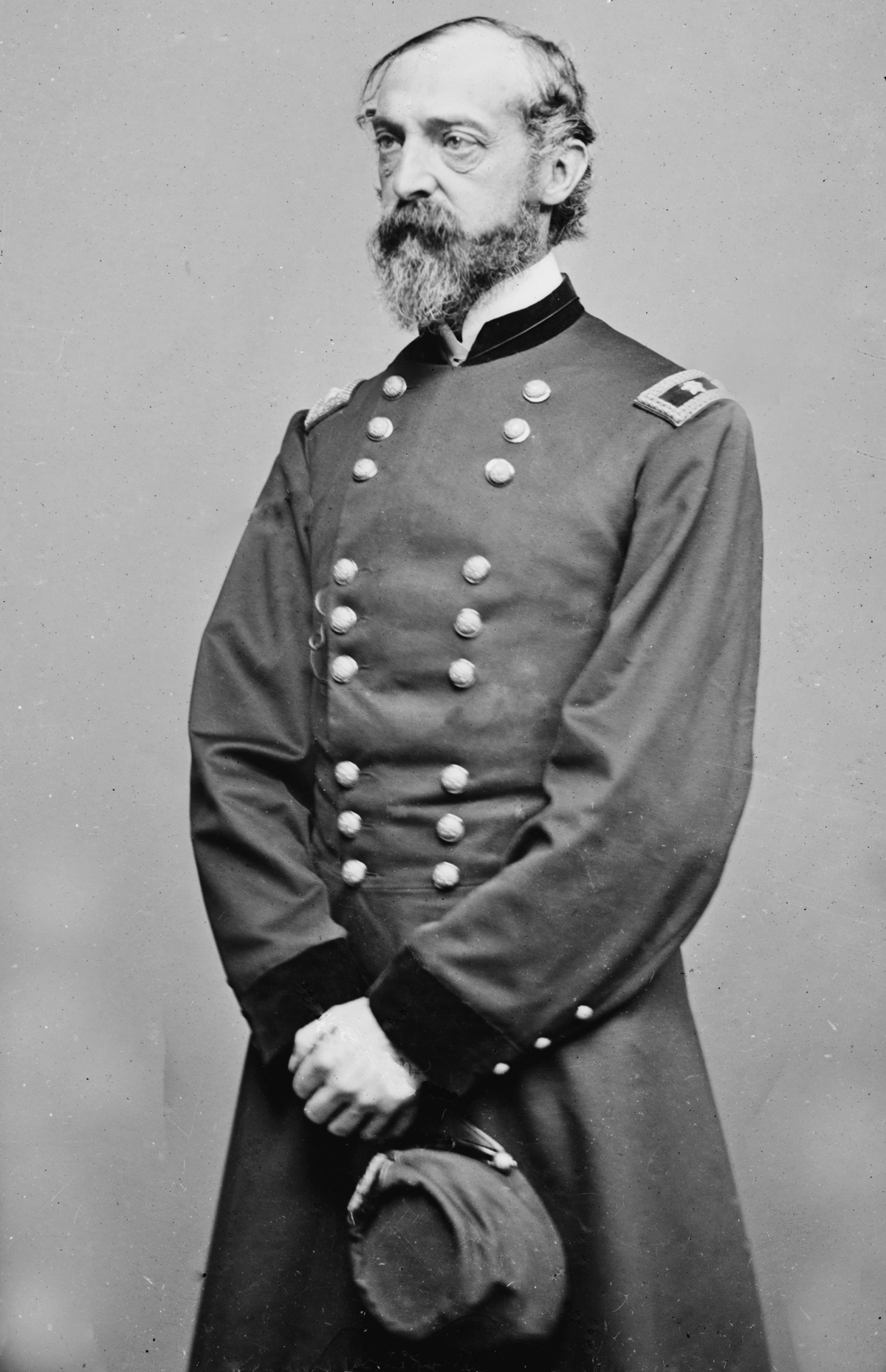
George Gordon Meade
On September 22, 1861, George Meade sat down to write his wife, Margaretta. "I hope you will not be very much put out at not receiving a letter earlier from me, but I have really been very much occupied..." Meade was head of the Second Brigade of McCall's Division, better known as the Pennsylvania Reserves. He wrote from his headquarters in Tenleytown, in or near the new Fort Pennsylvania that the men of the division had finished recently.

By 1865, Meade would be a household name, but in 1861 that an obscure army officer could have one of the most sought after positions in the Northern states - command of a brigade in George McClellan's assembling Army of the Potomac - was somewhat astounding. That it was not just any army officer, but the notoriously difficult George Meade was even more astounding.

Meade had graduated from West Point in 1836, three years before G.T. Beauregard and a decade before McClellan. He had ranked 19th out of 56, securing him one of the last slots for artillery in his graduating class and saving him the indignity of going into the infantry. Not that Meade particularly cared, since he had never wanted to attend West Point in the first place.

Friday, September 16, 2011

By Command of Lieutenant-General Scott

Wherein the old boy gets his second wind
........................................................................................................................

View from Ft. Marcy, completed in late September 1861 by W.F. "Baldy" Smith's brigade


On September 16, George McClellan got an order transmitted by Lt. Colonel Edward Townsend, chief of staff for the general-in-chief of the U.S. Army, Winfield Scott.
The commanding general of the Army of the Potomac will cause the position, state, and number of troops under him to be reported at once to general headquarters, by divisions, brigades, and independent regiments or detachments, which general report will be followed by reports of new troops as they arrive, with the dispositions made of them, together with all the material changes which may take place in said army.
"By command of Lieutenant-General Scott," Townsend helpfully signed it, opting for a more military valediction than his typical "your obedient servant". Winfield Scott was at last striking back.

Almost since McClellan had arrived in Washington (and certainly since Scott had poo-pooed his intelligence that an attack by over 100,000 Confederates was imminent), the junior general had attempted to circumvent the elderly general-in-chief. He had decided that Scott had become too senile or too stuck in his ways to take the bold actions needed to save the Union. And Scott was affecting a cadre of senior officers from the old Army. Only by breaking the stranglehold of the same military leaders that had let the South secede, take Federal property, and win at Bull Run and Wilson's Creek, could McClellan save the Union.

Sunday, July 3, 2011

Fighting With Old Zach in Mexico

This is the second part of a four-part series on the influence of the Mexican War on the American Civil War.  
Part 1. Part 2. Part 3. Part 4.


The Battle of Monterrey


First Lieutenant Joe Hooker, departed on a leave of absence from the U.S. 1st Artillery Regiment stationed in Pensacola, Florida on June 11, 1846. He was bound for the Texas-Mexico border and, he hoped, glory with the Army of Occupation under Major General Zachary Taylor.

President James K. Polk had originally been nominated for president by the Democrats because they couldn't agree on any of the front-runners in their party. He had won the presidency promising fiscal reforms, annexation of Texas and Alta California, and settlement of the dispute with Britain over Oregon Country in favor of the United States (the famous "Fifty-four Forty or Fight", in reference to the American claim to own the territory along the Pacific all the way up to the tip of Russian-owned Alaska). It was a balanced platform designed to appeal to Northerners and Southerners.

But while pushing his war with Mexico in 1845 and the first half of 1846, Polk had negotiated and signed a treaty that established the northern border of the United States at the 49th parallel, ceding nearly all of the disputed Oregon Territory to Britain. The Southern Democrat dominated Senate quickly ratified it around the same time Hooker left for Texas, to the outrage of Northern Whigs and Democrats in the Northwest (today known as the Mid-west). They rightly assumed Polk had settled with the British to be better prepared for a war with Mexico.