Showing posts with label Stonewall. Show all posts

Tuesday, July 10, 2012

Who Is John Pope?

Wherein we search for something likable about the new commanding general
...........................................................................................................................................

George McClellan was beloved by his men and officers, even after he was dismissed in disgrace, and some modern writers have gone out of their way to lionize him. Joe Hooker, after losing Chancellorsville, went on to be a hero at Lookout Mountain, and has an equestrian statue right in front of the Massachusetts State House in Boston. Ambrose Burnside and Irvin McDowell both suffered major failures, but continued to serve afterwards and maintained the respect of their peers for awhile, and still have their apologists today. Even George Meade is finally experiencing a renaissance as people begin to recognize his significant role in winning the war under the shadow of Grant.

But the one man with no vocal defenders is John Pope. He first drifts into our scope in the last week of June 1862 and will be gone again by September 1862, the shortest time of any of the major subjects of this blog, but in that time he will do more than perhaps any man but Robert E. Lee to extend the life of the Confederacy and the war to sustain it for at least an additional year. Who was this man and how was he so universally disliked and somehow still remains a footnote of history?

***


GENERAL ORDERS No. 7
                                                                                                    Headquarters, Army of Virginia
                                                                                                    Washington, July 10, 1862


Tuesday, June 26, 2012

The Whole Matter Is With General Banks

In which rival strategic visions lead to the arrival of John Pope, good for no one
.....................................................................................................................................................

June 26 is best known as Robert E. Lee's first offensive with the Army of Northern Virginia, and the second day of the Seven Days, the spectacular offensive that reversed the war's strategic situation and began the legend of Lee. But for Maj. General Irvin McDowell, lately commanding the Department of the Rappahannock, it was another day when his dreams of rehabilitation and glorious military command were yanked from him.

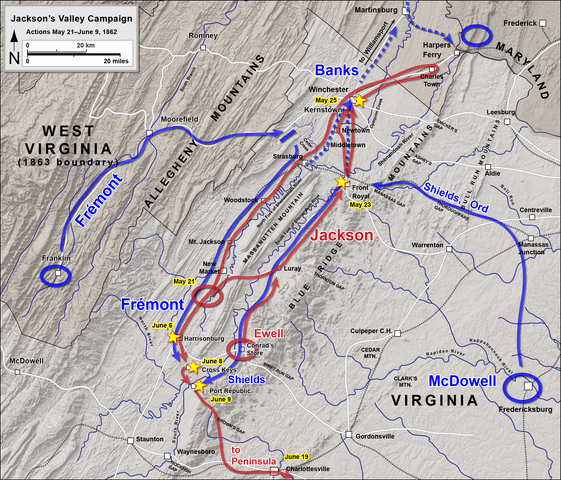
The Confederate Maj. General Thomas "Stonewall" Jackson and his second-in-command, Maj. General Dick Ewell, had over the month of May upended all the carefully restored order from the banks of the Potomac to the Allegheny Mountains with a campaign that had made fools of the Union commanders he faced (all that had saved their careers thus far was that the size of Jackson's army remained greatly exaggerated). McDowell, with authority over all of northern Virginia, but only west to the Blue Ridge Mountains, had initially resisted having men from his department dragged into the affair, then pledged to solve the problem the other generals couldn't, then when it appeared clear the situation had been defused again tried to extricate his command from it. Jackson's twin victories at Cross Keys and Port Republic only further cemented in McDowell's mind that his men should never have been involved.

Where McDowell's men belonged, in McDowell's mind was not Front Royal, not Manassas Junction, not even Fredericksburg, but outside Richmond with the rest of the Army of the Potomac, from which his command had been carved. That's where the war was being one, he believed, and that's where he had the chance to redeem his name from the shame of the battle at Bull Run, which was really the fault of his subordinate commanders' inability to execute his plan. The nonsense with Jackson stood between McDowell and getting to Richmond.

McDowell had sent two divisions to the Valley, his First Division under Maj. General James Shields, and his Second Division under the temporary command of Brig. General James Ricketts after its former commander was transferred out West to remove him from his feud with McDowell. It was half of Shields' division that had been defeated by Jackson at Port Republic, but nonetheless McDowell was urging their return to Falmouth the day after the battle. From his headquarters in Manassas Junction he practically begged the commander of the Department of the Shenandoah, Maj. General Nathaniel Banks, to resume responsibility for the Valley. In McDowell's mind he had bailed out Banks, so Banks owed it to him to quickly relieve his men.

Banks had other ideas, though. While McDowell thought the Jackson calamity had occurred because the borders of the departments had been drawn in a way that seemed to give him some responsibility for the Valley, Banks believed it had happened because McDowell had taken away almost all of his troops, leaving him with only two brigades to defend a vitally important area. Both were right, in a way. The real problem was without an overall commander with a broad view of the situation, the individual commanders had set conflicting plans of operation into motion. McDowell could not march to reinforce McClellan while Banks also had sufficient forces to protect against a Confederate army moving up the Valley to threaten Maryland. One of the safety of Washington, the reinforcement of McClellan, or the Confederate army had to be eliminated before the others could happen.

There was a third person involved in the affair, Maj. General John Fremont, commander of the Mountain Department. Fremont had also been ordered into the Valley to bail out Banks, and his and McDowell's forces were supposed to have worked together to cut off Jackson and destroy his army. But McDowell had let Jackson get by him and followed him to Cross Keys, where he had been defeated.

Sunday, June 10, 2012

Made to Pay

The exciting conclusion of Jackson's Valley Campaign minus Jackson or the Valley
........................................................................................................................................

In case you missed it, on Tuesday we looked at how Jackson's capture of Front Royal in mid-May postponed McDowell's planned march on Richmond. On Thursday, we saw the resulting race to Front Royal when Jackson continued marching north, in hopes of trapping him in the Lower Valley and eliminating his command.


On the evening of June 10, Colonel Edmund Schriver, chief of staff for the Department of the Rapphannock, and sitting in Front Royal as Maj. General Irvin McDowell's eyes and ears, ruefully forwarded a "sorry picture of Shields' division" in the form of a report from its head, Maj. General James Shields in Luray. That town, Schriver told his boss, was "filled with so-called sick officers and men, who, it is said, will never be of use again."
In any calculations you may take as to numbers do not rely on more than half what the returns call for. I do not think any of our army will be fit to take the field unless King's division, in less than a fortnight. Horses are used up as well as the men. The want of discipline and ignorance of the plainest duties are distressing. There is nothing but confusion and disorder.
Just two weeks earlier James Shields had told Schriver, "I will clear the valley of the Shenandoah of the enemy as far as I advance." Now it seemed like his men would never march again. In between they had met Maj. General Thomas "Stonewall" Jackson, who in the second part of his stunning Valley Campaign, had incapacitated two more Union forces and saved Richmond for the Confederacy.

As in our two previous posts, however, our story doesn't lie in the Valley, but east of the Blue Ridge in the Piedmont where McDowell's army in the Department of the Rapphannock had put its plans to march on Richmond on hold, to make an all-out rush for the Shenandoah Valley and Jackson. On May 31, it looked like they were well on their way to accomplishing their goal of trapping his army between Union reinforcements based around Harper's Ferry and a combined army of McDowell's men and men from the Mountain Department at Front Royal and Strasburg.

Shields, McDowell's star division commander, had two of his brigades already at Front Royal and two more that would arrive before the night was out. To the west on the Manassas Gap Railroad, another division under Maj. General Edward O.C. Ord had advanced to about Thoroughfare Gap, but damage to the railroad by Confederate cavalry near Front Royal and a train wreck near McDowell's headquarters at Rectortown was slowing them down. Further south, the division of Rufus King was at Catlett's Station, and could make use of the O&A Railroad to get to Manassas Junction and switch to the Manassas Gap line. The problem for McDowell was feeding so many men and horses.

"Fremont has not yet reached Strasburg, and I fear he will not reach it in time." Shields had told McDowell and McDowell had relayed to Secretary of War Edwin Stanton, "Ord's division should be pushed forward, but with supplies, or it will starve here without them."

Fremont was supposed to have marched from the west side of the Allegheny Mountains to Harrisonburg, but had decided instead to cross further north directly at Strasburg. Throughout the race of Shields to get to the Valley, the Lincoln Administration had taken for granted that Fremont's men would get their first--for one, they had much less ground to cover--but instead Shields sat in Front Royal and Strasburg sat empty. McDowell was pleased in his morning telegram to Staunton to note that his men had arrived on hour before Lincoln's proscribed time.

Thursday, June 7, 2012

Nothing But A Panic

Wherein the race to cut off Jackson is on
................................................................................................................................................

In case you missed it, check out Tuesday's post on the beginning of Jackson's Valley Campaign, as viewed from the Piedmont. In short: McClellan counted on the forts surrounding Washington to defend the city, but the Lincoln Administration wasn't so sure, so it kept McDowell behind. After months of waiting, McDowell was ready to go to Richmond, but on the day he was supposed to kick off, Jackson surprised and captured Front Royal. McDowell's orders to march were cancelled by the President himself.

"This is a crushing blow to us," Maj. General Irvin McDowell telegraphed Edwin Stanton on the evening of May 24 from his headquarters at Falmouth.

On orders from the Secretary of War, the commander of the Department of the Rapphannock was preparing to depart to meet Secretary of the Treasury Salmon P. Chase at Aquia Creek Landing at midnight for full oral orders from the President. Chase had been sent for two reasons: first, Stanton was preoccupied with theater-strategic concerns because Jackson's offensive threatened three different too-narrowly-drawn departments; and second, as a fellow Ohioan Chase had been McDowell's patron in the capital in the spring of 1861 and helped get him his star(s) in the first place. Since McClellan looked like he would be at the gates of Richmond within the week, Chase might help soothe McDowell's agony at being excluded from the grand campaign to conclude the war.

Lincoln was certainly bending over backwards to ease McDowell's disappointment. At 8:00 pm, two hours after McDowell's crushing blow telegram had been received, the President himself, not the Secretary of War, telegraphed a reply.
I am highly gratified by your alacrity in obeying my order. The change was as painful to me as it can possibly be to you or to any one. Everything now depends upon the celerity and vigor of your movement.
Confederate Maj. General Thomas "Stonewall" Jackson was loose somewhere north of Front Royal with between 7,000 and 10,000 men from his division and that of Maj. General Dick Ewell, and the main Union defender, Maj. General Nathaniel P. Banks, was at least as far north as Winchester, with the remains of only two brigades amounting to, at most, 4,000 men. McDowell was supposed to send two divisions of his department (about 20,000 out of over 40,000 men) to Front Royal as fast as possible, while Maj. General John C. Fremont of the Mountain Department sent as many of his as he could spare to Staunton.

At 9:30 pm, Lincoln received another bitter, but this time more loquacious, reply from McDowell.
I obeyed your order immediately, for it was positive and urgent, and perhaps as a subordinate there I ought to stop; but I trust I may be allowed to say something in relation to the subject, especially in view of your remark that everything now depends upon the celerity and vigor of my movements. I beg to say that cooperation between General Fremont and myself to cut Jackson and Ewell there is not to be counted upon, even if it is not a practical impossibility.
McDowell had tried to explain his objections to Stanton earlier in the day and now he tried again with Lincoln. "I am entirely beyond helping distance of General Banks," he protested, "no celerity or vigor will avail so far as he is concerned."
Next, that by a glance at the map it will be seen that the line of retreat of the enemy's forces up the valley is shorter than mine to go against him. It will take a week or ten days for the force to get to the valley by the route which will give it food and forage, and by that time the enemy will have retired. I shall gain nothing for you there, and shall lose much for you here.

"It is therefore not only on personal grounds that I have a heavy heart in the matter," McDowell unburdened himself, "but that I feel it throws us all back, and from Richmond north we shall have all our large masses paralyzed, and shall have to repeat what we have just accomplished."

He would send Maj. General James Shields with his division, ironically just from the Valley after a laborious march, in the morning and follow with another division in the afternoon. But first he promised to see Chase and "express myself more fully to him."

Tuesday, June 5, 2012

A Crushing Blow

Wherein Jackson's Piedmont Campaign kicks off
..................................................................................................................................................

This Saturday marks the 150th Anniversary of the stunning conclusion of Jackson's Valley Campaign, an epic feat of operational warfare genius that can only be rivaled in American history by Patton's Winter '44-'45 campaigns and Washington's New Jersey campaign (with the caveat that tactically, Jackson was by far the inferior of either). Last month, we took time to examine why there was a Valley Campaign, noting the failures of Union intelligence gathering and analysis and the failures of Union planning and organization that allowed Jackson to perfectly exploit his foes.

While less exciting, Jackson's campaign was paradigm-changing for concepts of security around Washington, DC. Over the course of three weeks in early summer the plan for defending the nation's capital shifted from one based on stationary fortification to one based on a campaigning army, and in doing so sealed the fate of George McClellan. In that sense, Jackson also achieved the primary objective of warfare in the mind of a 4th Century BC Chinese strategist he had never heard of: disrupt your enemy's strategy.

While it is most exciting to study the operational masterpiece from the viewpoint of the man who commanded both sides and the men who marched themselves ragged, to appreciate the deep strategic significance it is best to look at the story from the perspective of those in the Piedmont of Virginia, specifically one sitting on the banks of the Rappahannock River. There, in Falmouth, was the headquarters of the Department of the Rapphannock, commanded by Maj. General Irvin McDowell, rehabilitated loser of Bull Run.

The Lincoln Administration had quietly--almost apologetically--stood by McDowell the turmoil of the post-disaster outrage, and, in the Spring, rewarded him with promotion to major general of volunteers, making him one of the most senior generals in the Army. They believed McDowell had been a victim of circumstances, irrational public zeal, and poor subordinates, and retained Winfield Scott's initial high confidence of his abilities--a great deal more confidence, in fact, than they had in Maj. General George McClellan, who was leading the marquee army for Union, the Army of the Potomac, in a march on Richmond up the Virginia Peninsula from Fort Monroe.

McDowell should have been leading the First Corps of the Army of the Potomac under McClellan's supervision, but, at the last minute, the Lincoln Administration had withheld him until the defense of the capital was settled. McClellan's scheme for defense relied on an impenetrable system of forts that he had constructed over the winter that had turned the District of Columbia into the most fortified city on earth. A small mobile corps was to operate in the area, making sure that any enemy couldn't get too comfortable in Northern Virginia again, but it was the futility of attacking the string of fortifications that McClellan counted on to convince strategists in Richmond that their men were better used in different theaters.

But McClellan had violated his own strategy in the opinion of the Administration, particularly Secretary of War Edwin Stanton. An analysis conducted by two veteran generals at Stanton's request found that McClellan had shortchanged the defenses and the mobile corps in manpower and so McDowell's corps had been retained until the problem could be corrected. To better maintain control over the capital's defense, Stanton had created new Departments over which McClellan had no authority for McDowell and other commanders in the Shenandoah, the western Virginia mountains, the District, and Maryland.

Friday, May 18, 2012

Why Was There A Valley Campaign?

In which we look at Northern organization and strategy
..................................................................................................................................................

This is the second in a two part post on Northern mistakes in the first month of May.

Last week we looked at how mistakes in intelligence gathering and analysis led leaders of the Northern war effort to coalesce behind a likely enemy course of action that ended up being drastically different from the one actually pursued by their Southern opponents. But history is full of poor intelligence gathering and analysis that nevertheless ends in victory. So this week, we'll look at the mistakes those same leaders made in their own planning--mistakes that allowed Stonewall Jackson to execute his brilliant Valley Campaign.

Central to our discussion is what are known in modern military doctrine as the "levels of war." The concept goes back to ancient times, when it was recognized that some leaders needed to tell individuals where to stand and who to fight, while others needed to decide where the battle should occur. The "general" officer was created precisely to make those sorts of general decisions. By the time of the American Civil War, it was already long understood that even among general officers there were further levels of responsibility, with some moving groups of men in the field, and some deciding where to move armies several months hence. Today, we recognize roughly four levels of war: national-strategic, theater-strategic, operational, and tactical.

Prior to the American Civil War, there had never been a clear delineation of responsibility for military strategy in the United States--who to put where and when, in order to win a war. At the highest level, which we would call today "National-Strategic" and some 1862 contemporaries would have called "Grand Strategy", control depended on the personality of the Secretary of War. More aggressive secretaries would locate and direct men and materiel themselves, while secretaries selected more for their politics than their smarts would defer to the senior general in the U.S. Army, which, after 1841, meant Winfield Scott. But there was no clearly expressed distinction between the responsibilities of the general-in-chief and the Secretary.

Friday, May 11, 2012

Why Was There A Valley Campaign?

Wherein we examine failures of intelligence
.............................................................................................................................................

The first of two posts on mistakes by the North the first week of May 1862.

May 8, 1862, was the date of the Battle of McDowell, the beginning of Stonewall Jackson's legendary Valley Campaign. Much has justly been written about Jackson's operational-level brilliance and an equal amount has unjustly been written about his rather mundane tactics. Only in recent years, have reevaluations of the campaign been conducted, most notably in Peter Cozzens fantastic Shenandoah 1862 which acknowledges the immense personal cost to the soldiers of Jackson's army and, in the words of the friend who gifted the book to me, "bothers to examine the Yankee sources."

The Valley, though technically in the Potomac watershed, has simply been beyond the capacity of your blogger to post on, which means the area that drains directly into the Shenandoah has usually been beyond the scope of this blog. But Jackson's campaign deeply threatened the area we usually cover, and ended up being the strategic center of gravity for the entire Virginia theater. Without Jackson's operation, Joe Johnston, hundreds of miles away on the Virginia Peninsula, would have been unable to fend of McClellan's army, and Richmond would have been scrambling to find defenders in fall 1862 instead of Washington.

Edwin Stanton
It was largely planning mistakes made in Washington at the strategic level from May 8 to May 17 that allowed Jackson to conduct his famous campaign. This post focuses on the first part of those mistakes, the failure in intelligence collection and analysis.

With the demotion of McClellan in March, Secretary of War Edwin Stanton became the Administration's principle war planner. Unlike his predecessor, Simon Cameron, Stanton believed the Secretary should be active in decisions about the prosecution of the war, rather than only concerned with supplying and administering the armies. Stanton signaled this when he added Peter H. Watson as a second Assistant Secretary of War as a condition of joining the Administration himself. Watson was appointed to straighten out and manage the contracts the Department made to supply the army, which was usually a tightly held responsibility of the Secretary in order to bestow political favors.

Sunday, May 6, 2012

Before It's Too Late

Wherein the end of the war is imminent
.........................................................................................................................................

On May 6, 1862 nowhere was the imminent Union victory in the Civil War more apparent than in Northern Virginia, and no one in Northern Virginia was working harder to put the final nail in the Confederacy than the man who had botched up the whole thing ten months earlier. Maj. General Irvin McDowell, commander of the Department of the Rappahannock was working night and day to repair both the historic Potomac Path [U.S. 1] and the Fredericksburg and Richmond Railroad to allow a full advance towards Richmond.

McDowell can be forgiven for being swept up into the prevailing opinion that the end of the war was months away. In the West, several armies had been united under the command of Maj. General Henry Halleck in what we would call an "Army Group" today, with the purpose of capturing Confederate strongholds on the Mississippi and, by controlling the continent's great river, slicing the Southern nation in half and crushing their internal economy. Halleck's armies were drawing tight around Corinth, the key to defending Memphis, and General P.G.T. Beauregard, in command by accident after the death of the preferred Albert Sidney Johnston, appeared out-manned, out-gunned, and out-generaled.

At the other end of the Mississippi, Tennessee native and loyal Unionist Commodore David Farragut had completed a daring operation in cooperation with Maj. General Benjamin Butler and captured New Orleans, providing an ideal harbor for the Gulf Blockade Squadron as well as closing the best blockade-running port for cotton transited south from the cotton-growing Confederate heartland. With major Northern armies present in Pensacola, Port Royal, and Roanoke, too, the South was being dissected.

And in Virginia, McClellan was finally on the move. By May 6, word had arrived that the siege at Yorktown on the Virginia Peninsula was over, and McClellan was on the heels of Joe Johnston's army as it bolted back towards Richmond. Lincoln and his Secretaries of War, Navy, and the Treasury had taken the revenue cutter Miami the evening of May 5 to Fort Monroe to view the collapse of the major army defending Richmond personally. While they did so, Johnston had made a stand at Williamsburg, where after a brutal day of fighting for Joe Hooker's division, the Army of the Potomac had triumphed [Johnston's army had belatedly and at last assumed its famous name, the Army of Northern Virginia].

Friday, March 2, 2012

Two Weeks That Changed the War

Wherein operations along the Potomac begin McClellan's downfall
...............................................................................................................................

At the beginning of this week we looked at the first of two weeks that changed the American Civil War. The fall of Ft. Donelson on the Cumberland River to the obscure Brig. General Ulysses S. Grant had become a challenge to the general-in-chief of the Northern armies, Maj. General George B. McClellan. As Brig. General George Meade, commanding a brigade in McCall's Division (the Pennsylvania Reserves) put it on February 23 in a letter to his wife: "I fear the victories in the Southwest are going to be injurious to McClellan, by enabling his enemies to say, 'Why cannot you do in Virginia what has been done in Tennessee?'"

In the week that followed he had no choice but to begin an offensive motion with his Army of the Potomac, despite his long-laid plans to move it to the Rappahannock River and march on Richmond. The results of that decision changed the war.

February 24, Monday

Don Carlos Buell
The soldiers of Brig. General Don Carlos Buell reached the northern banks of the Cumberland River and looked across into an abandoned Nashville. McClellan's protege would occupy the city, despite the efforts of his (nominal) immediate superior Maj. General Henry Halleck to get Grant there first. Telegraphing his headquarters in St. Louis from Washington, McClellan told Halleck to "cooperate with [Buell] to the full extent of your power, to secure Nashville beyond a doubt." He said he would order Buell to next seize the nearby railroad junction and then "the next move should be either a direct march in force upon the rear of Memphis or else first upon the communications and rear of Columbus."

He may have gotten Columbia's name wrong, but McClellan's orders set in motion the movement of armies that led to Shiloh, what would be the bloodiest single day in American history until McClellan himself surpassed it at Antietam, and the bloodiest multi-day battle in American history until Gettysburg. The ferociousness of the battle would play a significant role in undermining McClellan's plans for what would become the Peninsula Campaign.

Monday, February 27, 2012

Two Weeks That Changed the War

Wherein the reverberations of the capture of Ft. Donelson spur action
..........................................................................................................................................

After months of low-level activity between the two Armies of the Potomac that had resided in the Washington area since summer 1861, the last two weeks of February saw the beginning of a flurry of activity. Rapid-fire decisions led logically to other rapid-fire decisions that set the course of the war for long after both armies left the theater. This is a day-by-day look at those two weeks of decisions made in the Washington area that led to the beginning of the Civil War as we know it.

February 17, Monday

On the day Joe Hooker sat frustrated, waiting for general-in-chief George McClellan to provide the transports needed to make an attack from Liverpool Point in Charles County, Maryland, across the Potomac River to Evansport [Quantico], Washington City was electrified by the details of the surrender of Fort Donelson, on the Cumberland River. The fort had fallen the day before when its Confederate commander (and former U.S. Secretary of War) John Floyd and his second-in-command, Gideon Pillow, had fled on February 16, leaving a disgusted Simon Bolivar Buckner to surrender it that evening to the unknown Brig. General Ulysses S. Grant.

Grant could not say he was unknown on February 17, and all of Washington was titillated to learn that when Buckner had sent asking for terms of surrender, Grant had written back "unconditional and immediate surrender." For those in Washington already angry at Buckner's good pre-war friend McClellan for moving slowly, the contrast couldn't be starker. Grant's control of the fort made Nashville indefensible, McClellan's inaction kept the Confederates in Centreville. Lincoln sent Grant's nomination to major general of volunteers to the Senate that night.

Thursday, January 26, 2012

The Other Feud

Wherein we follow the little remembered Southern command crisis
..................................................................................................................................

Joe Johnston wrote with a barely contained rage:
Sir: A colonel of a Mississippi regiment has just informed me that you had referred him to me for information in relation to the recent act of Congress granting bounties and furloughs to non-commissioned officers and privates of the Provisional Army. I have received no order from the War Department directly on this subject.
If the first winter of the war for the North was headlined by the struggle between McClellan and the Lincoln Administration, it was equally true that the winter for the South revolved around a similar power battle between Johnston and the Davis Administration. But the latter fight is remembered only as a side-note by even the more diligent historians while the former is the centerpiece of even the most casual histories of the war.

There are many reasons this may be. For one, Johnston was a far less colorful character, who bequeathed history no inflammatory personal letters. But the story also lacks a hero. Johnston was not a great general in his campaigning and won no great victories that he could claim sole credit for (forever having to share Manassas with Beauregard), while the gross mismanagement of the Davis Administration hardly provides a sympathetic character to the reader. And the later success of Lee commanding the same army helps write a simple narrative for the war: South is dominant up until Gettysburg, when either the little guy North wins through pluck and determination or the resource-rich North crushes the valiant South tragically, but inevitably (depending on your persuasion). Johnston, and his feud with Davis and his surrogates, sullies that narrative by forcing us to recognize two equally inept factions, struggling to create a physical embodiment of their ideological passions and impose it on the continent.

When General Joseph E. Johnston started writing Secretary of War Judah P. Benjamin on January 18, the specific issue was bounties and furloughs, an ill advised solution to a manpower problem. In the early days of 1861, when it was still a secession crisis and not yet a war, the Provisional Confederate Congress had to solve the problem of how to protect their would-be nation from the U.S. Army. After all, it had been Maj. General Winfield Scott that had mobilized U.S. soldiers in South Carolina to help put an end to the Nullification Crisis a quarter of a century earlier, and it was Winfield Scott who was advising Lincoln on how to deal with the Secession Crisis in 1861.

Wednesday, November 9, 2011

Gradually Carried Into Effect

Wherein we take stock of the belligerents at an early turning point
.....................................................................................................................................

November 1861 saw the realization of plans for change in both Northern and Southern armies that had been percolating since July, changes that when completed over the winter would shape the next two years of warfare. The most immediately obvious was the removal of Bvt. Lt. General Winfield Scott in favor of Maj. General George McClellan as general-in-chief of the U.S. Army and thus the Northern war effort, but changes in the South had equal impact.

McClellan had already put an indelible touch on the North's Army of the Potomac through his careful shepherding of young officers of his own military and social persuasions through the process of nomination to and confirmation of the grade of brigadier general of U.S. Volunteers. These were men that believed in a professional, European-style army, were socially and politically conservative, and for the most part had not been senior officers in the pre-war Army (and therefore had not been hand-picked already by Winfield Scott).

Among the division commanders, the senior leadership of McClellan's new army after his own staff, five of the 11 commanders named by November 9 could safely be called McClellan's men: William Franklin, Fitz John Porter, Charles P. Stone, Don Carlos Buell, and "Baldy" Smith. Only Irvin McDowell was truly Scott's man, though Sam Heintzelman was also from the Old Army leadership promoted by Scott. Nathaniel Banks, Louis Blenker, George McCall, and Joe Hooker were the President's political picks.

Among the 32 brigades commanded by those generals collectively, 15 were led by men who can safely be called McClellanites, with a few more sympathizers additionally. Strategically, McClellan tended to group the brigades of his people together under a divisional commanders that were also his people. McClellan's appears to have already been thinking of divisions as "trustworthy" and "suspected", a separation that would grow in his mind until it became a major problem in the spring.

Much is made about the impact of political generals on the Army of the Potomac, but that may be a function of how many McClellanites served in the army that were around to complain about them for years after the war. Of the three subsequent commanders of the army, two would be fully disciples of McClellan and two would also be ousted by coups engineered by senior leadership cabals consisting of McClellan disciples. Long after he ceased commanding the army, the men that McClellan had put into command positions by Fall 1861 would direct the course of battles and campaigns.

Thursday, October 27, 2011

The Key to Decipher History

Wherein he blogs about that thing that didn't happen
...........................................................................................................................................

Just a short post today on the nature of writing history. McClellan spent October 27 reviewing troops from the division of Fitz John Porter at Fort Corcoran [Rosslyn]. Joe Hooker was leading his division down to Budd's Ferry, opposite Evansport [Quantico], to monitor the Confederates and see if action could be taken to shut down their battery there. Charles P. Stone was trying to get his division put back together after Ball's Bluff. And Winfield Scott was darkly waiting for the President's order into retirement, having heard the results of the previous week's cabinet meeting.

But in the Southern army headquarters at Centreville, the concern was entirely focused on areas outside the theater. First, the army's commander, General Joseph E. Johnston, was doing his best to ignore an order he had received on October 23 from Richmond assigning one of the new major generals he and his fellow general, G.T. Beauregard, had fought to obtain. Maj. General Thomas Jackson, called "Stonewall" because of his actions at Manassas, was supposed to command a division in Johnston's Second Corps. But the Confederate War Department had decided instead to send him to organize the defenses of the Shenandoah Valley in a new subordinate command to Johnston's, the District of the Valley.

Theoretically, Johnston agreed with the creation of a command specifically focused on delivering the Valley, the breadbasket of Virginia. He didn't know it, but Winfield Scott had created a semi-analogous Northern command, the District of Harper's Ferry and the Cumberland, which was to protect the critical railroad infrastructure that Confederates from the Valley could easily spill into and disrupt, cutting the capital from Ohio Its commander, Frederick Lander, had been wounded the day following Ball's Bluff and was in Washington recuperating before heading to his new command. On October 27, men from his department under Brig. General Benjamin Kelley (a former B&O executive and a key player in McClellan's early war western Virginia successes) took aggressive action and captured the mountain city of Romney, underscoring the need for a Confederate commander.

Johnston just didn't want to lose Jackson, who, along with J.E.B. Stuart, he had been working with since April and come to rely heavily on. The trick was dragging his feet enough that the War Department would ask him to name a different commander to the critical post. Richmond, for its part, was too occupied with a different threat altogether to bother Johnston about sending Jackson (or the daily lecture about reorganizing the army to brigading state regiments together). "Sir," acting Secretary of War Judah P. Benjamin wrote Johnston, "We have received from several quarters information that the enemy intend a movement in force up the Rappahannock and that he has about 25,000 men in the fleet now concentrated at Fort Monroe for that purpose."

Benjamin continued (with a typically peculiar and prickly addendum):
This may be a feint or the information although coming from friends may have been allowed to leak out with the view of deceiving us, yet it is of sufficient importance to be sent to you. I send a private note to Colonel [Thomas] Jordan the adjutant of General Beauregard by special messenger. The note incloses [sic] a communication in cipher sent to the President from some unknown quarter and the President has an impression that Colonel Jordan has a key which will decipher it. If so, the contents will no doubt be communicated to you by General Beauregard, if of any importance. We have so many apparently reliable yet contradictory statements about the destination of this great expedition that we are much at a loss to prepare defense against it.
History recognizes the expedition as the Port Royal Expedition and so usually leaves out the consternation it caused Joe Johnston when he thought his flank was about to be turned, and instead focuses on the planning, lead-up to, execution, and aftermath of the event as if it was one coherent whole. Union Brig. General Thomas W. Sherman and Commodore Samuel F. DuPont (of the Circle fame) were using Hampton Roads as a rendezvous for two separate forces before heading off to South Carolina together. But for those living it, the arc of the story would only be clear much later, and not fully until after the war. At the time it was a confusing event that led Benjamin to federalize the Virginia militia and accelerate the deployment of troops from as far as Georgia to Virginia, in order to protect Johnston's flank, as well ask ask Johnston to be prepared to shift large numbers of his men around.

On the next day, Benjamin wrote to Johnston, saying, "Just heard from Norfolk that the enemy's great fleet is going to sea, thus indicating that the threat of attack on the Rappahannock was intended to deceive us." Even then, though, for the people living the event, where was the flotilla headed to? Thomas Jordan wrote back to Jefferson Davis directly, coolly ignoring the question about the cipher key and instead confidently let him know that his informants in Washington City indicated the attack was to be on Cape Fear, North Carolina. He was wrong, but that wouldn't be clear for another week, until the expedition appeared at Port Royal. Cape Fear wouldn't be attacked until 1864.

But while the non-story of a Union flank attack via the Rappahannock is ignored by historians short on time and space, the subject Benjamin turned his mind to next shows up in almost every account, because the story it begins goes somewhere stunning:


Wednesday, October 12, 2011

On the Eve of Battle

Wherein George Meade prepares himself and his family for a Confederate attack
..........................................................................................................................................

October 12, 1861 was a fairly quiet day in the Confederate Army of the Potomac. The promotions to major general had come in for James Longstreet and T.J. Jackson (who was being called "Stonewall" in the popular press after the story about his defense of Henry Hill had spread over the summer), who were assigned to G.T. Beauregard's First Corps and G.W. Smith's Second Corps, respectively. It would be a few more days before they were given multiple brigades to make up their divisions. At least in Longstreet's case, it would only be two brigades, preserving hope that the plan of creating multiple divisions under major generals might continue despite provisional President Jefferson Davis' recent attempts to kill it once and for all (Jackson's subordinates are not recorded in the Official Records, if they were even made).

But in the Union Army of the Potomac, things were aflutter. "I am at this moment looking after the enemy," its commander, Maj. General George B. McClellan wrote to his wife, Mary Ellen. He splurged to send the message by telegram, because that morning he had received a telegram from her announcing she had given birth to the couples fifth (and, as it turned out, final) child, Mary. "I thank God you are safe," McClellan had told her, before his words about seeing to an enemy attack. Despite being sure he would be "in the saddle all day" he encouraged her to telegraph him throughout the day with updates of her status.

McClellan had been at the camp of Fitz John Porter, in what is now Rosslyn, when he received word that the enemy was advancing on the divisions of Brig. Generals W.F. "Baldy" Smith at Lewinsville, Virginia and George McCall at Langley, Virginia. General Joe Johnston, as we have seen, had no intention of an offensive operation, but since Manassas he and his subordinates had actively deceived McClellan about their true intentions. Beauregard especially enjoyed dabbling in these schemes and had a willing partner in his signals and ordnance chief Porter Alexander. In an undated plot implied by Beauregard's biographer to be in August and by Alexander to be in the early fall (perhaps after the Evansport battery opened) the two took advantage of new technology Alexander had wheedled out of Richmond to unhinge the whole Union command structure. As Alexander recalled:
I had my signal stations scattered about on the high places, & of course under orders to report promptly all unusual occurrences. One night, I remember, about bedtime receiving a report that one or two or possibly more rockets had been seen over the Federal lines. I took the report to Gen. Beauregard & he asked me if I had rockets. I said yes, every station was provided, on which he told me to have every station send up one & during the night to have one or two more demonstrations of them. It took very few minutes to send the orders everywhere, & we soon had rockets apparently answering each other for a long distance right & left, & couriers were sent to shoot others, later, at other points. The next papers from the North brought the story above referred to It was said McClellan complained to Lincoln that only he and Gen. Scott knew of his plans, & yet they were allowed to become known to some one who must have betrayed us.

Friday, October 7, 2011

After the Stampede

A boring day leading an army
..................................................................................................................................

With history of warfare, it's easy to write about the fighting, the things before the fighting that led to it, and the things after that resulted from it. But real-time life in warfare is full of insignificant events that appear monumental, and significant events that go unnoticed. Both occurred in the first week of October.

"I have not written you since the few lines the day we expected to have a fight," Brig. General George Meade wrote to his wife on October 6 from his new camp in present-day McLean, referring to his last letter dashed off at 3:00 pm on September 30. "The stampede lasted for thirty-six hours." In his characteristic fashion, the mild cynic related to her the rumor going through the Union Army of the Potomac that its commander, Maj. General George McClellan, had planned a trap that would be slammed shut by the Pennsylvania Reserves, the informal name for the division to which Meade's brigade of four regiments belonged. "There is no doubt [the Confederates] were appraised of it, though McClellan asserts he did not tell even the generals who were to share in it till the very moment of action, and he is now convinced it is impossible to do or attempt anything without their knowing it."
At the present all is quiet, the enemy having withdrawn to his old lines at Manassas [Meade was off, they had only retired to Fairfax Court-House]. His threatening Washington was a bravado, hoping to draw McClellan out. Failing in this, he has fallen back, thinking we would rush after him, and thus give them a chance to get us at a disadvantage. They are, as Woodbury said, great on strategy, but I guess they will find after awhile that our movements are not to be governed by theirs, and that McClellan is not going to move until he is ready, and then not in the direction they want him.

Monday, August 8, 2011

WAR!

Wherein the old and new Fuss and Feathers blast each other to pieces
.....................................................................................................................................

George B. McClellan
"How does he think that I can save this country when stopped by Genl Scott?" George McClellan fumed to his wife, Mary Ellen, in his nightly letter after a frustrating meeting with Secretary of State William Seward.

I do not know whether he [Scott] is a dotard or a traitor! I can't tell which. He cannot or will not comprehend the condition in which we are placed & is entirely unequal to the emergency. If he cannot be taken out of my path I will not retain my position, but will resign & let the admn take care of itself. I have hardly slept one moment for the last three nights, knowing well that the enemy intend some movement & fully recognizing our own weakness.
The trouble should hardly have been a surprise. Too alike in temperament, the aged Brevet Lieutenant General Winfield Scott and the ambitious Major General George McClellan had grown tired of each other in less than two weeks. Each was a man obsessed with professionalism, each believed himself a master of grand strategy, and each regarded everyone as a threat to his own special mission to save the Union.

Friday, July 29, 2011

Eppa Hunton Returns to Leesburg

In which we name check Prince William, Fauquier, and Loudon
........................................................................................................................................

Eppa Hunton II
"We made our march to Leesburg, the citizens all along the road greeting the victorious soldiers with tumultuous joy, and welcoming their safe return to the County of Loudoun," Eppa Hunton remembered about the days following Manassas. Hunton was colonel of the 8th Virginia Volunteer Infantry Regiment, which had guarded the two major Potomac River crossings near Leesburg (Edward's and Conrad's Ferries) while Charles P. Stone's Rockville Expedition was ongoing. When Irvin McDowell began his march on Washington and Stone went west to Harper's Ferry, the 8th Virginia and a South Carolina regiment that had reinforced them had scurried south to Manassas to bolster the Army of the Potomac, then under G.T. Beauregard.


At a crucial moment on Henry Hill, Hunton had thrown his regiment into the fray after deciding on it with another regiment's colonel and helped turn the tide decisively. But in the confusion it was unclear whether the result was going to be a Union retreat, or the forces were just repositioning themselves closer to Stone Bridge to try to flank. Hunton's eight company regiment would have been the only ones to defend such an attack and the colonel became very grim until it became clear the Northerners had broken and were running for Washington. Hunton wrote in his autobiography:
I had up to that time passed with my soldiers for an exceedingly pious man, but I lost my reputation as such, then and there. After I discovered that this force that I thought I would have to fight, had broken into pieces, I was extremely relieved and galloped back to my regiment, only a hundred yards off; and they said, and proved, that I proclaimed with a hearty oath that the Yankees were running like dogs. I was utterly unconscious of using an oath, but have no doubt I did. They proved it on me conclusively, and I never recovered my reputation for piety during the war.

Thursday, July 21, 2011

2:00 pm: The struggle continues on Henry Hill

Henry Hill

The West Point Battery was tearing up the Confederate line when the most infamous case of mistaken battlefield identity in the battle occurred. The 33rd Virginia, from Jackson’s brigade, emerged from the woods to their left and began marching towards the battery. One of Griffin’s guns pivoted to take aim, but McDowell’s chief of artillery ran to them and stopped them. They wore blue uniforms (the traditional Virginia militia color), he said, and they must be the extra infantry guard Griffin had been requesting.

The 33rd Virginia opened fire at point blank range on the battery. Griffin wrote: “In this charge of the enemy every cannoneer was cut down and a large number of horses killed, leaving the battery (which was without support except in name) perfectly helpless.” Nearby, the other advanced battery, led James Ricketts, was experiencing a similar catastrophe. Two companies of cavalry led by Colonel J.E.B. Stuart charged the 11th New York (the Fire Zouaves) and scattered them, then fell on the battery at the same time as the 33rd Virginia, repeating the massacre of Griffin’s guns. Ricketts was wounded three times and would be captured.

The fight for the hill turned into a well-dressed riot, with the multitude of uniforms swirling back and forth with little to no clear direction. The most intense fight was over the guns of Ricketts and Griffin, which neither side could quite hold and changed hands at least three times. McDowell, Beauregard, and countless other generals were swept up in it, unable to do more than command small handfuls of men.

Matthew’s Hill
Near the Warrenton Turnpike the 2nd New Hampshire took up their position.
While we were halting a moment, one of the men offered me some water from his canteen, which he had just filled at a pool nearby. Upon my declining it, he raised his canteen to his own lips, throwing his head back, when a cannonball nearly severed his head from his body. Such a sight at home would have made me sick and faint with horror; but now… my principal feeling was astonishment that a cannonball could make such a clean, knifelike cut, so quickly does one adjust one’s self to one’s environment.
At top of Matthew’s Hill, Fry and Barnard saw Griffin’s guns fall. Fry wrote: “As the battle seemd to me to be going against us, and not knowing where McDowell was, with the concurrence of Barnard... I immediately sent a note to [reserve commander] Miles, telling him to move two brigades of his reserve up to Stone Bridge…

Noon: 2nd Div (US) pursues Confederates, meets a Stone Wall

Matthew’s Hill
With the Confederates pushed back over the Warrenton Turnpike, and Heintzelman’s Third Division chasing them and two brigades of Tyler’s First Division joining them, it seemed unlikely that Hampton’s Legion could hold out long. McDowell had stationed himself on Matthew’s Hill, watching and directing the action with his chief of staff, James Fry. In short order, they were met by Colonel Cump Sherman from the First Division, asking where his brigade might be of most use (McDowell sent him against Hampton’s Legion), and Colonel Ambrose Burnside asking to pull his men out of the battle to rearm and rest, since (he smugly noted) they had done the bulk of the fighting in the victory (Fry said: “McDowell, in the excitement of the occasion, gave reluctant assent…”).

Burnside’s men backed away from the confusion, replaced by some of Porter’s brigade and some of Sherman’s brigade, and walked up Matthew’s Hill to behind the artillery pounding away at Henry Hill where they waited for more ammunition to be brought to them. Fiske, now in command of the 2nd New Hampshire with his colonel wounded, wrote:

A cheer came from away off to the right, and was taken up by us and rolled along to the extreme left. McDowell rode down our front announcing that we had won a glorious victory. One of our men near me said, pointing to some columns of dust over the trees to the south of us and moving toward us, “It seems to me, Colonel, that if we have whipped them, that dust ought to be moving the other way…”

McDowell ordered Heintzelman to aggressively position his Third Division along the Sudley Road south of the Warrenton Turnpike, which would be full of men from Porter’s brigade and Tyler’s division to form a massive L that would push the Confederate army in on itself until it collapsed.

Henry Hill
Johnston and Beauregard arrived to a scene of chaos on Henry Hill. The brigades of Bee, Bartow, and Evans were no more than an armed mob, their commanding officers abandoning all pretenses to structure and gathering knots of men to lead on charges. Hampton’s legion was now surrounded on three sides and as they watched began to crumble. At some point over the next hour Bartow would be dead, but the situation was too chaotic to identify when.

It was a desperate situation and a dramatic legend was born of it. As with all legends, there are multiple versions and few verifiable facts. At some point in the mayhem, Barnard Bee compared the unmoving line of Colonel Thomas Jackson to a stone wall. In some accounts, when all seems lost he cries out “Look boys, there stands Jackson like a stone wall. Rally around the Virginians!” In others, he is cursing the general who rather than come to the aid of his men is “standing there like a bloody stone wall.” And it’s also possible that Bee never said anything at all about stone walls. In the following hour he would be shot through the abdomen and over 24 hours slowly and painfully bleed to death in a Confederate hospital before the story would begin to be told.

But what Beauregard and Johnston saw was enough to make the legend credible. The colonel in the dingy blue VMI uniform had his men standing stock still while the wave of Northerners rushed towards them, holding their fire until they couldn’t miss and stunning the advancing army. Beauregard quickly had the remainder of Hampton’s Legion fall in beside Jackson’s brigade and then he and Johnston rode their horses around fleeing men, pushing them back into a battle line on the far end of Henry Hill.

Key People and Sources

Wednesday, July 20, 2011

Attacking the Left

Wherein two generals make plans to swap places
................................................................................................................................................

While Brigadier General Irvin McDowell, commanding the Army of Northeastern Virginia on behalf of the Federal government and the Unionist states, professionally prepared his study of bypassing the Confederate defensive position on Bull Run, the Confederate position was being reinforced. Brigadier General Thomas J. Jackson had started the reinforcements after dark on the night of the 19th, bringing just under 2,500 men to add to the total. Throughout the night parts of two more brigades arrived by train at Manassas Junction, and at noon, the commander of the Army of the Shenandoah himself, Brigadier General Joseph E. Johnston.

Joseph Eggleston Johnston
Porter Alexander, Chief Engineer for the Confederate Army of the Potomac defending Manassas Junction, remembered his first look at Johnston years later:
I think [he] was more the soldier in looks, carriage, and manner than any of our other generals... His pictures, which are common, give an excellent idea of his strong and intellectual face. He was of a medium stature but of most extraordinary strength, vigor, and quickness.
Like many of his peers, Johnston was a decorated hero of the Mexican War, leading his men over the wall at Chapultepec (without their guide, Joe Hooker), getting wounded time and again in battle (Winfield Scott had once quipped, "Johnston is a great soldier, but he had an unfortunate knack of getting himself shot in nearly every engagement."). He had also been the first West Point graduate to attain the rank of general in the U.S. Army, being appointed Brigadier General as Quartermaster of the U.S. Army, but held the rank only a short time before resigning to follow Virginia to the Confederacy. He was the highest ranking officer to do so.