Showing posts with label E.D. Baker. Show all posts

Tuesday, January 31, 2012

Evidence Said to Impeach

In which Charles P. Stone testifies a second time
.........................................................................................................................

McClellan's winter offensive came sputtering to a halt on the last day of January. Since the end of his illness, he had worked politically to regain complete control of the U.S. war effort, and he thought he had achieved it. But on January 27, President Lincoln had issued General Order No. 1 ordering all Federal armies to begin advancing by February 22. Throughout the week he rapidly put together a plan and pitched it to the President, but on January 31, McClellan received the President's rejection--by reading a copy of Special Order No. 1, directed to the commander of the Army of the Potomac (McClellan, concurrently with his responsibilities as general-in-chief), as shown to him by a member of the press.
Ordered, That all the disposable force of the Army of the Potomac, after providing safely for the defense of Washington, be formed into an expedition for the immediate object of seizing and occupying a point upon the railroad southwestward of what is known as Manassas Junction; all details to be in the discretion of the General in Chief, and the expedition to move before or on the 22d day of February next.
One thing McClellan didn't take into account was the fracturing of Lincoln's political base over the winter, best epitomized by the rise of the Joint Committee on the Conduct of the War. The Radical Republican-dominated Committee had spent most of January interviewing McClellan's division commanders about the possibility of forward advance. They had concluded it was, and they had conveyed that assurance to Lincoln's new Secretary of War, Edwin Stanton. McClellan wasn't aware of it yet, but despite Stanton's reliable Democratic politics his views on the war were actually closely aligned with the Committee's. While McClellan had spent a great deal of time consulting with Stanton before his appointment to Secretary of War, it was almost certainly Stanton who suggested Lincoln's two orders.


Stanton's regular meetings with members of the Committee had yielded another decision in their favor that struck a blow at McClellan's control of the Army of the Potomac. On January 28, almost certainly on the advice of members of the Committee who had met with him the previous day, Stanton issued an order to arrest Brig. General Charles P. Stone.


McClellan was aghast. Not only was Stone one of his handpicked division commanders (even though he had also been a protege of Winfield Scott, a rarity), but the attacks in the Republican press and in both chambers of Congress had taken on a decidedly partisan tone towards Stone's conservative politics, which happened to be McClellan's as well. Eager to avoid carrying out the order, McClellan convinced both Stanton and the members of the Committee that Stone's first, confrontational testimony before the Committee had been incomplete, and to allow him another chance.

Thursday, January 5, 2012

A Disloyal Man

Wherein the Joint Committee checks every Stone
.................................................................................................................................................

Fort Corcoran [Rosslyn] (Harper's Weekly)
January 5, 1862 was a Sunday, and in the town of Hancock, Maryland, a small force of Union troops under Brig. General Frederick Lander was receiving an ultimatum from Stonewall Jackson. Lander's men had been chased out of Bath the day before [today, in West Virginia, and primarily known by its unofficial name, Berkeley Springs]. Lander arrived during the day on January 5 and was told by Jackson that the town would be shelled if the Northerners didn't abandon it. With characteristic bravado, Lander told his envoy (Colonel Turner Ashby) to "bombard and be damned!... He will injure more of his friends than he will of the enemy, for this is a damned secesh place anyhow!" Lander then scribbled a more professional note for Ashby, and sent a message back to Washington for reinforcements. But the environment it would find in Washington was one that pointedly illustrates the differences between 1861 and 1862.

Lander was in charge of the Department of Harper's Ferry and Cumberland, located on the Maryland side of the Potomac River, between, not surprisingly, Cumberland and Harper's Ferry, but including a 30 mile patch of land on the southern side of the river (which, modified based on later military organizations, became the basis for that strange nub in the West Virginia panhandle, established in 1863). This little department had been established by Winfield Scott months earlier, because Lander pledged to be more aggressive than the Army of the Potomac's George McClellan and reopen the B&O Railroad to freight traffic, but he had been delayed in reaching his command. In the meantime, McClellan had succeeded Scott as general-in-chief of the U.S. Army and Lander's department had been added to the Army of the Potomac as a division (despite McClellan not countermanding the order that it was an independent command).

So Lander sent his request down the line to the next division commander, Maj. General Nathaniel P. Banks, in Frederick, Maryland. Banks, who heartily shared Lander's belief that an immediate offensive was needed to gain Winchester and control of the lower Shenandoah Valley as well as reopen the B&O, would have sent the request on down the line. Next in line was the division of Brig. General Charles P. Stone, headquartered in Poolesville (though the request probably would have taken the direct route from Frederick, through Gaithersburg and Rockville). Next were the divisions of Brig. Generals George McCall (the Pennsylvania Reserves) and W.F. "Baldy" Smith, placed on the Virginia side of the Potomac (in Langley and Lewinsville, respectively), completing the right-wing of the Army of the Potomac.

Sunday, December 18, 2011

A Brave and Impetuous Soldier

Wherein we begin the tribulations of Charles P. Stone
................................................................................................................

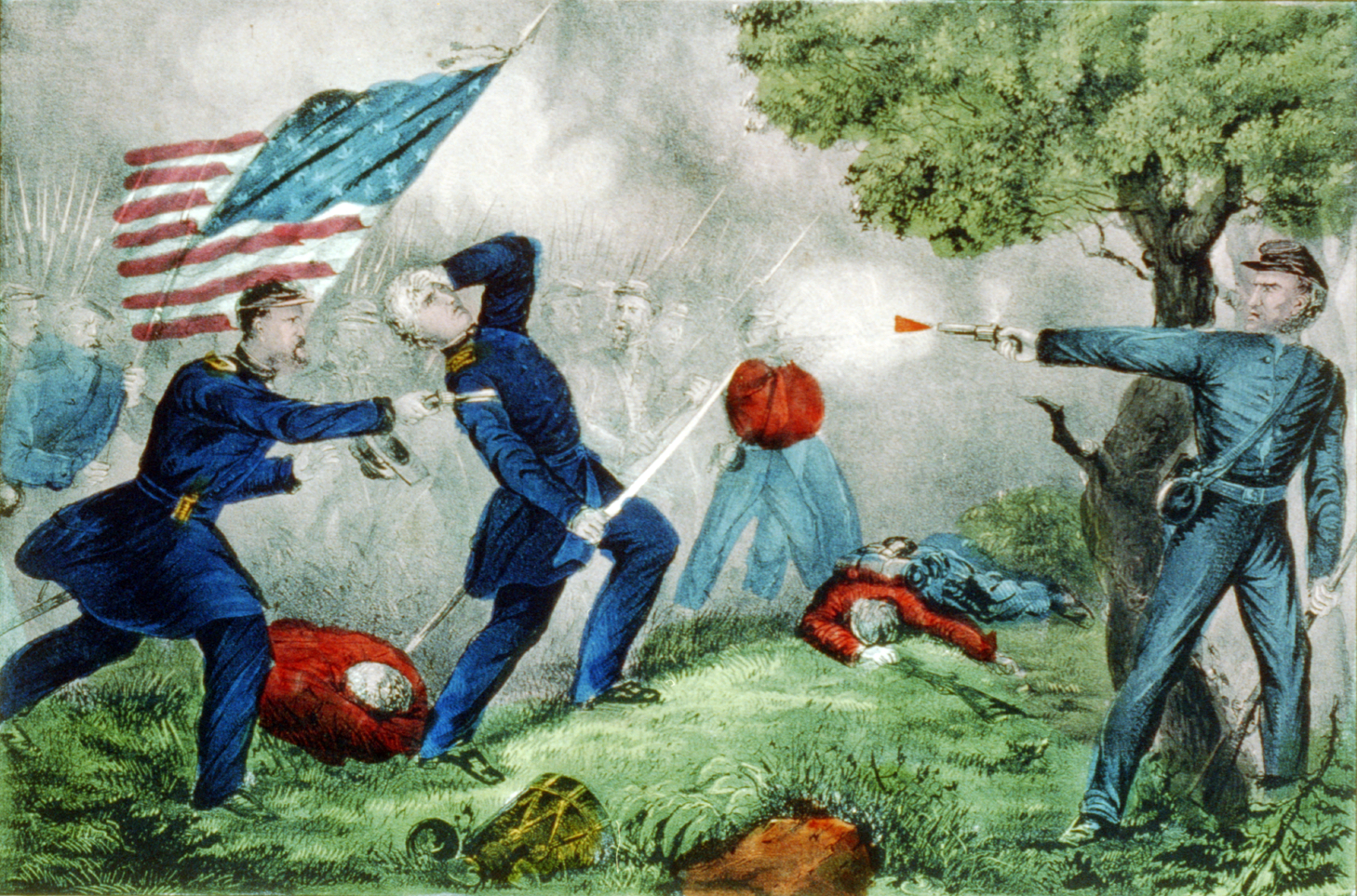
The Senate had changed since it last met in the summer. In the days following the Union defeat at Bull Run (actually, before it too) the top critics of the Lincoln Administration were Democratic Senators John C. Breckinridge from Kentucky and Trusten Polk from Missouri. Neither was present when the Senate reconvened at the beginning of December. Breckinridge had fled to the Confederacy and was expelled December 4, but Polk's whereabouts (as well of those of his fellow Missouri Senator Wade Johnson) were unknown. It was suspected (correctly) that both had joined the Confederates, and on December 18 the Senate debated expelling two more of their colleagues. The fourth missing member was Senator Edward Baker of Oregon, who had been killed leading troops at the Battle of Ball's Bluff in late October.

Outside the Senate, the war effort had changed to. The top military adviser was now Maj. General George B. McClellan, who had advocated a policy of holding on all fronts while the Army of the Potomac, which he also commanded, was built up for an advance on the Confederate capital at Richmond. Unfortunately, the Lincoln administration still favored a policy closer to that devised by the former general-in-chief, Winfield Scott, which relied on a blockade of the South and controlling the Mississippi River to break the control of secessionists over Southern State governments.

The combination of traitors in their midst and strategic shifts brought back a Senate (and House) much more aggressive about overseeing the Administration's execution of the war. One of their very first acts when returning was to create a Joint Committee on the Conduct of the War, Chaired by Senator Benjamin Wade (D-OH). At the top of the Committee's list of priorities was to find out what had happened at Bull Run and Ball's Bluff.

Saturday, October 29, 2011

Something of an Epilogue

Wherein Edward Baker's body begins its journey home
........................................................................................................................................

A brief post today, courtesy of the Evening Star reprinted in the New York Times. Baker is the blog's first reoccurring individual during the 150th Anniversary of the Civil War to depart from our area of interest permanently (since Cump Sherman will be back), though he will not be the last and the impact of his death will loom over the remainder of the war.
The Evening Star,
October 29, 1861
The Body of Col. Baker  
The evening after the funeral of the lamented Col. Baker, the corpse was removed from the vault in the Congressional Cemetery, where it was deposited, to the embalming rooms of Dr. Holmes, to be prepared for transmission to its final resting place in California. The committee of Californians who have charge of the body, have taken great care that all the arrangements for the removal of the body should be made in the most appropriate manner. The undertaker's work, by Buchly, is in his best style. 
The temporary coffin in which the body of Col. B. was brought from Poolesville, has been replaced by a handsome metallic case, imitation of rosewood, mounted with silver; a large plate of glass covering the face, through which the features of the deceased may be seen by his friends, below which, over the breast, is a silver plate with the inscription: "Col. E.D. Baker, killed in battle near Ball's Bluff, Virginia, Oct. 21, 1861." 
The process of embalming was made very difficult by the shattered condition of the body, upon inspection of which eight wounds were apparent. One large wound in the left temple; a small ball wound above the right ear; one in the back of the neck; one between the collar bone and shoulder blade, passing down into the body; one through the chest; one passing across the thighs; one dividing all the interior fleshy portion of the left arm; and one in the breast, near the left armpit.  
Notwithstanding these difficulties, Dr. Holmes succeeded in thoroughly embalming the body. The torn and blood-stained uniform in which he was killed was removed, and this morning, clad in a new uniform, he lay in the coffin not a ghastly and pale corpse, but as life-like as we have seen him in all the glow of health, and if lying upon a couch, he would be easily mistaken for a sleeping soldier.  
Today, by invitation of the committee, the President and other distinguished friends of the gallant dead will visit the rooms of Dr. Holmes, at Buchly's establishment, Pennsylvania avenue near Ninth street, and see the face of their late friend for the last time; after which the case will be sealed for transmission to New York, thence to California.
Baker's body would reach its final resting place at San Francisco National Cemetery after a tour through the Union, including a massive parade in Philadelphia. Long after the war, a statue of Baker would be commissioned, and then delivered to the Capitol.
The Evening Star, April 13, 1868
Statue of General Baker  
On Saturday last a beautiful statuette of the late General E.D. Baker, Senator from Oregon, who was killed at the battle of Ball's Bluff, in the early part of the war, was received here from Rome, by Colonel Stephens, of California, for whom it was made by the well-known Washington, Dr. Horatio Stone, who is now in the Eternal City. It is now on exhibition at Messrs. Galt & Bro.'s jewelry store. 
Gen. Baker is represented with a roll of manuscript in his right hand, in the act of delivering a speech, and the likeness is pronounced by all who knew the deceased, to be most striking. The work is mounted on a pedestal, the upper portion of which revolves with the statue. It bears representations of justice, war, etc., and below are the following lines from the last speech of the deceased in the Senate delivered August, 1861. 
"There will be some graves reeking with blood, watered by the tears of affection. There will be some privation. There will be some loss of luxury. The will be somewhat more need of labor to procure the necessaries of life. When that is said, all is said. If we have the country, the whole country, the Union, the Constitution, Free Government, with all these will return all the blessings of well ordered civilization. The path of the country will be a career of greatness and glory, such as our Fathers in the olden time foresaw in the dim visions of years yet to come; and such as would have been ours today had it not been for the treason for which the Senator [Breckinridge] too often seeks to apologize."
Galt & Brothers opened in 1802 near the White House and operated as a District cornerstone until 2001. Baker's statue (which fittingly inscribed part of his final stemwinder countering John Breckinridge) stood for years in the Capitol rotunda and is still somewhere in the building (your intrepid blogger is hunting down its location). But the impact of his death would return to haunt the capital must more quickly.

Wednesday, October 26, 2011

Stars, Falling and Rising

Wherein an extinguished political career helps launch a newspaper's
......................................................................................................................................
Ad for Baker's Philadelphia funeral march,
November 7, 1861


The newspaper of record in Washington City in 1861 was the Evening Star, sometimes called the Washington Star outside of the city, a name it wouldn't take officially until 1970s and would keep until it closed in 1981. Its presses and building (and the contracts of many of its staff, including Mary McGrory, Howard Kurtz, Fred Hiatt, and Jonathan Yardley, as well as rights to those soap comics that still run) were purchased by the Washington Post. The building at the corner of 11th and Pennsylvania now houses Fogo de Chao, among other tenants, but the paper's original 1861 building stood across Pennsylvania Avenue. The paper was small and new then, it had only been in operation for ten years, but the boom in population in Civil War Washington would build the paper, and the evolving, sensational news surrounding Ball's Bluff and the death of sitting U.S. Senator Edward Baker would be part of what caused the paper's circulation to explode.

On October 23, the paper reprinted George McClellan's General Orders No. 31 commemorating Baker, and added its own report, which would subsequently be forwarded by newspapermen around the country:
The remains of the late gallant Col. E.B. Baker have not yet reached Washington.  They are to be taken to the residence of Major J.W. Webb, at the corner of Fourteenth and H streets--No. 363.  We learn incidentally that his body was pierced with six balls, either of which would probably have been fatal; thus showing that his person on the field was a shining mark indeed. On leaving his quarters at his friend, Major Webb's for the field of his death, he remarked to that gentleman that he expected to be in action in less than forty-eight hours, and felt that he should lose his life; closing the conversation with a request that Major W. should send for his body if his presentment proved true.

Saturday, October 22, 2011

Something Being Done

Wherein a sitting Senator is dead on the field of battle
.........................................................................................................................................

The death of Senator Edward D. Baker at Ball's Bluff
A quick programming note: it had been my intention to live blog the Battle of Ball's Bluff, but life sometimes gets in the way of plans. However, if study of the Civil War battlefield reveals anything, it's that the victorious are rarely those who planned the best, but those who adapted their plans best when they met reality. Hopefully that works for writing about history too. And so, I'll continue my plan to live blog the battle, but instead I'll live blog it the way most Americans experienced it -- through the weeks and months afterwards that it took to understand what had happened. For a more traditional account, I recommend Disunion today. Or, if you prefer to read in "real time", I recommend the collection of telegrams between Washington and Poolesville that tell the story rather poignantly (though slightly out of order).

On the evening of October 21, the public around the capital city was beginning to realize that something had happened. For those living along the upper Potomac River, the day had been punctured by the deep boom of artillery and the staccato rattle of musketry, signifying that that thing must be a battle, and word was spreading about it fairly quickly. But who had been engaged and who had won?

Only the barest rumors of a battle had George Meade, leading a brigade of the Pennsylvania Reserves. On the afternoon, Meade was marching with the rest of his division away from Dranesville, only a few miles from the battlefield, where men from the division of Charles P. Stone were suffering and dying all day long. The Reserves, under Brig. General George McCall, had been moved to Dranesville on October 19, by order of the commanding general of the Army of the Potomac, Maj. General George McClellan. McClellan had received a report from Stone, who was charged with watching the river crossings around Leesburg, that the Confederates there had mostly withdrawn. So he had sent McCall and the Reserves to scout out the area and try to scare away any remaining troops, hoping that Stone might have the chance to capture Leesburg, and thus secure Union control of the Potomac.

On October 19, McClellan had wanted McCall to march back to their camp in Langley immediately the next day, so as to not leave a hole in the army's line of defenses around Washington. But the older general had persuaded his young commander to allow him to keep his men out through the weekend in order to give his engineers time to make detailed maps that would be needed for a possible future attack on Leesburg. If the division required to pick up McCall's slack hadn't been that of McClellan favorite "Baldy" Smith, then there may have been no Ball's Bluff, but as it happened, McClellan accepted McCall's request under strict orders that the Reserves were to be back in Langley by October 21.
At 10:00 am on Monday, October 21, McCall dutifully ordered his three brigades to return home. The men marched back down the Georgetown Pike towards Langley, probably split between disappointment that no battle had been fought and eagerness for a properly cooked dinner when they reached camp. The historian of the division recorded that two brigades had reached Camp Pierpont at 1:00 pm (probably Meade's and the Colonel McCalmont's), when McCall was presented with a telegram from McClellan ordering him to remain in Dranesville, if he hadn't left yet. McCall quickly sent a reply asking for new orders, since he had already returned to camp, and was told to let the men rest, but be prepared to move out.

Thursday, October 20, 2011

A Slight Demonstration

Wherein Stone attempts to scare Evans out of Leesburg
........................................................................................................................................

On the morning of October 20, Brig. General Charles P. Stone commanding a division of the Army of the Potomac based at Poolesville received the following message from that army's commanding general's staff:


Stone had been in charge of guarding the river crossings on the upper Potomac River since the launch of the Rockville Expedition in July. As a sizable community in a fertile country, with two good ferrying points, Leesburg would make a splendid base of operations for a sudden northward stab by the Confederates to cut the line between Washington and southern-sympathizing Baltimore, thus enveloping the capital. The bulk of the Army of the Potomac blocked the direct approach for the Southerners on Washington, Harper's Ferry was far enough away to allow a wheeling movement by that army, and a Northern flotilla controlled the lower Potomac (the batteries at Evansport not yet fully operational), and so throughout the summer and fall, Leesburg was presumed to be the jumping off point for an attack by the overestimated-in-size Confederate army.

Stone was the man asked to guard that point, and it was a job he intended to do professionally. He was a serious man, described as polished and well-mannered. A Democrat fiercely loyal to the Union, Stone had accomplished the unusual feat of being well-liked by both his immediate commander, Maj. General George McClellan, and the aged general-in-chief, Bvt. Lt. General Winfield Scott. Stone's obsession with doing things according to the professional code he had developed in his career with the U.S. Army sometimes bothered his superiors and volunteer troops. He was famous for sending careful enumerations of his division's supply problems, persistently requesting regular troops to carry out his mission, and scolding the War Department for sending him documents marked "secret" by U.S. Mail. His men had just had a run-in on October 16, when, after catching two possible Confederate spies in camp selling pornography to the men, he expelled them and then had the entire division searched for pornography, which he destroyed.

Monday, October 3, 2011

Beginning to Move

Four vignettes of the beginning of October
..........................................................................................................................

As the weather changed in October 1861, the stagnation that had characterized summer around the nation's capital began to break up. At the end of September, the Confederates evacuated their advanced position at Munson's and Mason's Hills, and the picket war around Bailey's Crossroads and Falls Church died down. The Confederacy's Army of the Potomac, under General Joseph E. Johnston, was falling back to a stronger defensive position, in light of the conclusion that they would be unable to launch an offensive anytime soon.

For Maj. General George McClellan, commanding the Union's Army of the Potomac, it was a time when command of his army was coming together. For McClellan, though, the passing of the imminent threat of Confederate attack (not that he didn't still believe it might come, he just felt prepared for it) seems to have given him full time to worry about his personal battles. "I am becoming daily more disgusted with this administration," he wrote to Mary Ellen on October 2, "perfectly sick of it."
If I could with honor resign I would quit the whole concern tomorrow; but so long as I can be of any real use to the nation in its trouble I will make the sacrifice. No one seems able to comprehend my real feeling--that I have no ambitious feelings to gratify, & only want to serve my country in its trouble, & when this weary war is over to return to my wife...


Wednesday, August 31, 2011

Chance (Or A Good Friend) Has Placed Me In Command

In which feelings are hurt
..........................................................................................................................................
Sir:

I have the honor to acknowledge the receipt of the Commission of brigadier General, which you are pleased to confer on me.

The opinion manifested by the Senate of the United States as to the incompatibility of the office of a Senator of the United States with the office of General compels me to decline the Commission. I do not feel myself at liberty to resign the position with which I am honored by the State of Oregon.

While nearly every man of even minor influence in the North and South was trying to get himself a commission in the growing armies, Senator Edward Baker was busy turning one down. True, he already held the rank of colonel in the lead of the 1st California Volunteer Regiment that he had dreamed up (recruited from New Yorkers and Philadelphians), and, as he observed in his letter of refusal to Lincoln "the government is pleased to allow me a command with my present rank", but everyone else around Washington was scrambling to command one of the divisions that Major General George McClellan was creating for his new, grand Army of the Potomac.

McClellan's first two picks for division command had been perfunctory, former commanders of the Departments of Northeastern Virginia and the Shenandoah, Irvin McDowell and Nathaniel P. Banks, respectively. Both had seen their commands folded into McClellan's new Army of the Potomac, so both had been given some compensation. But his next two picks, announced on August 28 and August 30, had been more surprising.

Monday, August 1, 2011

Pointed Arguments

Wherein sharp words find their logical place in the Senate
.................................................................................................................................

In the wake of the Northern loss on the hills overlooking Bull Run all the fears of March returned to Washington. The rout of Irvin McDowell's army had galvanized the South, in the same way the surrender of Fort Sumter had months before. Virginia, Arkansas, Tennessee, and North Carolina had all waited until after Lincoln's April 17 call for volunteers to secure Federal property before seceding, but the fall of Sumter on April 12 couldn't have been overlooked when they decided to leave the Union. Another Confederate victory in northern Virginia could be the push Kentucky, Maryland, Delaware, or Missouri needed to declare for Richmond.

The Lincoln Administration had been aggressively attempting to make sure this did not happen. In Missouri, where the state's secessionist governor and part of the state militia had taken up arms against the Federal government claiming the state had left the Union already (the legislature voted to do so, but without a proper quorum), there was an army of militia under Nathan Lyon and John C. Fremont marching to quash the insurrection. In Maryland, soon-to-be Major General (USV) Nathaniel P. Banks had been using military might to detain suspected secessionists (especially in Baltimore) without trial since May, and his successor when he took over at Harper's Ferry, John Dix, was actively searching for secessionists too.

Sunday, July 31, 2011

Jockeying For Position

In which new stars appear and Hooker does what Hooker does
............................................................................................................................................

Grade insignia (yellow indicates cavalry). Volunteers
and regular army wear the same insignia
Since the secession of South Carolina seven months before military men throughout the North had been attempting to get a high-ranking position in the war. While rank was equally important to Southerners, the North already had an army, making competition for leadership slots tougher than in the South (though no more vicious). Most of these men had been junior officers during the Mexican War, and some had acquired a taste for combat that no civilian pursuit could satisfy, while others saw the leaders of the Mexican War rise to fame and fortune based on their service (two became Presidents of the United States), and still others believed in the Union fervently enough to shed their blood for it. Most were motivated by a combination of some or all of these things.

In the aftermath of the defeat at Bull Run, the opportunities for high command became greater. The influx of three-year regiments and the determination to field a larger army around Washington created a higher demand for general officers, and the passage of a law establishing a corps of U.S. Volunteers (USV) to supplement the U.S. Army (USA) also allowed Lincoln to appoint as many officers as he needed. Starting on Wednesday, July 31, the floodgates of USV promotions opened as the White House finalized its consultations with the War Department and sent a large list of nominations to the Senate.

Monday, July 25, 2011

Starting Anew

In which U.S. leaders decide to get back on the horse
...........................................................................................................................

Burnside (center) and the leadership of the 1st Rhode Island, back home
On July 25, Colonel Ambrose Burnside reluctantly formed up the 1st Rhode Island and prepared to lead them out of Washington for the last time. Because Burnside had pulled them back to Matthew's Hill to rearm rather than send them up Henry Hill, the regiment was in considerably better condition than most in the army. Burnside reported 13 killed, 39 wounded, and 39 missing. But their 90 days of Federal service had been reached, so it was back to Rhode Island, where the men would return to their homes and Colonel Burnside would again become a private citizen.

They left behind a capital trying to get back on track after the shock of their defeat on the hills overlooking Bull Run. The attempts to reconstitute the Northern war effort began immediately as the first troops stumbled through the terrible storm back to their fortified positions, but on the 25th it finally began coalescing into something like concrete changes.

Tuesday, July 12, 2011

Scott's Triumphant March to Mexico City

This is the fourth in a four-part series on the impact of the Mexican War on the American Civil War.  

Part 1. Part 2. Part 3. Part 4.
Scott's entry into Mexico City, as painted by Austrian Carl Nebel in 1851

On March 29, 1847, after 12 days of siege, Vera Cruz surrendered to Major General Winfield Scott and he could finally begin his campaign in earnest (when Congress made him Brevet Lieutenant General in 1855, they dated it to the capitulation of Vera Cruz). It had been a harder siege than Scott had expected (his landing outside the city was the first large-scale amphibious operation in U.S. history), but it was over and he could have a firm base of operations for a march on the Mexican capital that would force the dictator General Antonio Lopez de Santa Anna to sign a peace treaty recognizing the Rio Grande as the border of the two countries and selling Alta California to the United States.

Sunday, July 10, 2011

Battling In The Senate

As noted earlier, I have been out of town for a few days and have the blog autoposting, but July 10, 1861 was an important day in the U.S. Senate and worth noting in this quickie post. Lincoln had transmitted with his July 4 message a list of legislative requests to raise and pay for an army. However, the first order of business that the Senate took up was addressing the legitimacy of the President's actions while Congress had been out of session.

The President had made arrangements for and begun a war without Congressional approval, so his allies in the Senate set about passing a resolution approving of everything he had done so far ( thanks to the departure of the Southern delegates they were the majority party, 30-16 -- officially, anyway, soon to be 30-13 when three Senators who hadn't bothered resigning were expelled on July 11).

Thursday, June 16, 2011

Senator Baker's Appointment

Col. Edward Baker in Harper's Weekly
On June 16, 1861, Senator Edward Baker was in New York City. Congress had adjourned from the special session called by President Buchanan in March to determine what to do about secession, but President Abraham Lincoln, a personal friend of Senator Baker, had called Congress into special session on July 4. Even if Baker hadn't represented Oregon and been unable to make the long cross-country journey (the Pacific Railroad Act, which would lay the groundwork for a transcontinental railroad network, was still a year away), he would not have gone home. That's because Senator Baker was also Colonel Baker.

One month after the fall of Fort Sumter, Lincoln had asked Baker to be a general in the 75,000-strong U.S. Volunteer force he had called up, and be responsible for raising a portion of those volunteers. Baker had been one of the first people Lincoln met when he moved to Springfield in 1837. In evenings, Lincoln would gather with the men of the town to talk current events and Baker (as well as Stephen Douglas) was frequently in attendance. The plain-spoken Kentuckian and the London-born lawyer hit it off, and Lincoln named his second son, born in 1846, Edward Baker Lincoln.