Showing posts with label McDowell. Show all posts

Tuesday, July 10, 2012

Who Is John Pope?

Wherein we search for something likable about the new commanding general
...........................................................................................................................................

George McClellan was beloved by his men and officers, even after he was dismissed in disgrace, and some modern writers have gone out of their way to lionize him. Joe Hooker, after losing Chancellorsville, went on to be a hero at Lookout Mountain, and has an equestrian statue right in front of the Massachusetts State House in Boston. Ambrose Burnside and Irvin McDowell both suffered major failures, but continued to serve afterwards and maintained the respect of their peers for awhile, and still have their apologists today. Even George Meade is finally experiencing a renaissance as people begin to recognize his significant role in winning the war under the shadow of Grant.

But the one man with no vocal defenders is John Pope. He first drifts into our scope in the last week of June 1862 and will be gone again by September 1862, the shortest time of any of the major subjects of this blog, but in that time he will do more than perhaps any man but Robert E. Lee to extend the life of the Confederacy and the war to sustain it for at least an additional year. Who was this man and how was he so universally disliked and somehow still remains a footnote of history?

***


GENERAL ORDERS No. 7
                                                                                                    Headquarters, Army of Virginia
                                                                                                    Washington, July 10, 1862


Tuesday, June 26, 2012

The Whole Matter Is With General Banks

In which rival strategic visions lead to the arrival of John Pope, good for no one
.....................................................................................................................................................

June 26 is best known as Robert E. Lee's first offensive with the Army of Northern Virginia, and the second day of the Seven Days, the spectacular offensive that reversed the war's strategic situation and began the legend of Lee. But for Maj. General Irvin McDowell, lately commanding the Department of the Rappahannock, it was another day when his dreams of rehabilitation and glorious military command were yanked from him.

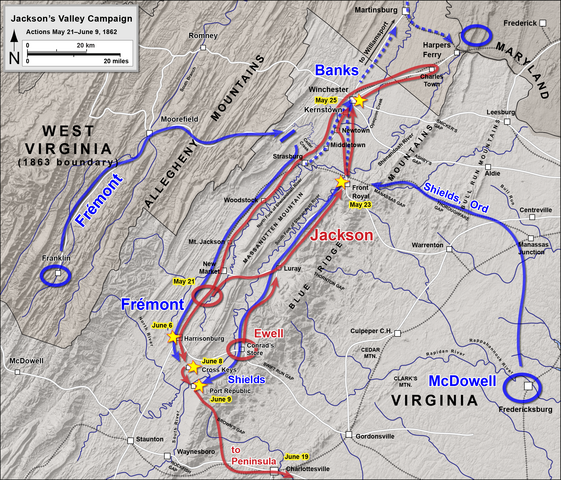
The Confederate Maj. General Thomas "Stonewall" Jackson and his second-in-command, Maj. General Dick Ewell, had over the month of May upended all the carefully restored order from the banks of the Potomac to the Allegheny Mountains with a campaign that had made fools of the Union commanders he faced (all that had saved their careers thus far was that the size of Jackson's army remained greatly exaggerated). McDowell, with authority over all of northern Virginia, but only west to the Blue Ridge Mountains, had initially resisted having men from his department dragged into the affair, then pledged to solve the problem the other generals couldn't, then when it appeared clear the situation had been defused again tried to extricate his command from it. Jackson's twin victories at Cross Keys and Port Republic only further cemented in McDowell's mind that his men should never have been involved.

Where McDowell's men belonged, in McDowell's mind was not Front Royal, not Manassas Junction, not even Fredericksburg, but outside Richmond with the rest of the Army of the Potomac, from which his command had been carved. That's where the war was being one, he believed, and that's where he had the chance to redeem his name from the shame of the battle at Bull Run, which was really the fault of his subordinate commanders' inability to execute his plan. The nonsense with Jackson stood between McDowell and getting to Richmond.

McDowell had sent two divisions to the Valley, his First Division under Maj. General James Shields, and his Second Division under the temporary command of Brig. General James Ricketts after its former commander was transferred out West to remove him from his feud with McDowell. It was half of Shields' division that had been defeated by Jackson at Port Republic, but nonetheless McDowell was urging their return to Falmouth the day after the battle. From his headquarters in Manassas Junction he practically begged the commander of the Department of the Shenandoah, Maj. General Nathaniel Banks, to resume responsibility for the Valley. In McDowell's mind he had bailed out Banks, so Banks owed it to him to quickly relieve his men.

Banks had other ideas, though. While McDowell thought the Jackson calamity had occurred because the borders of the departments had been drawn in a way that seemed to give him some responsibility for the Valley, Banks believed it had happened because McDowell had taken away almost all of his troops, leaving him with only two brigades to defend a vitally important area. Both were right, in a way. The real problem was without an overall commander with a broad view of the situation, the individual commanders had set conflicting plans of operation into motion. McDowell could not march to reinforce McClellan while Banks also had sufficient forces to protect against a Confederate army moving up the Valley to threaten Maryland. One of the safety of Washington, the reinforcement of McClellan, or the Confederate army had to be eliminated before the others could happen.

There was a third person involved in the affair, Maj. General John Fremont, commander of the Mountain Department. Fremont had also been ordered into the Valley to bail out Banks, and his and McDowell's forces were supposed to have worked together to cut off Jackson and destroy his army. But McDowell had let Jackson get by him and followed him to Cross Keys, where he had been defeated.

Sunday, June 10, 2012

Made to Pay

The exciting conclusion of Jackson's Valley Campaign minus Jackson or the Valley
........................................................................................................................................

In case you missed it, on Tuesday we looked at how Jackson's capture of Front Royal in mid-May postponed McDowell's planned march on Richmond. On Thursday, we saw the resulting race to Front Royal when Jackson continued marching north, in hopes of trapping him in the Lower Valley and eliminating his command.


On the evening of June 10, Colonel Edmund Schriver, chief of staff for the Department of the Rapphannock, and sitting in Front Royal as Maj. General Irvin McDowell's eyes and ears, ruefully forwarded a "sorry picture of Shields' division" in the form of a report from its head, Maj. General James Shields in Luray. That town, Schriver told his boss, was "filled with so-called sick officers and men, who, it is said, will never be of use again."
In any calculations you may take as to numbers do not rely on more than half what the returns call for. I do not think any of our army will be fit to take the field unless King's division, in less than a fortnight. Horses are used up as well as the men. The want of discipline and ignorance of the plainest duties are distressing. There is nothing but confusion and disorder.
Just two weeks earlier James Shields had told Schriver, "I will clear the valley of the Shenandoah of the enemy as far as I advance." Now it seemed like his men would never march again. In between they had met Maj. General Thomas "Stonewall" Jackson, who in the second part of his stunning Valley Campaign, had incapacitated two more Union forces and saved Richmond for the Confederacy.

As in our two previous posts, however, our story doesn't lie in the Valley, but east of the Blue Ridge in the Piedmont where McDowell's army in the Department of the Rapphannock had put its plans to march on Richmond on hold, to make an all-out rush for the Shenandoah Valley and Jackson. On May 31, it looked like they were well on their way to accomplishing their goal of trapping his army between Union reinforcements based around Harper's Ferry and a combined army of McDowell's men and men from the Mountain Department at Front Royal and Strasburg.

Shields, McDowell's star division commander, had two of his brigades already at Front Royal and two more that would arrive before the night was out. To the west on the Manassas Gap Railroad, another division under Maj. General Edward O.C. Ord had advanced to about Thoroughfare Gap, but damage to the railroad by Confederate cavalry near Front Royal and a train wreck near McDowell's headquarters at Rectortown was slowing them down. Further south, the division of Rufus King was at Catlett's Station, and could make use of the O&A Railroad to get to Manassas Junction and switch to the Manassas Gap line. The problem for McDowell was feeding so many men and horses.

"Fremont has not yet reached Strasburg, and I fear he will not reach it in time." Shields had told McDowell and McDowell had relayed to Secretary of War Edwin Stanton, "Ord's division should be pushed forward, but with supplies, or it will starve here without them."

Fremont was supposed to have marched from the west side of the Allegheny Mountains to Harrisonburg, but had decided instead to cross further north directly at Strasburg. Throughout the race of Shields to get to the Valley, the Lincoln Administration had taken for granted that Fremont's men would get their first--for one, they had much less ground to cover--but instead Shields sat in Front Royal and Strasburg sat empty. McDowell was pleased in his morning telegram to Staunton to note that his men had arrived on hour before Lincoln's proscribed time.

Thursday, June 7, 2012

Nothing But A Panic

Wherein the race to cut off Jackson is on
................................................................................................................................................

In case you missed it, check out Tuesday's post on the beginning of Jackson's Valley Campaign, as viewed from the Piedmont. In short: McClellan counted on the forts surrounding Washington to defend the city, but the Lincoln Administration wasn't so sure, so it kept McDowell behind. After months of waiting, McDowell was ready to go to Richmond, but on the day he was supposed to kick off, Jackson surprised and captured Front Royal. McDowell's orders to march were cancelled by the President himself.

"This is a crushing blow to us," Maj. General Irvin McDowell telegraphed Edwin Stanton on the evening of May 24 from his headquarters at Falmouth.

On orders from the Secretary of War, the commander of the Department of the Rapphannock was preparing to depart to meet Secretary of the Treasury Salmon P. Chase at Aquia Creek Landing at midnight for full oral orders from the President. Chase had been sent for two reasons: first, Stanton was preoccupied with theater-strategic concerns because Jackson's offensive threatened three different too-narrowly-drawn departments; and second, as a fellow Ohioan Chase had been McDowell's patron in the capital in the spring of 1861 and helped get him his star(s) in the first place. Since McClellan looked like he would be at the gates of Richmond within the week, Chase might help soothe McDowell's agony at being excluded from the grand campaign to conclude the war.

Lincoln was certainly bending over backwards to ease McDowell's disappointment. At 8:00 pm, two hours after McDowell's crushing blow telegram had been received, the President himself, not the Secretary of War, telegraphed a reply.
I am highly gratified by your alacrity in obeying my order. The change was as painful to me as it can possibly be to you or to any one. Everything now depends upon the celerity and vigor of your movement.
Confederate Maj. General Thomas "Stonewall" Jackson was loose somewhere north of Front Royal with between 7,000 and 10,000 men from his division and that of Maj. General Dick Ewell, and the main Union defender, Maj. General Nathaniel P. Banks, was at least as far north as Winchester, with the remains of only two brigades amounting to, at most, 4,000 men. McDowell was supposed to send two divisions of his department (about 20,000 out of over 40,000 men) to Front Royal as fast as possible, while Maj. General John C. Fremont of the Mountain Department sent as many of his as he could spare to Staunton.

At 9:30 pm, Lincoln received another bitter, but this time more loquacious, reply from McDowell.
I obeyed your order immediately, for it was positive and urgent, and perhaps as a subordinate there I ought to stop; but I trust I may be allowed to say something in relation to the subject, especially in view of your remark that everything now depends upon the celerity and vigor of my movements. I beg to say that cooperation between General Fremont and myself to cut Jackson and Ewell there is not to be counted upon, even if it is not a practical impossibility.
McDowell had tried to explain his objections to Stanton earlier in the day and now he tried again with Lincoln. "I am entirely beyond helping distance of General Banks," he protested, "no celerity or vigor will avail so far as he is concerned."
Next, that by a glance at the map it will be seen that the line of retreat of the enemy's forces up the valley is shorter than mine to go against him. It will take a week or ten days for the force to get to the valley by the route which will give it food and forage, and by that time the enemy will have retired. I shall gain nothing for you there, and shall lose much for you here.

"It is therefore not only on personal grounds that I have a heavy heart in the matter," McDowell unburdened himself, "but that I feel it throws us all back, and from Richmond north we shall have all our large masses paralyzed, and shall have to repeat what we have just accomplished."

He would send Maj. General James Shields with his division, ironically just from the Valley after a laborious march, in the morning and follow with another division in the afternoon. But first he promised to see Chase and "express myself more fully to him."

Tuesday, June 5, 2012

A Crushing Blow

Wherein Jackson's Piedmont Campaign kicks off
..................................................................................................................................................

This Saturday marks the 150th Anniversary of the stunning conclusion of Jackson's Valley Campaign, an epic feat of operational warfare genius that can only be rivaled in American history by Patton's Winter '44-'45 campaigns and Washington's New Jersey campaign (with the caveat that tactically, Jackson was by far the inferior of either). Last month, we took time to examine why there was a Valley Campaign, noting the failures of Union intelligence gathering and analysis and the failures of Union planning and organization that allowed Jackson to perfectly exploit his foes.

While less exciting, Jackson's campaign was paradigm-changing for concepts of security around Washington, DC. Over the course of three weeks in early summer the plan for defending the nation's capital shifted from one based on stationary fortification to one based on a campaigning army, and in doing so sealed the fate of George McClellan. In that sense, Jackson also achieved the primary objective of warfare in the mind of a 4th Century BC Chinese strategist he had never heard of: disrupt your enemy's strategy.

While it is most exciting to study the operational masterpiece from the viewpoint of the man who commanded both sides and the men who marched themselves ragged, to appreciate the deep strategic significance it is best to look at the story from the perspective of those in the Piedmont of Virginia, specifically one sitting on the banks of the Rappahannock River. There, in Falmouth, was the headquarters of the Department of the Rapphannock, commanded by Maj. General Irvin McDowell, rehabilitated loser of Bull Run.

The Lincoln Administration had quietly--almost apologetically--stood by McDowell the turmoil of the post-disaster outrage, and, in the Spring, rewarded him with promotion to major general of volunteers, making him one of the most senior generals in the Army. They believed McDowell had been a victim of circumstances, irrational public zeal, and poor subordinates, and retained Winfield Scott's initial high confidence of his abilities--a great deal more confidence, in fact, than they had in Maj. General George McClellan, who was leading the marquee army for Union, the Army of the Potomac, in a march on Richmond up the Virginia Peninsula from Fort Monroe.

McDowell should have been leading the First Corps of the Army of the Potomac under McClellan's supervision, but, at the last minute, the Lincoln Administration had withheld him until the defense of the capital was settled. McClellan's scheme for defense relied on an impenetrable system of forts that he had constructed over the winter that had turned the District of Columbia into the most fortified city on earth. A small mobile corps was to operate in the area, making sure that any enemy couldn't get too comfortable in Northern Virginia again, but it was the futility of attacking the string of fortifications that McClellan counted on to convince strategists in Richmond that their men were better used in different theaters.

But McClellan had violated his own strategy in the opinion of the Administration, particularly Secretary of War Edwin Stanton. An analysis conducted by two veteran generals at Stanton's request found that McClellan had shortchanged the defenses and the mobile corps in manpower and so McDowell's corps had been retained until the problem could be corrected. To better maintain control over the capital's defense, Stanton had created new Departments over which McClellan had no authority for McDowell and other commanders in the Shenandoah, the western Virginia mountains, the District, and Maryland.

Friday, May 18, 2012

Why Was There A Valley Campaign?

In which we look at Northern organization and strategy
..................................................................................................................................................

This is the second in a two part post on Northern mistakes in the first month of May.

Last week we looked at how mistakes in intelligence gathering and analysis led leaders of the Northern war effort to coalesce behind a likely enemy course of action that ended up being drastically different from the one actually pursued by their Southern opponents. But history is full of poor intelligence gathering and analysis that nevertheless ends in victory. So this week, we'll look at the mistakes those same leaders made in their own planning--mistakes that allowed Stonewall Jackson to execute his brilliant Valley Campaign.

Central to our discussion is what are known in modern military doctrine as the "levels of war." The concept goes back to ancient times, when it was recognized that some leaders needed to tell individuals where to stand and who to fight, while others needed to decide where the battle should occur. The "general" officer was created precisely to make those sorts of general decisions. By the time of the American Civil War, it was already long understood that even among general officers there were further levels of responsibility, with some moving groups of men in the field, and some deciding where to move armies several months hence. Today, we recognize roughly four levels of war: national-strategic, theater-strategic, operational, and tactical.

Prior to the American Civil War, there had never been a clear delineation of responsibility for military strategy in the United States--who to put where and when, in order to win a war. At the highest level, which we would call today "National-Strategic" and some 1862 contemporaries would have called "Grand Strategy", control depended on the personality of the Secretary of War. More aggressive secretaries would locate and direct men and materiel themselves, while secretaries selected more for their politics than their smarts would defer to the senior general in the U.S. Army, which, after 1841, meant Winfield Scott. But there was no clearly expressed distinction between the responsibilities of the general-in-chief and the Secretary.

Friday, May 11, 2012

Why Was There A Valley Campaign?

Wherein we examine failures of intelligence
.............................................................................................................................................

The first of two posts on mistakes by the North the first week of May 1862.

May 8, 1862, was the date of the Battle of McDowell, the beginning of Stonewall Jackson's legendary Valley Campaign. Much has justly been written about Jackson's operational-level brilliance and an equal amount has unjustly been written about his rather mundane tactics. Only in recent years, have reevaluations of the campaign been conducted, most notably in Peter Cozzens fantastic Shenandoah 1862 which acknowledges the immense personal cost to the soldiers of Jackson's army and, in the words of the friend who gifted the book to me, "bothers to examine the Yankee sources."

The Valley, though technically in the Potomac watershed, has simply been beyond the capacity of your blogger to post on, which means the area that drains directly into the Shenandoah has usually been beyond the scope of this blog. But Jackson's campaign deeply threatened the area we usually cover, and ended up being the strategic center of gravity for the entire Virginia theater. Without Jackson's operation, Joe Johnston, hundreds of miles away on the Virginia Peninsula, would have been unable to fend of McClellan's army, and Richmond would have been scrambling to find defenders in fall 1862 instead of Washington.

Edwin Stanton
It was largely planning mistakes made in Washington at the strategic level from May 8 to May 17 that allowed Jackson to conduct his famous campaign. This post focuses on the first part of those mistakes, the failure in intelligence collection and analysis.

With the demotion of McClellan in March, Secretary of War Edwin Stanton became the Administration's principle war planner. Unlike his predecessor, Simon Cameron, Stanton believed the Secretary should be active in decisions about the prosecution of the war, rather than only concerned with supplying and administering the armies. Stanton signaled this when he added Peter H. Watson as a second Assistant Secretary of War as a condition of joining the Administration himself. Watson was appointed to straighten out and manage the contracts the Department made to supply the army, which was usually a tightly held responsibility of the Secretary in order to bestow political favors.

Sunday, May 6, 2012

Before It's Too Late

Wherein the end of the war is imminent
.........................................................................................................................................

On May 6, 1862 nowhere was the imminent Union victory in the Civil War more apparent than in Northern Virginia, and no one in Northern Virginia was working harder to put the final nail in the Confederacy than the man who had botched up the whole thing ten months earlier. Maj. General Irvin McDowell, commander of the Department of the Rappahannock was working night and day to repair both the historic Potomac Path [U.S. 1] and the Fredericksburg and Richmond Railroad to allow a full advance towards Richmond.

McDowell can be forgiven for being swept up into the prevailing opinion that the end of the war was months away. In the West, several armies had been united under the command of Maj. General Henry Halleck in what we would call an "Army Group" today, with the purpose of capturing Confederate strongholds on the Mississippi and, by controlling the continent's great river, slicing the Southern nation in half and crushing their internal economy. Halleck's armies were drawing tight around Corinth, the key to defending Memphis, and General P.G.T. Beauregard, in command by accident after the death of the preferred Albert Sidney Johnston, appeared out-manned, out-gunned, and out-generaled.

At the other end of the Mississippi, Tennessee native and loyal Unionist Commodore David Farragut had completed a daring operation in cooperation with Maj. General Benjamin Butler and captured New Orleans, providing an ideal harbor for the Gulf Blockade Squadron as well as closing the best blockade-running port for cotton transited south from the cotton-growing Confederate heartland. With major Northern armies present in Pensacola, Port Royal, and Roanoke, too, the South was being dissected.

And in Virginia, McClellan was finally on the move. By May 6, word had arrived that the siege at Yorktown on the Virginia Peninsula was over, and McClellan was on the heels of Joe Johnston's army as it bolted back towards Richmond. Lincoln and his Secretaries of War, Navy, and the Treasury had taken the revenue cutter Miami the evening of May 5 to Fort Monroe to view the collapse of the major army defending Richmond personally. While they did so, Johnston had made a stand at Williamsburg, where after a brutal day of fighting for Joe Hooker's division, the Army of the Potomac had triumphed [Johnston's army had belatedly and at last assumed its famous name, the Army of Northern Virginia].

Monday, April 23, 2012

Aquia Creek

Wherein we learn the strategic value of a forgotten tributary
...................................................................................................................................................

On April 20, 1862, the Revenue Cutter Miami sat in Aquia Creek. The Miami was a sleek, 150 foot craft with a schooner-rigged screw-driven steamship that looked like a glamorous luxury yacht. She was. The Revenue Service (one of the forerunners of today's Coast Guard) had purchased her in January from Arthur Leary, owner of one of the largest lines of merchant vessels in the world (briefly in business with Sir Edward Cunard, son of the founder of the Cunard Line--to sneak a Titanic centennial in here, the unsinkable ship was built by White Star in response to Cunard's building of the Lusitania). Like the Harriet Lane, which had become the flagship of the Potomac Flotilla, the Revenue Service had outfitted the Miami for war.

Her arrival at the Navy Yard to receive her guns and ordnance the first week of April had drawn crows of admirers, including Abraham Lincoln, who insisted on a cruise to Alexandria with his family in her. On April 20, Lincoln was again on board, but this time with a more serious purpose. Secretary of War Edwin Stanton, Secretary of the Treasury Salmon Chase, and a gaggle of staff of various ranks were with him, all on their way to visit the Army of the Potomac on the Virginia Peninsula.

Lincoln had stopped at Aquia Creek to confer with the commander of the Department of the Rappahannock, Maj. General Irvin McDowell. McDowell had captured Fredericksburg the day before, the latest in a series of Union victories occurring everywhere except for the Virginia Peninsula (as a city on the Rappahannock, Fredericksburg is outside of the purview of this blog, but there is a remarkably exciting collection of official reports relating to the capture that are worth a read, if you like such things).

Wednesday, April 4, 2012

Entirely Secure

Wherein Lincoln turns to McDowell to defend Washington...again
.............................................................................................................................................

On Tuesday, April 1, 1862, Maj. General George B. McClellan had sailed away from Alexandria en route to the Virginia Peninsula. On Wednesday, April 2, 1862, Secretary of War Edwin M. Stanton moved to banish him from the capital region for good.

Stanton, like Winston Churchill, was a pedantic, obnoxious, arrogant, unlikable, borderline sociopath, without whom the world as we know it today would not exist. Like Churchill, Stanton's highest loyalty was to his own ideas, and the resulting wild shifts in political affiliations led to accusations of opportunism. Both men were beyond stubborn, and held no beliefs loosely, and had become fanatically devoted to ideas they had hatched that proved disastrously wrong. Both also got the most important question of their lifetime right, and their single-minded devotion to seeing it achieved saved democracy for their countries.

For Stanton, that idea was the primacy of the Union, which required the full efforts of a dominant Federal government to establish and sustain. Stanton was a lawyer from Ohio, who had dropped out of Kenyon College when his father died and completed his studies reading with a lawyer in his home town. He was relentless in his cases, and early on earned a reputation for ruthlessness or dedication, depending on which side of the court room one sat. He earned national fame when he defended then-Congressman Daniel Sickles from charges of murder when he shot District of Columbia U.S. Attorney Philip Barton Key (son of the author of the Star Spangled Banner) to death in Lafayette Park. Sumner argued successfully for the first time in an American court room that Sickles had become temporarily insane because of Key's affair with the Congressman's wife (in the opinion of this blogger the defense was a lie; Sickles was permanently insane).

In 1858, Attorney General Jeremiah Black sent Stanton to California, deputized to settle land disputes. Stanton's well-known anti-slavery Democratic politics made him appealing to the Buchanan Administration, which was trying to split the difference between its Northern and Southern wings. His popularity at getting the Democrat Sickles off in what had become a very political celebrity trial made his appointment a victory of sorts for Northern Democrats, who felt they were losing out by Buchanan's gentle treatment of Southerners. But in California, Sickles turned his formidable intellect and pit bull personality on the land disputes and uncovered a massive conspiracy to defraud the Federal government. On top of his celebrity, he had turned out to be useful.

In December 1860, Buchanan's Northern Democrat Secretary of State resigned in protest, because the President had refused to deploy the U.S. Army to defend Federal property in South Carolina after it announced secession. Buchanan quickly asked Black to serve in the position. Black advocated a less confrontational approach: reinforce Fort Sumter, but let the South Carolinians cool down and then reengage diplomatically. Stanton was appointed Attorney General to replace Black.

If Buchanan thought Stanton might support his administration's balanced approach to session, he was disastrously wrong. Stanton instead almost single-handedly dragged Buchanan to condemn secession, and thundered about the need for immediate military action. When it became clear Buchanan would not do so, and that Secretary of War John Floyd was secretly supplying information to the South Carolinians, whipping for secession votes in his home state of Virginia, and making it easy for secessionists to seize arsenals in the South, Stanton decided to begin supplying information to President-elect Lincoln and general-in-chief Winfield Scott. It's largely thanks to Stanton that the Lincoln Administration had even limited ability to respond to the secession crisis when it was sworn in in March.

The new Secretary of War, Simon Cameron, was clearly in way over his head, at best. At worst, he may have been a corrupt war profiteer. Either way, Lincoln asked Stanton to stay on as a special counsel at the War Department. In that role, Stanton befriended fellow Ohio Democrat George McClellan, who had come to the capital after Bull Run to make things right. Or so McClellan thought. Stanton, like the famous paraphrase of Lord Palmerston's remarks to Parliament, had no friends, only interests. When it became clear that Cameron was tragically inept, Stanton made use of McClellan (who at least could recognize good ideas) to push for the organization of an army strong enough to impose Federal will on the rebellious states.

When Lincoln told Cameron he was resigning, Stanton was brought in to root out the corruption at the War Department. With fanatical zeal he turned his brain to ungumming the bureaucracy and creating an efficient machine for the administration of what later generations of Americans would learn to call total war. But with himself in the driver's seat and able to depress the gas pedal fully, McClellan had become the impediment to reinstating the Union as quickly and thoroughly as possible. And so, Edwin Stanton turned his relentless talents towards destroying McClellan.

It was probably Stanton who was responsible for Lincoln's change of heart towards his role as commander-in-chief. During Cameron's time at the War Department, the President had believed war was best left to general-in-chief Scott and his replacement, McClellan. But since January, the President had issued orders for all armies to advance, had forced McClellan to step down as general-in-chief, had created corps for the Army of the Potomac, and had set conditions for McClellan to meet before his plans could receive approval. Stanton had probably convinced him that  the first word of commander-in-chief had real meaning. At the very least, Stanton had empowered him to act on beliefs he had developed himself.

Stanton had also decided to balance McClellan's dominance of the new upper echelon of the Army created by the promotion of his favorites to brigadier generals of U.S. Volunteers, by elevating prominent members of the old pre-war Army. At the operational level, four were now McClellan's corps commanders, much to his irritation. At the national-strategic level, Stanton pulled Adjutant General Lorenzo Thomas out of the dusty corner he had been confined to by McClellan, and reinstated as a major general Ethan Allen Hitchcock, to be a special advisor to the Secretary. Both men had been born around the turn-of-the-century, and both men had had senior roles in the army before the Mexican War. They were perfect for Stanton's scheme of pitting experience against the youthful "genius" of McClellan.

On April 2, Stanton turned to them to exorcise the ghost of McClellan from the capital. He submitted a request to the two men to review five papers he provided and "report to me whether the President's order and instructions have been complied with in respect to the forces to be left for the defense of Washington and its security and at Manassas."

First up was the President's General War Order No. 3, issued on March 8, which forbade shifting the base of operations of the Army of the Potomac until McClellan and all four corps commanders certified Washington was safe. The second document was that certification, with the Fourth Corps' Erasmus Keyes, the Third's Sam Heintzelman, and the First's Irvin McDowell, all further stipulating that if all the forts on the Virginia side of the Potomac were garrisoned, then only 25,000 men would be needed. The Second Corps' Edwin Sumner calculated differently, saying a total force of 40,000 men would be needed, but still agreed the city was safe under McClellan's plan. The unanimous agreement had shocked and irritated Stanton, who believed the capital needed a significantly larger force to defend it.

Third, was Stanton's own concurrence with the plan approved by the corps commanders, further stipulating that not only must Washington be secure, but Manassas Junction must be secured for the duration of the war. It's unclear how much Stanton did this to secure the line of communication that had caused disaster in July 1861 when the Valley Confederates and the Northern Virginia Confederates were able to support each other, and how much Stanton did this to move the goal posts on McClellan. It managed to accomplish both.

Fourth was McClellan's own report written on board the Commodore on April 1 as he was departing. It left under the military governor of Washington, Brig. General James Wadsworth, 18,000 men for the forts and the city, as well as under Maj. General Nathaniel P. Banks 55,456 men for defending the Valley, Warrenton, Manassas, and Charles County on the Lower Potomac.

Finally, the April 2 report from Wadsworth that precipitated Stanton's request from Thomas and Hitchcock, showing 20,000 men under his command, but complaining that he had, in fact, far less, since McClellan had ordered him to send nearly half to places Banks was supposed to defend. Stanton would have had McClellan's report, which Wadsworth did not, and know that the defense scheme called for Banks to replace Wadsworth as soon as he was done finally putting an end to Stonewall Jackson in the Valley, but it was Wadsworth's other charge that the troops under him were untrained and the worst of the regiments brought in during the winter that angered him and gave him an opportunity to eliminate the deliberate, limited war waging McClellan.
I deem it my duty to state that, looking at the numerical strength and character of the force under my command, it is my judgment entirely inadequate and unfit for the important duty to which it assigned. I regard it very improbably that the enemy will assail us at this point, but this belief is based upon the hope that they may be promptly engaged elsewhere and may not learn the number and character of the force left here.
 Hitchcock and Thomas made a reply the very same day. On examining the documents they determined that 55,000 men would be necessary total to accomplish, with 30,000 men manning the forts (every fort, unlike McClellan's scheme to man only the Virginia forts) around Washington and 25,000 in a mobile corps, that could engage launch counterattacks. So far, so good, for McClellan. He even received unexpected support when they declared Stanton's order about Manassas Junction unnecessary, since "as the enemy have destroyed the railroads leading to it it may be fair to assume that they have no intention of returning for the reoccupation of their late position...."

But when comparing Wadsworth's report to McClellan's, Thomas and Hitchcock struck the coup de grace. McClellan had double counted a brigade of Wadsworth's men as defending Washington and defending Manassas Junction. Since the men couldn't be in both places, no matter what their quality, McClellan's report was inaccurate. An argument can be made that the commanding general was exhausted from the long hours loading his army for transport and simply made a mistake, but Stanton was happy to claim perfidy.

Thomas and Hitchcock gave him the conclusion he needed:
In view of the opinion expressed by the council of the commanders of the army corps of the force necessary for the defense of the capital, though not numerically stated, and of the force represented by General McClellan as left for that purpose, we are of opinion that the requirement of the President that this city shall be left entirely secure, not only in the opinion of the General-in-Chief, but that of the commanders of all the army corps also, has not been fully complied with.
It took until April 4 for Stanton to take action, he first had to convince Lincoln to interfere with the plan McClellan had made and that all his corps commanders had approved. But finally the president agreed, and Lorenzo Thomas issued an order by telegraph the day that McDowell's First Corps had been scheduled to board transports in Alexandria: "By direction of the President, Gen. McDowell's army corps has been detached from the force under your immediate command, and the general is ordered to report to the Secretary of War."

It would take several days for the letter Thomas also mailed explaining that the detachment was because of the insufficiency of forces to defend Washington, but by that point McDowell's First Corps had been officially turned into the Department of the Rapphannock, with authority from its namesake river to the Patuxent River in Maryland, and west to the Blue Ridge Mountains, where the new Department of the Shenandoah under Nathaniel Banks picked up. Both former subordinates of McClellan now reported directly to Stanton, and McClellan's authority was at last confined only to the troops within his army.

Saturday, March 17, 2012

A Dazzling Spectacle

Wherein the first division leaves Alexandria for Fort Monroe
...............................................................................................................................................

"The morning of the 17th of March dawned bright and beautiful, with just enough coolness in the air to give vigor and make it a luxury to breathe the exhilarating atmosphere," the history of the 63rd Pennsylvania Infantry Regiment poetically recorded when it was published by their heirs over half a century after March 17, 1862. The log of their fellow Keystone Staters in the 3rd Pennsylvania Cavalry corroborates their memory, but with a somewhat more jaundiced take on the crisp spring weather of the DC metro area: "Weather changeable, grounds drying rapidly."

1860 property boundaries superimposed on modern street map
The 63rd Pennsylvania woke up that morning in Camp Johnston, on the property of George Mason, today the location of the Route 1 Chuck-E-Cheese's. Mason was from the the same clan that had bred the Father of the Bill of Rights (unfortunately, since they all seem to be named George, your intrepid blogger cannot identify the precise relationship), and was an ardent secessionist who hadn't fled with his family quite fast enough and consequently ended up under house arrest by Union cavalry. The Pennsylvanians had spent the winter there, helping to construct nearby Fort Lyon (on the heights of Huntington, very close to today's Metro station) and gleefully customizing the property of their unwilling host to fit their needs.

The 63rd was led by a Mexican War veteran, and regular Army captain, Alexander Hays, who had quickly been readmitted to, and then immediately granted leave from Andrew Porter's 16th Infantry Regiment to take up a colonelcy in the Pennsylvania militia. His father had been a congressman and Pennsylvania militia general and still had enough sway in Pennsylvania politics to get Governor Andrew Curtin to notice his son. He was also, like his men, from Allegheny County in West Pennsylvania, and so not part of the glut of Philadelphia-based Pennsylvania men that filled Washington in early 1862.

The 63rd joined several other West Pennsylvania regiments in the brigade of Brigadier General Charles Davis Jameson, a Maine native who had lost the 1860 election for governor, and became one of the many Democratic political generals in the Army of the Potomac. It's not clear whether Jameson was one of McClellan's hand-picked men, but considering he had led the 2nd Maine at Bull Run as part of a brigade that McClellan generally disliked it appears unlikely that he was.

Monday, March 12, 2012

Taking the Field

Wherein Little Mac gets more free time than he wanted
...........................................................................................................................................

On the morning of March 12, 1862, Brig. General Randolph Marcy, chief of staff to the general-in-chief, as well as his father-in-law, sat in Army Headquarters in Washington City looking at the National Intelligencer. Something of a cross between today's Politico and New Republic, the Intelligencer was full of all the savviest political news and analysis, with a sharp Whig bent. As a political paper whose political party had joined the dinosaurs, the Intelligencer had found new life in the national crisis as the critique from center of the President's war policies.

Whether Marcy discovered it first for himself or someone else brought the paper to his attention, the paper led with Lincoln's war orders from March, including a new one that must have panicked Marcy--one relieving George B. McClellan of the duties of general-in-chief.
Major-General McClellan having personally taken the field at the head of the Army of the Potomac, until otherwise ordered he is relieved from the command of the other military departments, he retaining command of the Department of the Potomac.
Seemingly without any warning or any direct communication, Lincoln had stripped McClellan of his authority. It was a vicious slight. Marcy hurried to telegraph McClellan at Fairfax Court-House, who, though deeply wronged, pledged himself to the President's war plan. Or at least this is the scenario that was later presented by McClellan himself, and subscribed to by pro-Union, but anti-Lincoln Northerners. The real story of McClellan's demotion is much more complex and harder to nail down.

Lincoln was well aware that McClellan would be upset at losing his status as the nation's top general. Though he didn't know about the vague fantasies of dictatorship that his general-in-chief had expressed in his private letters to his wife, he was well aware that McClellan believed all military matters should be in the military's control. But Lincoln had lost faith in McClellan during the two weeks that changed the war, and could not have the momentum of Union armies in the West slowed by McClellan's finicky insistence on ideal warfighting.

Like with his assignment of corps commanders for the Army of the Potomac, he also may have been holding try-outs for a new general. If McClellan's massive army around Washington created a natural power center within the Northern military, Lincoln intended to create two new ones to provide balance. First, he combined the Departments of Missouri and Kansas and the half of the Department of the Ohio west of Knoxville into a new Department of the Mississippi with McClellan's top rival, Maj. General Henry Halleck, in command. Halleck now had a command that straddled the mighty Mississippi, as well as all its major tributaries, giving him full authority over an advance downriver that would cut the Confederacy in two and reopen the Midwest's primary trade routes. It was a resurrection of Winfield Scott's war strategy, and if Halleck could pull it off he would be the nation's savior.

Sunday, March 11, 2012

One of the Greatest Victories of the War

Wherein Centreville is captured without very much blood
.........................................................................................................................................

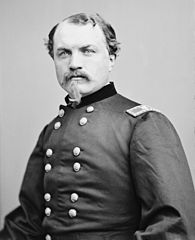
William W. Averell
The morning of March 11, 1862 dawned "clear and mild", according to the daily log kept by Colonel William Averell's 3rd Pennsylvania Cavalry. "Beautiful day," it recorded, but perhaps the most beautiful thing about it for the Keystone State men is that they were camped inside the rebel fortifications at Centreville.

Since March 9, the day after Lincoln's order assigning corps commanders to the Army of the Potomac, Maj. General George B. McClellan's army had been on the move, slowly at first, but gaining speed. Averell's Pennsylvanians had been at the front of that movement.

Company F, which had been part of the tangle with the North Carolina cavalry on the road to Hunter's Mill back in November, had a new captain on March 9, George Johnson, formerly second lieutenant of Company L. Averell had spent the winter as a holy terror to his officers, most of whom he found deficient, to either provoke them to improve their abilities or to drive them from the service. Johnson's predecessor had not passed the test, but the young second lieutenant had been impressive enough to win a double promotion.

The day of his promotion, Captain Johnson was put through the nerve-wracking ordeal of an inspection. Whether Johnson was beside himself or cool and collected, he was responsible not only for making sure all his men turned up in perfect uniform, but then performed the drills asked of them. The inspector was Brig. General Fitz John Porter, leader of one of McClellan's infantry divisions and a known protege of the general-in-chief. Fortunately, it went well:
The review and inspection ended, the officers were summoned in front of the Colonel's quarters. General Porter addressed the officers briefly, congratulated them upon the fine appearance of the troops, and gave utterance to his feelings in remarks of a most flattering character.

Thursday, March 8, 2012

Not Much Choice Between Them

Wherein corps and cracks are formed
..................................................................................................................................


After the Two Weeks That Changed The War the two Armies of the Potomac began moving. Ron over at All Not So Quiet Along the Potomac has done some great stuff about the Confederate preparation and subsequent departure from Northern Virginia, which I will not attempt to duplicate, so make sure you stop over and read it.


 On March 8, 1862, Abraham Lincoln and his new Secretary of War, Edwin Stanton, made a momentous decision--they would overrule McClellan's armies and establish four corps d'armee. French for "body of the army", the grouping of divisions in "corps" had been popularized by the phenomenal success of Napoleon. The units were designed to be armies fully capable of operating independently, but which worked in conjunction within the same theater. But since the 14 divisions of the Army of the Potomac were each larger than any American army previously in existence, the idea was anathema to many Northern leaders.

As usual, the general-in-chief, Maj. General George B. McClellan, lay at the center of what had become a controversial discussion fueled by the Joint Committee for the Conduct of the War. In McClellan's earliest days in Washington, he had stated his intention to form his army into corps. But as part of his systematic effort to remake the U.S. Army in his own image, he had held off on grouping the divisions into corps without explanation. In the meantime, the Joint Committee had caught corps fever, and on February 25 at 8:00 pm, had met with Lincoln in the White House to urge their creation. According to the Committee's report published in 1863:
They made known to the President that, having examined many of the highest military officers of the army, their statements of the necessity of dividing the great army of the Potomac into corps d'armie [sic] had impressed the committee with the belief that it was essential that such a division of that army should be made...The President observed that he had never considered the organization of this army into army corps so essential as the committee seemed to represent it to be; still he had long been in favor of such an organization. General McClellan, however, did not seem to think it so essential, though he had at times expressed himself as favorable to it. The committee informed the President that the Secretary of War had authorized them to say to him that he deemed such an organization necessary.

Friday, February 17, 2012

Indisposed to Make It

Wherein Hooker and McClellan don't really help each other
......................................................................................................................

The noose was beginning to tighten around Maj. General George B. McClellan, general-in-chief of the U.S. Army, and commander of the Army of the Potomac. President Abraham Lincoln had clearly become unhappy with the course of the war, appointing a new Secretary of War, Edwin Stanton, and using his commander-in-chief powers to issue a general order for all armies to begin operations by February 22. McClellan was uncertain if Lincoln himself--who McClellan called "the original gorilla" in private, a nickname invented by Stanton a few months before he joined the administration--was the source of the pressure, or if he was responding to the Radical Republicans in Congress, who had convened the Joint Committee on the Conduct of the War to drum out "traitors" from the war effort, a word they considered synonymous with "Democrats". They had already claimed their first victim, Charles P. Stone, who was imprisoned without charge in Fort Lafayette in New York Harbor, but McClellan knew that he was their real target.

In his own Army, there were generals conspiring to replace him. Brig. General Irvin McDowell, who had appeared to see his career as a commander of troops crushed with the loss at Bull Run, was experiencing a resurgence thanks to his willingness to tell the Joint Committee and Lincoln his proposal for a repeat attack on Manassas Junction. Another division commander, Brig. General Samuel Heintzelman, appeared to be in league with McDowell, ordering reconnaissances along his proposed lines of attack. On the distant right, the senior division commander, Maj. General Nathaniel P. Banks, was requesting McClellan allow him to march his division from Frederick, Maryland, to Winchester, Virginia, almost daily, insisting he could bounce the Confederate force under "Stonewall" Jackson out of the Shenandoah Valley with virtually no losses. To the right of Banks, Brig. General Frederick Lander had been making similar requests with such impertinence that McClellan ordered Banks (through whom his messages were routed) to tell him that the general-in-chief "might comment very severely on the tone of his dispatches, but abstain[s]."

And worst of all for McClellan, other generals were winning successes that he didn't seem able to convince Lincoln were thanks to McClellan's leadership in Washington. His old friend Ambrose Burnside had seized Roanoke Island in North Carolina, providing another base from which to threaten Gosport Shipyard [Norfolk Naval Shipyard], the home port for the new ironclad the Confederates had built out of the scuttled remains of the U.S.S. Merrimack. McClellan might have been due some credit for that operation, but the success in Tennessee against Fort Henry and Fort Donelson by troops under the ultimate command of McClellan's top rival, Maj. General Henry Halleck, looked ominous for Little Mack's tenure.

McClellan had to somehow satisfy Lincoln's insistence, without sacrificing his grand scheme to transport the Army of the Potomac to the Rappahannock and march on Richmond directly. He would need at least a month for the troop ships from Burnside's expeditions to return in order to ferry another army. For McClellan, Joe Hooker provided the solution.

Saturday, January 28, 2012

The Deadline

Wherein Lincoln sets deadlines, luckily for Hooker
................................................................................................................................

Gen. Order No. 1, with quotation highlighted (LOC)
On January 27, 1862, President Abraham Lincoln decided it was time to stop waiting for his general-in-chief's report on how the nation's army would take to the field. Maj. General George McClellan had promised Lincoln such a document when he wrested control of the war strategy back following his sickness. But the report hadn't come. And so Lincoln issued an order to attack using his Article II power as commander-in-chief:
Ordered that the 22nd day of February 1862, be the day for a general movement of the Land and Naval forces of the United States against the insurgent forces.
The order didn't specify which movements, though, which Lincoln expected McClellan to fill in.

But McClellan's plan was probably not complete. Assuming that the Confederate forces around Centreville numbered at least 150,000 in fixed positions, he wanted to use the Rappahannock River to split his opponents off from Richmond and either take their capital or induce them to attack him in a strong defensive position. That much had been conveyed to Lincoln by his loyal surrogate, Brig. General William B. Franklin. But the actual plan of operations was still known only to McClellan, and it was this that Lincoln hoped General Orders No. 1 would elicit (as well as the plans for other theaters).

But even if McClellan wasn't providing plans to the President, plans were being made. On the same day, Brig. General Joseph Hooker responded to an inquiry from McClellan's adjutant general, Seth Williams, about his thoughts on the best way to attack. Hooker had been in Southern Maryland's Charles County since late October, suppressing the region's trade of goods and information with the Confederacy and keeping an eye on the batteries at Evansport [Quantico]. But Hooker was an ambitious man, and he had plotted how he could turn his lonely post on the extreme right of the army into a way to crush the Confederate army.

Sunday, January 15, 2012

McClellan's Winter Offensive

Wherein Little Mac strikes back against his enemies
.....................................................................................................................................

Long Bridge [14th Street Bridge] across the Potomac
"Your Excellency," Maj. General George B. McClellan, general-in-chief of the U.S. Army, wrote President Abraham Lincoln on the morning of January 15, 1862, "I am so much better this morning that I am going before the Joint Committee. If I escape alive I will report when I get through."

McClellan was in the midst of a campaign to reassert his authority. Three weeks earlier, he had fallen sick, usually reported as typhoid fever. It couldn't have happened at a less convenient time, for the general. In mid-December there had already been grumbling about the lack of movement by the massive army he had assembled along the Potomac, and the disaster at Ball's Bluff and the winter campaign of Stonewall Jackson in the Shenandoah Valley had stirred up the embers from the pre-Bull Run fire for rapid advance. Without McClellan's boundless energy for political wrangling to quash it, the fire had blazed up fiercer than ever in Washington, fueled by frustrated officers who had been slighted by McClellan's remaking of the army hierarchy.

The Joint Committee for the Conduct of the War was certainly the most prominent organ of dissent. Committee Chair Senator Benjamin Wade (R-OH) and member Senator Zachariah Chandler (R-MI) had interviewed almost all of McClellan's division commanders (the exceptions: Banks and Hooker, furthest away from Washington), attempting to establish a case that McClellan could attack at any time, and simply wasn't. Both men and a growing number of the so-called "Radical" wing of the Republican Party were becoming more and more convinced that this was because of treasonous beliefs among the conservative West Point officers in charge of the war effort.

Thursday, January 5, 2012

A Disloyal Man

Wherein the Joint Committee checks every Stone
.................................................................................................................................................

Fort Corcoran [Rosslyn] (Harper's Weekly)
January 5, 1862 was a Sunday, and in the town of Hancock, Maryland, a small force of Union troops under Brig. General Frederick Lander was receiving an ultimatum from Stonewall Jackson. Lander's men had been chased out of Bath the day before [today, in West Virginia, and primarily known by its unofficial name, Berkeley Springs]. Lander arrived during the day on January 5 and was told by Jackson that the town would be shelled if the Northerners didn't abandon it. With characteristic bravado, Lander told his envoy (Colonel Turner Ashby) to "bombard and be damned!... He will injure more of his friends than he will of the enemy, for this is a damned secesh place anyhow!" Lander then scribbled a more professional note for Ashby, and sent a message back to Washington for reinforcements. But the environment it would find in Washington was one that pointedly illustrates the differences between 1861 and 1862.

Lander was in charge of the Department of Harper's Ferry and Cumberland, located on the Maryland side of the Potomac River, between, not surprisingly, Cumberland and Harper's Ferry, but including a 30 mile patch of land on the southern side of the river (which, modified based on later military organizations, became the basis for that strange nub in the West Virginia panhandle, established in 1863). This little department had been established by Winfield Scott months earlier, because Lander pledged to be more aggressive than the Army of the Potomac's George McClellan and reopen the B&O Railroad to freight traffic, but he had been delayed in reaching his command. In the meantime, McClellan had succeeded Scott as general-in-chief of the U.S. Army and Lander's department had been added to the Army of the Potomac as a division (despite McClellan not countermanding the order that it was an independent command).

So Lander sent his request down the line to the next division commander, Maj. General Nathaniel P. Banks, in Frederick, Maryland. Banks, who heartily shared Lander's belief that an immediate offensive was needed to gain Winchester and control of the lower Shenandoah Valley as well as reopen the B&O, would have sent the request on down the line. Next in line was the division of Brig. General Charles P. Stone, headquartered in Poolesville (though the request probably would have taken the direct route from Frederick, through Gaithersburg and Rockville). Next were the divisions of Brig. Generals George McCall (the Pennsylvania Reserves) and W.F. "Baldy" Smith, placed on the Virginia side of the Potomac (in Langley and Lewinsville, respectively), completing the right-wing of the Army of the Potomac.

Friday, September 16, 2011

By Command of Lieutenant-General Scott

Wherein the old boy gets his second wind
........................................................................................................................

View from Ft. Marcy, completed in late September 1861 by W.F. "Baldy" Smith's brigade


On September 16, George McClellan got an order transmitted by Lt. Colonel Edward Townsend, chief of staff for the general-in-chief of the U.S. Army, Winfield Scott.
The commanding general of the Army of the Potomac will cause the position, state, and number of troops under him to be reported at once to general headquarters, by divisions, brigades, and independent regiments or detachments, which general report will be followed by reports of new troops as they arrive, with the dispositions made of them, together with all the material changes which may take place in said army.
"By command of Lieutenant-General Scott," Townsend helpfully signed it, opting for a more military valediction than his typical "your obedient servant". Winfield Scott was at last striking back.

Almost since McClellan had arrived in Washington (and certainly since Scott had poo-pooed his intelligence that an attack by over 100,000 Confederates was imminent), the junior general had attempted to circumvent the elderly general-in-chief. He had decided that Scott had become too senile or too stuck in his ways to take the bold actions needed to save the Union. And Scott was affecting a cadre of senior officers from the old Army. Only by breaking the stranglehold of the same military leaders that had let the South secede, take Federal property, and win at Bull Run and Wilson's Creek, could McClellan save the Union.

Saturday, August 27, 2011

Hooker's On Parade

In which McClellan, et al., review the new Army of the Potomac
.................................................................................................................................

The old Bladensburg dueling grounds
Since he had secured his U.S. Volunteers brigadier generalship in the most dramatic way possible, Joe Hooker had set to work proving that he was a "damned sight better general than [Lincoln] had on that field" on the banks of the Bull Run. Hooker was in command of a brigade stationed at Camp Union, just shy of Bladensburg on the B&O Railroad line, where the Bladensburg Road passed outside of the boundaries of the District of Columbia.

It was a historic area, even in 1861. Named after a pre-Revolution governor of Maryland, it developed as a port on the Eastern Branch of the Potomac (today called the Anacostia) for Maryland tobacco crops. On August 24, 1814 American briefly occupied the same territory as Camp Union, before they ran from British soldiers and marines at the Battle of Bladensburg in one of the most shameful defeats in U.S. history (part of the flight was in terror from the new Congreve rocket employed by the British, which would also give its red glare to the Baltimore sky a month later, inspiring Francis Scott Key). The British had a free pass into Washington City, and burned most of it that night.