Showing posts with label C.P. Stone. Show all posts

Wednesday, February 8, 2012

The Arrest of General Stone

Wherein the provost guard carries out an order
......................................................................................................................................

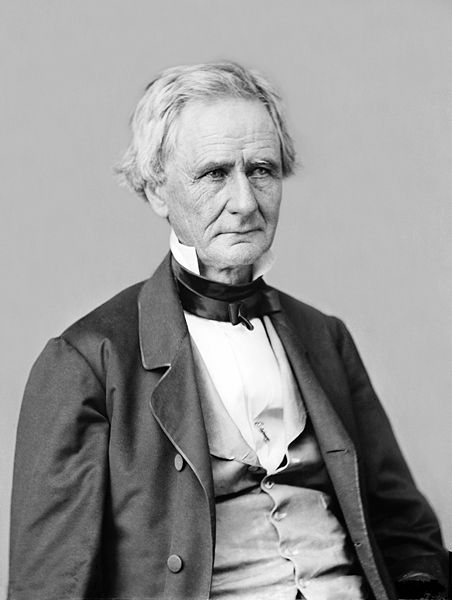
On February 8, Brig. General Andrew Porter received the following order from the general-in-chief, Maj. General George B. McClellan:
You will please at once arrest Brig Genl Chas P Stone U.S. Volunteers & retain him in close custody, sending him under suitable escort by the first train to Fort Lafayette there to be placed under charge of the comdg officer to await trial [sic]. See that he has no communication with any one from the time of his arrest.
Porter was the Provost Marshal for the Army of the Potomac, the officer charged with enforcing regulations and maintaining martial law in the area of the army's operations. He had served in the position since McClellan had taken command of that army, and was largely responsible for the vast improvement in discipline by the troops around Washington (though getting most of them out of the city and into the Virginia countryside had helped). He was also responsible for carrying out unpopular actions against local civilians, including the arrest of Washington City's mayor for conspiring against the government and the imprisonment of Rose O'Neal Greenhow and the other female secessionists.

Porter was a Pennsylvanian with the American army baked deep into his DNA. His father had been an officer in the War of 1812, and his grandfather had been a general in the American Revolution. Porter had only spent six months at West Point before dropping out to fight in the Mexican War, but he was nevertheless a consummate army professional. With the U.S. Mounted Rifles Regiment he was promoted to captain and won brevets to major and lieutenant colonel for prowess in battle. When Fort Sumter surrendered, Porter was chosen to be colonel of the new regular regiment the 16th Infantry, the only one of nine new colonels for the new regiments that had not graduated from West Point.

But before Porter had even seen his regiment, he was commanding a brigade in the Army of Northeast Virginia, whose commander, Irvin McDowell, had decided with such inexperienced troops a regular army colonel was needed to keep them under control. His division commander was the new colonel of his old Mounted Rifles, David Hunter, and the other brigade was commanded by Colonel Ambrose Burnside of the Rhode Island militia. Hunter was wounded on Matthews' Hill and, after the battle, Porter and Burnside argued publicly about which of them had led the division and helped out most in the battle.

Tuesday, January 31, 2012

Evidence Said to Impeach

In which Charles P. Stone testifies a second time
.........................................................................................................................

McClellan's winter offensive came sputtering to a halt on the last day of January. Since the end of his illness, he had worked politically to regain complete control of the U.S. war effort, and he thought he had achieved it. But on January 27, President Lincoln had issued General Order No. 1 ordering all Federal armies to begin advancing by February 22. Throughout the week he rapidly put together a plan and pitched it to the President, but on January 31, McClellan received the President's rejection--by reading a copy of Special Order No. 1, directed to the commander of the Army of the Potomac (McClellan, concurrently with his responsibilities as general-in-chief), as shown to him by a member of the press.
Ordered, That all the disposable force of the Army of the Potomac, after providing safely for the defense of Washington, be formed into an expedition for the immediate object of seizing and occupying a point upon the railroad southwestward of what is known as Manassas Junction; all details to be in the discretion of the General in Chief, and the expedition to move before or on the 22d day of February next.
One thing McClellan didn't take into account was the fracturing of Lincoln's political base over the winter, best epitomized by the rise of the Joint Committee on the Conduct of the War. The Radical Republican-dominated Committee had spent most of January interviewing McClellan's division commanders about the possibility of forward advance. They had concluded it was, and they had conveyed that assurance to Lincoln's new Secretary of War, Edwin Stanton. McClellan wasn't aware of it yet, but despite Stanton's reliable Democratic politics his views on the war were actually closely aligned with the Committee's. While McClellan had spent a great deal of time consulting with Stanton before his appointment to Secretary of War, it was almost certainly Stanton who suggested Lincoln's two orders.


Stanton's regular meetings with members of the Committee had yielded another decision in their favor that struck a blow at McClellan's control of the Army of the Potomac. On January 28, almost certainly on the advice of members of the Committee who had met with him the previous day, Stanton issued an order to arrest Brig. General Charles P. Stone.


McClellan was aghast. Not only was Stone one of his handpicked division commanders (even though he had also been a protege of Winfield Scott, a rarity), but the attacks in the Republican press and in both chambers of Congress had taken on a decidedly partisan tone towards Stone's conservative politics, which happened to be McClellan's as well. Eager to avoid carrying out the order, McClellan convinced both Stanton and the members of the Committee that Stone's first, confrontational testimony before the Committee had been incomplete, and to allow him another chance.

Thursday, January 5, 2012

A Disloyal Man

Wherein the Joint Committee checks every Stone
.................................................................................................................................................

Fort Corcoran [Rosslyn] (Harper's Weekly)
January 5, 1862 was a Sunday, and in the town of Hancock, Maryland, a small force of Union troops under Brig. General Frederick Lander was receiving an ultimatum from Stonewall Jackson. Lander's men had been chased out of Bath the day before [today, in West Virginia, and primarily known by its unofficial name, Berkeley Springs]. Lander arrived during the day on January 5 and was told by Jackson that the town would be shelled if the Northerners didn't abandon it. With characteristic bravado, Lander told his envoy (Colonel Turner Ashby) to "bombard and be damned!... He will injure more of his friends than he will of the enemy, for this is a damned secesh place anyhow!" Lander then scribbled a more professional note for Ashby, and sent a message back to Washington for reinforcements. But the environment it would find in Washington was one that pointedly illustrates the differences between 1861 and 1862.

Lander was in charge of the Department of Harper's Ferry and Cumberland, located on the Maryland side of the Potomac River, between, not surprisingly, Cumberland and Harper's Ferry, but including a 30 mile patch of land on the southern side of the river (which, modified based on later military organizations, became the basis for that strange nub in the West Virginia panhandle, established in 1863). This little department had been established by Winfield Scott months earlier, because Lander pledged to be more aggressive than the Army of the Potomac's George McClellan and reopen the B&O Railroad to freight traffic, but he had been delayed in reaching his command. In the meantime, McClellan had succeeded Scott as general-in-chief of the U.S. Army and Lander's department had been added to the Army of the Potomac as a division (despite McClellan not countermanding the order that it was an independent command).

So Lander sent his request down the line to the next division commander, Maj. General Nathaniel P. Banks, in Frederick, Maryland. Banks, who heartily shared Lander's belief that an immediate offensive was needed to gain Winchester and control of the lower Shenandoah Valley as well as reopen the B&O, would have sent the request on down the line. Next in line was the division of Brig. General Charles P. Stone, headquartered in Poolesville (though the request probably would have taken the direct route from Frederick, through Gaithersburg and Rockville). Next were the divisions of Brig. Generals George McCall (the Pennsylvania Reserves) and W.F. "Baldy" Smith, placed on the Virginia side of the Potomac (in Langley and Lewinsville, respectively), completing the right-wing of the Army of the Potomac.

Friday, December 23, 2011

Public Shot

The further adventures of Charles P. Stone's foot in his mouth
.......................................................................................................................

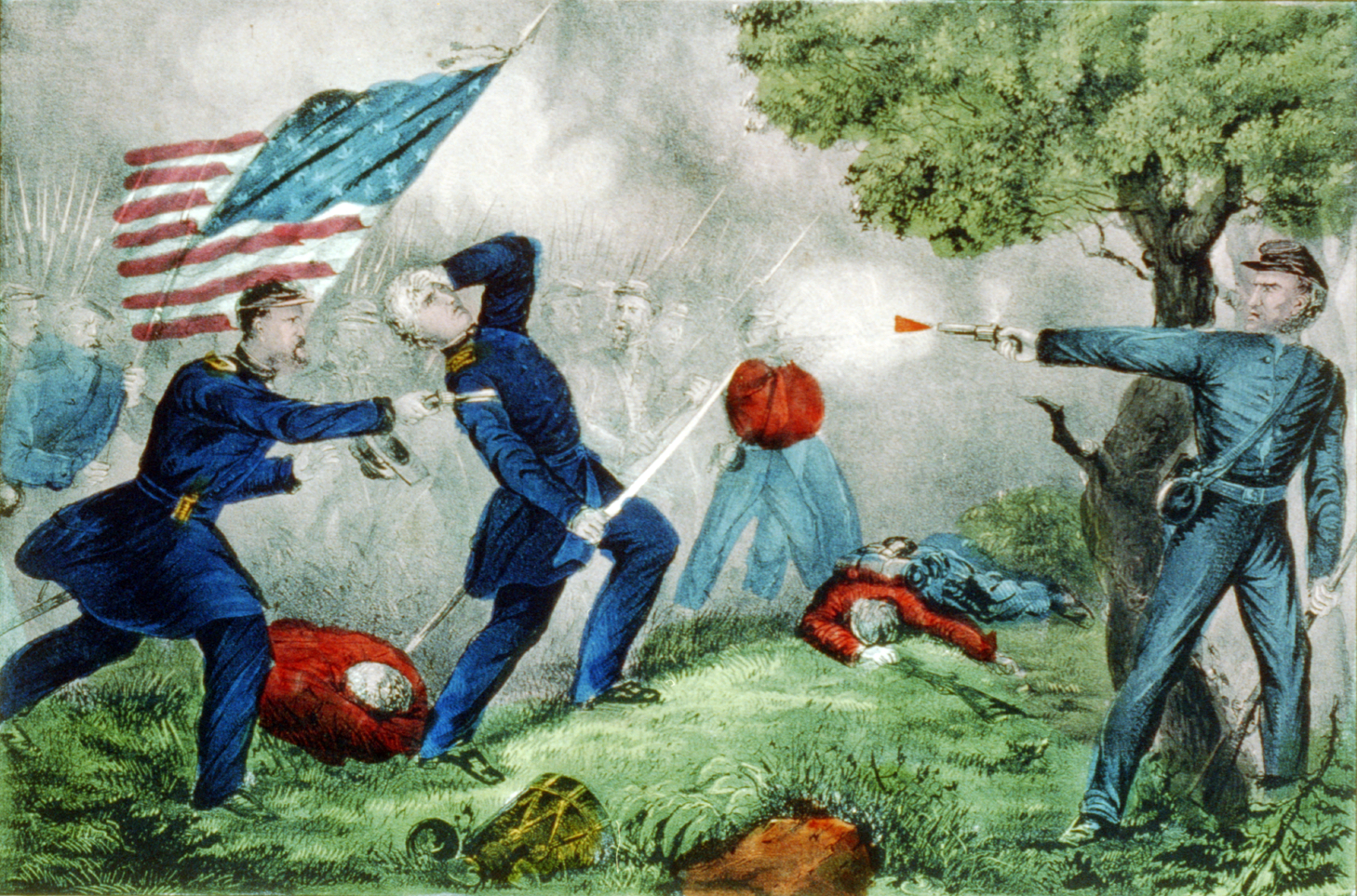
Charles P. Stone was furious when he sat down to write on December 23. Just a few days earlier, his own State's senator, Charles Sumner (R-MA), had denounced him on the Floor of the U.S. Senate. Angry that the Lincoln Administration and the War Department were forcing Massachusetts soldiers to comply with the Fugitive Slave Act, Sumner's thundering denunciation of the policy dragged Stone to the center of the fight between anti-slavery Republicans and the conservative prosecutors of the war. Sumner had sarcastically said that:
Brigadier General Stone, the well-known commander of Ball's Bluff, is now adding to his achievements there by engaging ably and actively in the work of surrendering fugitive slaves. He does this, sir, most successfully. He is victorious when the simple question is whether a fugitive slave shall be surrendered to a rebel.
If Sumner dragged Stone into the middle of the national spotlight, it was Stone who nailed himself to the ground so firmly there was no escaping. When a friend gave Stone a copy of Sumner's remarks, transcribed in the local papers, Stone sat down to angrily rebut the Senator's criticism. He argued that it was his orders and his responsibility to enforce the laws of the nation, including the fugitive slave law, and that only a strict respect for property rights of loyal civilians as understood before the war began would lead to a quick end and a reunion of the country (in fact, he had sent the commander of the expedition to Ball's Bluff with standing orders to shoot any soldier who plundered).

But if Stone's self-confidence was his greatest virtue, the arrogance it bred was his greatest vice. And his fury at Sumner's perceived mangling of his carefully considered position brought out the worst in Stone. The letter he wrote on December 23 was the first time since Ball's Bluff when he addressed anyone other than personal friends about the hot water he had found himself in outside of the official military channels, a major breach of personal decorum for Stone. Worse, he concluded his letter with words meant to insult:
Please accept my thanks for the speech in which you use my name... There can hardly be better proof that a soldier in the field is faithfully performing his duty than the fact that while he is receiving the public shot of the enemy in front he is at the same time receiving viterpuration [sic] of a well-known coward from a safe distance in the rear.
Never politically savvy, Stone probably did not realize he was making himself Enemy No. 1 of the group of Republicans that would come to be known as the Radical Republicans (a name full of baggage and not contemporary to 1861, so I'll avoid it for now). Sumner took the letter immediately to Lincoln, when he received it. Sumner and his allies believed that Stone's actions at Ball's Bluff had been either gross mismanagement or outright treason, and that Lincoln's good friend, Senator Edward Baker, had paid the price to either save Stone's debacle or thwart Stone's malfeasance. The letter's conclusion seemed to offer proof that Stone was malicious.

Lincoln, who had closely interviewed Stone about Baker's death, was deeply disturbed, but told Sumner that though he would not have written such cruel words himself, he believed Stone was probably within his rights after the harsh treatment Sumner had given him on the Floor. Not recorded is what Lincoln responded to Sumner's original speech, considering it was his Administration's policy that Sumner was following.

Whatever Lincoln's feelings, Sumner also took the letter to Senators Benjamin Wade (R-OH) and Zachariah Chandler (R-MI), the top two members of the newly formed Joint Committee on the Conduct of the War. The investigation into what happened at Ball's Bluff now had a principal subject of investigation.

Sunday, December 18, 2011

A Brave and Impetuous Soldier

Wherein we begin the tribulations of Charles P. Stone
................................................................................................................

The Senate had changed since it last met in the summer. In the days following the Union defeat at Bull Run (actually, before it too) the top critics of the Lincoln Administration were Democratic Senators John C. Breckinridge from Kentucky and Trusten Polk from Missouri. Neither was present when the Senate reconvened at the beginning of December. Breckinridge had fled to the Confederacy and was expelled December 4, but Polk's whereabouts (as well of those of his fellow Missouri Senator Wade Johnson) were unknown. It was suspected (correctly) that both had joined the Confederates, and on December 18 the Senate debated expelling two more of their colleagues. The fourth missing member was Senator Edward Baker of Oregon, who had been killed leading troops at the Battle of Ball's Bluff in late October.

Outside the Senate, the war effort had changed to. The top military adviser was now Maj. General George B. McClellan, who had advocated a policy of holding on all fronts while the Army of the Potomac, which he also commanded, was built up for an advance on the Confederate capital at Richmond. Unfortunately, the Lincoln administration still favored a policy closer to that devised by the former general-in-chief, Winfield Scott, which relied on a blockade of the South and controlling the Mississippi River to break the control of secessionists over Southern State governments.

The combination of traitors in their midst and strategic shifts brought back a Senate (and House) much more aggressive about overseeing the Administration's execution of the war. One of their very first acts when returning was to create a Joint Committee on the Conduct of the War, Chaired by Senator Benjamin Wade (D-OH). At the top of the Committee's list of priorities was to find out what had happened at Bull Run and Ball's Bluff.

Saturday, October 22, 2011

Something Being Done

Wherein a sitting Senator is dead on the field of battle
.........................................................................................................................................

The death of Senator Edward D. Baker at Ball's Bluff
A quick programming note: it had been my intention to live blog the Battle of Ball's Bluff, but life sometimes gets in the way of plans. However, if study of the Civil War battlefield reveals anything, it's that the victorious are rarely those who planned the best, but those who adapted their plans best when they met reality. Hopefully that works for writing about history too. And so, I'll continue my plan to live blog the battle, but instead I'll live blog it the way most Americans experienced it -- through the weeks and months afterwards that it took to understand what had happened. For a more traditional account, I recommend Disunion today. Or, if you prefer to read in "real time", I recommend the collection of telegrams between Washington and Poolesville that tell the story rather poignantly (though slightly out of order).

On the evening of October 21, the public around the capital city was beginning to realize that something had happened. For those living along the upper Potomac River, the day had been punctured by the deep boom of artillery and the staccato rattle of musketry, signifying that that thing must be a battle, and word was spreading about it fairly quickly. But who had been engaged and who had won?

Only the barest rumors of a battle had George Meade, leading a brigade of the Pennsylvania Reserves. On the afternoon, Meade was marching with the rest of his division away from Dranesville, only a few miles from the battlefield, where men from the division of Charles P. Stone were suffering and dying all day long. The Reserves, under Brig. General George McCall, had been moved to Dranesville on October 19, by order of the commanding general of the Army of the Potomac, Maj. General George McClellan. McClellan had received a report from Stone, who was charged with watching the river crossings around Leesburg, that the Confederates there had mostly withdrawn. So he had sent McCall and the Reserves to scout out the area and try to scare away any remaining troops, hoping that Stone might have the chance to capture Leesburg, and thus secure Union control of the Potomac.

On October 19, McClellan had wanted McCall to march back to their camp in Langley immediately the next day, so as to not leave a hole in the army's line of defenses around Washington. But the older general had persuaded his young commander to allow him to keep his men out through the weekend in order to give his engineers time to make detailed maps that would be needed for a possible future attack on Leesburg. If the division required to pick up McCall's slack hadn't been that of McClellan favorite "Baldy" Smith, then there may have been no Ball's Bluff, but as it happened, McClellan accepted McCall's request under strict orders that the Reserves were to be back in Langley by October 21.
At 10:00 am on Monday, October 21, McCall dutifully ordered his three brigades to return home. The men marched back down the Georgetown Pike towards Langley, probably split between disappointment that no battle had been fought and eagerness for a properly cooked dinner when they reached camp. The historian of the division recorded that two brigades had reached Camp Pierpont at 1:00 pm (probably Meade's and the Colonel McCalmont's), when McCall was presented with a telegram from McClellan ordering him to remain in Dranesville, if he hadn't left yet. McCall quickly sent a reply asking for new orders, since he had already returned to camp, and was told to let the men rest, but be prepared to move out.

Thursday, October 20, 2011

A Slight Demonstration

Wherein Stone attempts to scare Evans out of Leesburg
........................................................................................................................................

On the morning of October 20, Brig. General Charles P. Stone commanding a division of the Army of the Potomac based at Poolesville received the following message from that army's commanding general's staff:


Stone had been in charge of guarding the river crossings on the upper Potomac River since the launch of the Rockville Expedition in July. As a sizable community in a fertile country, with two good ferrying points, Leesburg would make a splendid base of operations for a sudden northward stab by the Confederates to cut the line between Washington and southern-sympathizing Baltimore, thus enveloping the capital. The bulk of the Army of the Potomac blocked the direct approach for the Southerners on Washington, Harper's Ferry was far enough away to allow a wheeling movement by that army, and a Northern flotilla controlled the lower Potomac (the batteries at Evansport not yet fully operational), and so throughout the summer and fall, Leesburg was presumed to be the jumping off point for an attack by the overestimated-in-size Confederate army.

Stone was the man asked to guard that point, and it was a job he intended to do professionally. He was a serious man, described as polished and well-mannered. A Democrat fiercely loyal to the Union, Stone had accomplished the unusual feat of being well-liked by both his immediate commander, Maj. General George McClellan, and the aged general-in-chief, Bvt. Lt. General Winfield Scott. Stone's obsession with doing things according to the professional code he had developed in his career with the U.S. Army sometimes bothered his superiors and volunteer troops. He was famous for sending careful enumerations of his division's supply problems, persistently requesting regular troops to carry out his mission, and scolding the War Department for sending him documents marked "secret" by U.S. Mail. His men had just had a run-in on October 16, when, after catching two possible Confederate spies in camp selling pornography to the men, he expelled them and then had the entire division searched for pornography, which he destroyed.

Wednesday, October 19, 2011

Making Them Abandon Leesburg

Wherein McClellan sends the Pennsylvania Reserves to check on a key spot on the Potomac
..............................................................................................................................................

"It seems pretty well settle that I will be Comdr in Chf within a week," Maj. General George B. McClellan crowed to his wife, Mary Ellen, writing from Lewinsville, Virginia on October 19, where he was spending time with the division of "Baldy" Smith. McClellan had heard the results of  a secret cabinet meeting the day before, where the President had determined to act on the offer to resign by his general-in-chief, Bvt. Lt. General Winfield Scott, which had been pending for months now.

Secretary of the Navy Gideon Welles recorded the meeting in his diary:
The Presdt. read to us a draft to a letter to Gen S. (delicately and handsomely written) importing that Gen S. had expressed a wish to be retired, under the act, and only witheld [sic] it at the Presdt.'s request; that he would no longer object--That he would still, sometimes, need his advice--not so often as to burden him--and was disposed to deal generously by the Genl.'s military family...
Scott's military family meant the officers he had helped promote and whose careers he had helped advance, such as Brig. General Irvin McDowell. But foremost in Scott's mind would have been Henry Wager Halleck. Halleck was nicknamed "Brains" because of his intellectualism and Scott became enamored of him because of his translations of French military strategy and efforts to turn the rough American army into a leader in the realm of military science. When the Civil War broke out, Scott made sure that Halleck was made a major general in the regular army, fourth in rank behind himself, McClellan, and John C. Fremont. Then Scott sent Halleck to Missouri to clean up the mess Fremont had made.

"Genl Scott proposes to retire in favor of Halleck," McClellan told Mary Ellen. "The Presdt & Cabinet have determined to accept his retirement, but not in favor of Halleck. The old ____'s [sic] antiquity is wonderful & lasting." Welles wrote down no such comment about Halleck, but hindsight suggest McClellan's information was correct. By tradition, the general-in-chief was always the longest serving major general, anyway, so to name Halleck to the position while McClellan and Fremont were still on active duty would be unprecedented.

"The enemy have fallen back on Manassas--probably to draw me into the old error," McClellan added, almost as an afterthought. "I hope to make them abandon Leesburg tomorrow."

"I had just seated myself down to write you a nice long letter," George Meade had written his wife on the evening of October 18, "when orders came to march to-morrow, requiring me to stir about and give the requisite directions."

Monday, October 17, 2011

Their Absence Not Perceived

Wherein the beginning of the biggest story of October 1861 goes unnoticed
...................................................................................................................................

On the evening of October 17, 1861, Brig. General Charles P. Stone heard a remarkable report. The Confederates had left Leesburg. Since June, Stone had been responsible for soldiers based in Poolesville, Maryland watching the upper Potomac for signs of a Confederate crossing, save for approximately a week around the Battle of Bull Run. The size of their force had varied, but his opponents had never before abandoned Leesburg.

He carefully interviewed the scouts and peered across the river at their usual positions himself, before finally transmitting to the commander of his army the surprising news:


Stone's division of three brigades numbered about 12,000 men. His opponent on the Virginia side of the river mustered only 2,500 men by the more optimistic accounts. Colonel Nathan "Shanks" Evans, one of the heroes of Manassas, commanded the Seventh Brigade of General G.T. Beauregard's First Corps. It had one under-sized artillery battery, five companies of cavalry (numbering about 300 horsemen), three regiments of Mississippi infantry (about 600 each), and Colonel Eppa Hunton's 8th Virginia Infantry (at only about 450, probably due to the close proximity to the homes of its members).

Some of Evans' cavalry had close ties to the cavalry of Colonel Turner Ashby operating around Harper's Ferry (they either would eventually become part of his 7th Virginia Cavalry or already were, depending on the source) and were quick to report to the South Carolinian about a skirmish near there on the day before. The Seventh Brigade formed a salient, or a part of the line that sticks out and is surrounded on three sides, especially since the Union army had recently occupied Langley and Lewinsville. Continuing to hold Leesburg would put Evans at risk of being attacked from behind by a Union army.

So when Evans heard about the skirmish at Harper's Ferry and combined it with the occupation of Langley and Lewinsville, he assumed that the North was planning a push to secure Leesburg and Loudoun County beofre winter. So, without checking with anyone up the chain of command, he decided to move his little brigade to a safer line of defense at Goose Creek where it intersected the Old Carolina Road [today, the site of Oatlands Plantation].

Monday, October 3, 2011

Beginning to Move

Four vignettes of the beginning of October
..........................................................................................................................

As the weather changed in October 1861, the stagnation that had characterized summer around the nation's capital began to break up. At the end of September, the Confederates evacuated their advanced position at Munson's and Mason's Hills, and the picket war around Bailey's Crossroads and Falls Church died down. The Confederacy's Army of the Potomac, under General Joseph E. Johnston, was falling back to a stronger defensive position, in light of the conclusion that they would be unable to launch an offensive anytime soon.

For Maj. General George McClellan, commanding the Union's Army of the Potomac, it was a time when command of his army was coming together. For McClellan, though, the passing of the imminent threat of Confederate attack (not that he didn't still believe it might come, he just felt prepared for it) seems to have given him full time to worry about his personal battles. "I am becoming daily more disgusted with this administration," he wrote to Mary Ellen on October 2, "perfectly sick of it."
If I could with honor resign I would quit the whole concern tomorrow; but so long as I can be of any real use to the nation in its trouble I will make the sacrifice. No one seems able to comprehend my real feeling--that I have no ambitious feelings to gratify, & only want to serve my country in its trouble, & when this weary war is over to return to my wife...


Friday, September 16, 2011

By Command of Lieutenant-General Scott

Wherein the old boy gets his second wind
........................................................................................................................

View from Ft. Marcy, completed in late September 1861 by W.F. "Baldy" Smith's brigade


On September 16, George McClellan got an order transmitted by Lt. Colonel Edward Townsend, chief of staff for the general-in-chief of the U.S. Army, Winfield Scott.
The commanding general of the Army of the Potomac will cause the position, state, and number of troops under him to be reported at once to general headquarters, by divisions, brigades, and independent regiments or detachments, which general report will be followed by reports of new troops as they arrive, with the dispositions made of them, together with all the material changes which may take place in said army.
"By command of Lieutenant-General Scott," Townsend helpfully signed it, opting for a more military valediction than his typical "your obedient servant". Winfield Scott was at last striking back.

Almost since McClellan had arrived in Washington (and certainly since Scott had poo-pooed his intelligence that an attack by over 100,000 Confederates was imminent), the junior general had attempted to circumvent the elderly general-in-chief. He had decided that Scott had become too senile or too stuck in his ways to take the bold actions needed to save the Union. And Scott was affecting a cadre of senior officers from the old Army. Only by breaking the stranglehold of the same military leaders that had let the South secede, take Federal property, and win at Bull Run and Wilson's Creek, could McClellan save the Union.

Thursday, September 8, 2011

Informing Secretary Cameron

In which it becomes apparent the author has read too many McClellan letters
..................................................................................................................................

Secretary of War Simon Cameron
Secretary of War Simon Cameron knew that the commander of the Department of the Potomac, encompassing most of Virginia, Maryland, and all of the nation's capital, was not pleased with the U.S. Army's commander, Bvt. Lt. General Winfield Scott. In fact, Maj. General George McClellan was in something of a cold war with Scott at the moment, avoiding confrontation with him by pretending he didn't exist. For his part, Scott had still refused to withdraw his request to be placed on the retired list, effectively a resignation, but without sacrificing the gratitude the nation's longest-serving soldier expected to receive when he completed his career.

On September 7, Cameron decided the best way to make amends in the Union high command was to assuage McClellan's paranoia about a lack of support from the Lincoln Administration and the War Department. Assured, the younger general would then be able to give Scott the deference the older man thought he deserved. So he sent McClellan a carefully crafted note.
It is evident that we are on the eve of a great battle--one that may decide the fate of the country. Its success must depend on you, and the means that may be placed at your disposal. Impressed with this belief, and anxious to aid you with all the powers of my Department, I will be glad if you will inform me how I can do so.
Cameron was surely pleased with his little bit of diplomacy. It gave credence to McClellan's obsessive insistence that the Confederates were on the verge of attacking (which Scott continued to ridicule) and signaled that the War Department was eager to give McClellan what he felt he needed.

Sunday, September 4, 2011

Aiming Too High

In which the troops no one wanted are bombarded at Great Falls
..........................................................................................................................

Governor Andrew Curtin (Matthew Brady)
At approximately 8:30 in the morning of September 4, the attack came. Confederate cannon opened up on the 7th Pennsylvania Reserves stationed at Great Falls, just like Colonel Elisha B. Harvey had been warned.

Harvey had been preparing for the attack since August 24, when a message from the commanding officer of the Army of the Potomac, Major General George McClellan, had been transmitted to his brigade commander that a Confederate attack was imminent at Great Falls. The general - Brigadier General George A. McCall - had immediately sent Harvey to Great Falls with his regiment of infantry, a company of cavalry and a few artillery pieces to make sure a crossing couldn't occur without him knowing about it. Since then, Harvey had waited for the attack to begin.

McCall was part of a cordon McClellan had established along the Potomac River, reaching from Washington City to the division of Major General Nathaniel P. Banks at Harper's Ferry. Fittingly, the general commanding the most upstream brigade of the cordon was Charles P. Stone, the beleaguered then-colonel who had tried to cover the entire length of that distance during the Rockville Expedition with less than an eighth of the soldiers now assigned to the task. Back in Poolesville, Stone now only had to cover the distance from Point of Rocks down to Seneca Mills. To the east, the cordon was connected to the defenses of Alexandria County by a brigade under Brigadier General William Farrar Smith, better known as "Baldy" Smith, headquartered at the Chain Bridge.

Sunday, July 31, 2011

Jockeying For Position

In which new stars appear and Hooker does what Hooker does
............................................................................................................................................

Grade insignia (yellow indicates cavalry). Volunteers
and regular army wear the same insignia
Since the secession of South Carolina seven months before military men throughout the North had been attempting to get a high-ranking position in the war. While rank was equally important to Southerners, the North already had an army, making competition for leadership slots tougher than in the South (though no more vicious). Most of these men had been junior officers during the Mexican War, and some had acquired a taste for combat that no civilian pursuit could satisfy, while others saw the leaders of the Mexican War rise to fame and fortune based on their service (two became Presidents of the United States), and still others believed in the Union fervently enough to shed their blood for it. Most were motivated by a combination of some or all of these things.

In the aftermath of the defeat at Bull Run, the opportunities for high command became greater. The influx of three-year regiments and the determination to field a larger army around Washington created a higher demand for general officers, and the passage of a law establishing a corps of U.S. Volunteers (USV) to supplement the U.S. Army (USA) also allowed Lincoln to appoint as many officers as he needed. Starting on Wednesday, July 31, the floodgates of USV promotions opened as the White House finalized its consultations with the War Department and sent a large list of nominations to the Senate.

Friday, July 29, 2011

Eppa Hunton Returns to Leesburg

In which we name check Prince William, Fauquier, and Loudon
........................................................................................................................................

Eppa Hunton II
"We made our march to Leesburg, the citizens all along the road greeting the victorious soldiers with tumultuous joy, and welcoming their safe return to the County of Loudoun," Eppa Hunton remembered about the days following Manassas. Hunton was colonel of the 8th Virginia Volunteer Infantry Regiment, which had guarded the two major Potomac River crossings near Leesburg (Edward's and Conrad's Ferries) while Charles P. Stone's Rockville Expedition was ongoing. When Irvin McDowell began his march on Washington and Stone went west to Harper's Ferry, the 8th Virginia and a South Carolina regiment that had reinforced them had scurried south to Manassas to bolster the Army of the Potomac, then under G.T. Beauregard.


At a crucial moment on Henry Hill, Hunton had thrown his regiment into the fray after deciding on it with another regiment's colonel and helped turn the tide decisively. But in the confusion it was unclear whether the result was going to be a Union retreat, or the forces were just repositioning themselves closer to Stone Bridge to try to flank. Hunton's eight company regiment would have been the only ones to defend such an attack and the colonel became very grim until it became clear the Northerners had broken and were running for Washington. Hunton wrote in his autobiography:
I had up to that time passed with my soldiers for an exceedingly pious man, but I lost my reputation as such, then and there. After I discovered that this force that I thought I would have to fight, had broken into pieces, I was extremely relieved and galloped back to my regiment, only a hundred yards off; and they said, and proved, that I proclaimed with a hearty oath that the Yankees were running like dogs. I was utterly unconscious of using an oath, but have no doubt I did. They proved it on me conclusively, and I never recovered my reputation for piety during the war.

Wednesday, July 13, 2011

Guarding the Bridges

The Aqueduct Bridge, looking from Georgetown towards Rosslyn (LOC)
In mid-June, Colonel Charles P. Stone had been dispatched with the District of Columbia militia, the 1st New Hampshire, and 1st Pennsylvania, some cavalry and two field pieces, on the Rockville Expedition in order to guard the river crossing points between Washington and Harper's Ferry and strengthen general-in-chief Winfield Scott's cordon defense. By July 11, the ferries were undefended, the DC Militia was licking its wounds at home, and Stone had joined the two three-month volunteer regiments with the army of Robert Patterson near Martinsburg. Scott had chosen to abandon the goals of the Rockville Expedition in order to better execute an attack under Irvin McDowell on Confederates defending Manassas Junction.

But the ferries were not the only Potomac River crossings in 1861, three bridges also existed (all of which are located at river crossings today). The first was the Long Bridge, extending from the intersection of Maryland Avenue (today subsumed on an expanded rail right-of-way leading to L'Enfant Plaza) and 14th Street to Arlington Heights (today the site is the 14th Street Bridge). The second was the Chain Bridge (yes, that Chain Bridge) which went from rural Alexandria County (it wouldn't be renamed Arlington County until 1920) to rural Washington County (DC at the time consisted of Washington City, Georgetown, and Washington County within its current boundaries). The third bridge was the Aqueduct Bridge, which was a bridge of water that brought the C&O Canal from Georgetown across the river, extending it to Alexandria City (just up-river from today's Key Bridge).

Monday, July 4, 2011

Independence Day, 1861

Lincoln's draft of July 4 message
Almighty and everlasting God, be not angry with us for our sins, which we only confess and deplore; but pardon our offenses and extend us Thy favor. We thank Thee for Thy goodness on this anniversary of our nation--a day tenfold more precious by reason of our present troubles...disasters have befallen us and darkness broods in the land. And now we ask Thy mercy as the Senate is convening at a most momentous crisis in our history... And we beseech Thee to guide us... to cause that nothing shall fail, that the disorders of the land may be speedily healed, that peace and concord may prevail, that truth and righteousness may be established, and that Thy Church and Kingdom may flourish in a larger peace and prosperity...
So prayed Rev. Byron Sunderland, the new chaplain of the Senate at noon on Thursday, July 4. He was also the popular minister at the "Old First", the First Presbyterian Church located across from the Capitol, where the Rayburn House Office Building now stands. In 1857, he had rocked sleepy Washington by preaching abolition, and his close connections with the majority Republicans had led to his appointment (Sunderland would make waves again in 1866, when he allowed Frederick Douglass to preach from the Old First's pulpit -- he would also be instrumental in the early days of Howard and Gallaudet).

Sunday, July 3, 2011

Fighting With Old Zach in Mexico

This is the second part of a four-part series on the influence of the Mexican War on the American Civil War.  
Part 1. Part 2. Part 3. Part 4.


The Battle of Monterrey


First Lieutenant Joe Hooker, departed on a leave of absence from the U.S. 1st Artillery Regiment stationed in Pensacola, Florida on June 11, 1846. He was bound for the Texas-Mexico border and, he hoped, glory with the Army of Occupation under Major General Zachary Taylor.

President James K. Polk had originally been nominated for president by the Democrats because they couldn't agree on any of the front-runners in their party. He had won the presidency promising fiscal reforms, annexation of Texas and Alta California, and settlement of the dispute with Britain over Oregon Country in favor of the United States (the famous "Fifty-four Forty or Fight", in reference to the American claim to own the territory along the Pacific all the way up to the tip of Russian-owned Alaska). It was a balanced platform designed to appeal to Northerners and Southerners.

But while pushing his war with Mexico in 1845 and the first half of 1846, Polk had negotiated and signed a treaty that established the northern border of the United States at the 49th parallel, ceding nearly all of the disputed Oregon Territory to Britain. The Southern Democrat dominated Senate quickly ratified it around the same time Hooker left for Texas, to the outrage of Northern Whigs and Democrats in the Northwest (today known as the Mid-west). They rightly assumed Polk had settled with the British to be better prepared for a war with Mexico.

Friday, July 1, 2011

One Plan Started, Another Ended

Charles Stone was still unaware of the Cabinet meeting that had transpired while he continued to guard the crossings of the Potomac River. His comments in his report for the last day of June to General-in-chief Winfield Scott's chief of staff explain his frustration at having failed to secure the river over a three week period, largely because of Robert Patterson's continued lack of communication. In the intervening days Patterson had still not occupied Harper's Ferry, and had also not arranged with Stone to secure the Potomac, not even sending him a message. Harper's Ferry again sat unoccupied and Stone was in the same difficult position he had been in when it all began almost three weeks earlier.

Specifically, Stone fretted that "the railroad and canal are not safe for a single night" but he didn't have enough men to cover that entire stretch of river. "I suppose Major-General Patterson must have weighty reasons for leaving the point opposite Harper's Ferry without guard, for I fear each night risks an immense amount of private property and wearies local people, while it encourages the sympathizers of the enemy." Stone moaned that with just two more regiments he could occupy the entire line from Harper's Ferry to Georgetown, and with three could move across the river into Leesburg and split up the two Confederate forces.

Monday, June 27, 2011

A Picket's Charge

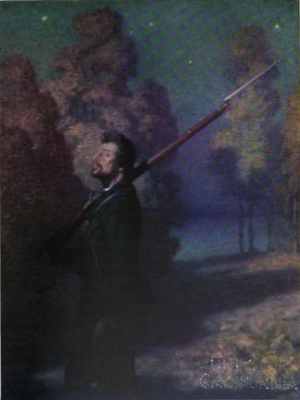
"The Picket-Guard" by N.C. Wyeth. Illustrating a poem
by the same name originally published in Harper's Weekly
November 1861.
"Nothing of importance has occurred since my last report," Charles P. Stone wrote tersely on June 27. But Stone's opposite at Leesburg had been busy. "The Virginia guards at the ferries seem to have been replaced by South Carolinia troops."

Since dunking one of their officers in the Potomac River with a timely cannon shot, Stone's men had developed an understanding of sorts with the men of Eppa Hunton's 8th Virginia - after all, a lot of Stone's men were from Washington and the Virginians were their neighbors.

In fact, on June 22 an event that sounds remarkable, but was actually fairly common, occurred. Stone reliably told Scott: "the opposing pickets at Conrad's Ferry met in the middle of the river, shook hands, and drank to each others health." Stone wasn't trying to warm the general-in-chief's heart, it was possibly important intelligence. "The Virginia picket men said they did not wish to fight, but 'wanted to go home'." (Of course, the moral of Stone's DC militia wasn't much better. He had reported for several days that they ought to be sent home to be replaced.)

Pickets were the eyes and ears of a Civil War-era military unit. One company out of the regiment would be chosen each day and night to act as a trip-wire. Unlike scouts, who would ride out to look for the enemy, pickets simply went a ways in front of the main position and spread out. They waited there, keeping their eyes and ears open. If an enemy was coming to attack, the pickets were supposed to stay under fire long enough to get a good idea what sort of enemy and how many were on their way, and then run back to the regiment and report in.