
Wherein the USS Pensacola attempts to run the Potomac blockade
....................................................................................................................................
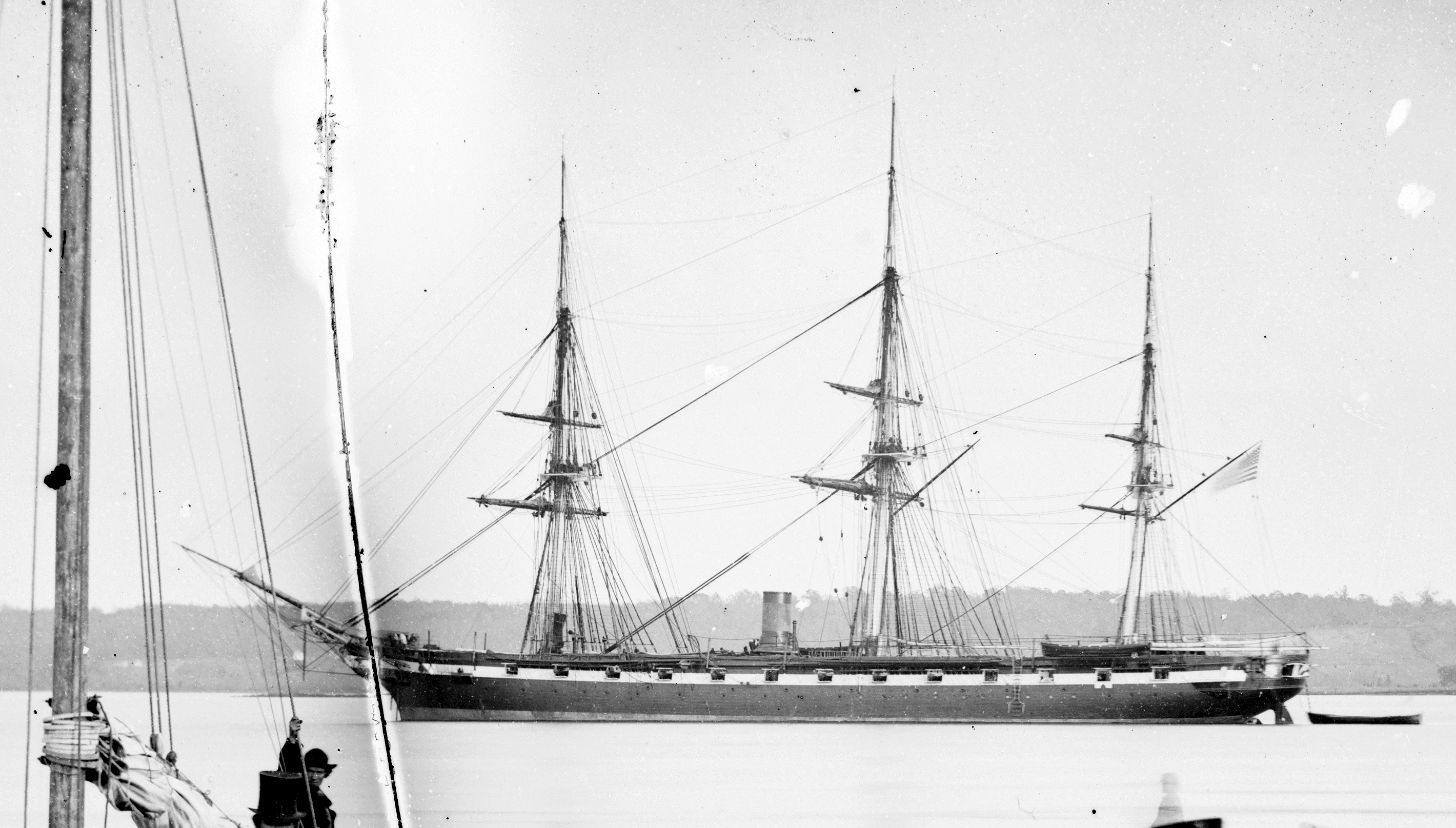 |
| The Pensacola moored at Alexandria in 1861 |
In the post-midnight blackness of January 12, the U.S.S. Pensacola slipped her mooring, and Captain Henry W. Morris and his sailors prepared to run the gauntlet. Morris had received his instructions four days earlier--from Secretary of the Navy Gideon Welles himself--ordering him to take the 3,000 ton screw steamer to Fort Monroe in Hampton Roads, where he would then be ordered south to the Gulf of Mexico to blockade New Orleans and other ports there. "It is important that every precaution should be made to pass the Rebel batteries on the Potomac with safety to the vessel and those under your command," Welles had written Morris. "The Department relies upon your skill and upon such means as your judgment may dictate to accomplish this object."
Since November, Confederate batteries along the lower Potomac in Prince William and Stafford Counties had made traffic to the capital by river too risky. A single shot from the large guns in the right place could send any ship to the bottom with a fiery explosion. The Pensacola was one of the Navy's top ships in 1862 and was needed to stem the tide of Confederate trade in the Gulf states.
Unlike the hodge-podge of ships that made up the local Potomac Flotilla, the Pensacola had been built by the Navy for warfare, and had been completed in late 1859, only just before the war. She had been laid up in the Washington Navy Yard for two years while additional machinery was installed, and had only been fully ready in September 1861. She had then sat off Alexandria, drilling her crew, and waiting for orders, which were delayed because of the lack of any ports to which she could return for supplies and repairs in the American South. Around the turn of the year, Welles decided to utilize Key West as a base for the Gulf Squadron, since its Southern-sympathizing residents had failed to evict its garrison, and set to work building it.
The Pensacola was a natural fit. She wasn't the fastest, able to make nearly 10 knots, which was good for its day, but with her steam screws she could do it in all weather, if required. She also carried 16 9-inch Dahlgren guns, at the time a massive broadside, each of which required 16 men to operate and could fire a 90-pound shot (though they more often fired exploding shells). By comparison, this was twice the amount of weight that could be fired by the 52 cannons on the vaunted U.S.S. Constitution (only taken off active battle stations in 1855). To cap it off, the Pensacola was equipped with a singe 11-inch Dahlgren gun that pivoted, and could fire a massive 166-pound shot almost two-thirds of a mile.
To get this warship there, however, Morris was going to have to navigate down the Potomac in darkness, past the Confederate batteries. The Pensacola drew 19 feet of water, meaning she had to stay within a very narrow pathway or risk running aground and making an easy target for Confederate gunners. To prepare, Morris moved his ship to White House Point, part of the already historic Belvoir plantation of the Fairfaxes [now part of Fort Belvoir] and anchored at low tide. The first battery he had to pass was at Cockpit Point, on the bluffs above the north side of Quantico Creek. The channel ran close to the bluffs, in those days, making it necessary to slip by after the moon had set, but Mattawoman Creek, which emptied into the Potomac on the Maryland side just north of Cockpit Point, dumped (and still does) massive amounts of silt into the river, creating dangerous mud flats that could ruin Morris's ship.


