Showing posts with label Today in History. Show all posts

Monday, August 27, 2012

Live Blogging Second Manassas (or Bull Run, if you prefer)

Wherein you can live the worst decision of my blogging career
.....................................................................................................................

Good people, for the past month and a half I have been involved in an all-consuming project of creating hourly updates for the entirety of the second battle fought at the intersection of Route 29 and Sudley Road. Having carried out a similar exercise for the first, I thought this would be no big deal and there'd be plenty of time on the side to build the story lines through northern Virginia on this blog. I was wrong. This battle was much more complex, and amounted to 45,000 words to tell the story when all was said and done. Over the next few days, I submit it to you, hour-by-hour.

Some resources to guide you through:

For your key media needs, including maps, I recommend the Civil War Trust's website:
http://www.civilwar.org/battlefields/second-manassas.html

For a strategic overview, Wikipedia serves you well:
http://en.wikipedia.org/wiki/Second_Battle_of_Bull_Run

Wikipedia is again useful for both orders of battle:
http://en.wikipedia.org/wiki/Second_Bull_Run_Union_order_of_battle
http://en.wikipedia.org/wiki/Second_Bull_Run_Confederate_order_of_battle

In addition to the wonderful sources listed in the books section, many of which were used, invaluable assistance was provided by:
  • John Hennessy's Second Manassas Battlefield Map Study, available at the Manassas National Battlefield Park visitor's center, that comes with 16 nifty maps and served as my framework
  • Peter Cozzen's John Pope: A Life for the Nation, which like Cozzen's other books provides a remarkably fair look at someone history has justly written off. Just because history is right, doesn't mean the guy doesn't deserve a book. You can (and should) purchase it here, or at other fine book-selling establishments.
Make sure to read about the Battle of Kettle Run that acts as a prelude to this fight, and did a lot to influence how deployments were made on the first day, and occurred 150 years ago at the very moment I am posting this.

Lastly, due to important life events I am unable to provide the full linkage, cross referencing, and photo posting that a blogger should. I consider those events a lot more important and fun, plus I know everyone can use Google, so you're not Gouverneur Warren sitting along above Groveton.

I hope you enjoy.

Wednesday, February 8, 2012

The Arrest of General Stone

Wherein the provost guard carries out an order
......................................................................................................................................

On February 8, Brig. General Andrew Porter received the following order from the general-in-chief, Maj. General George B. McClellan:
You will please at once arrest Brig Genl Chas P Stone U.S. Volunteers & retain him in close custody, sending him under suitable escort by the first train to Fort Lafayette there to be placed under charge of the comdg officer to await trial [sic]. See that he has no communication with any one from the time of his arrest.
Porter was the Provost Marshal for the Army of the Potomac, the officer charged with enforcing regulations and maintaining martial law in the area of the army's operations. He had served in the position since McClellan had taken command of that army, and was largely responsible for the vast improvement in discipline by the troops around Washington (though getting most of them out of the city and into the Virginia countryside had helped). He was also responsible for carrying out unpopular actions against local civilians, including the arrest of Washington City's mayor for conspiring against the government and the imprisonment of Rose O'Neal Greenhow and the other female secessionists.

Porter was a Pennsylvanian with the American army baked deep into his DNA. His father had been an officer in the War of 1812, and his grandfather had been a general in the American Revolution. Porter had only spent six months at West Point before dropping out to fight in the Mexican War, but he was nevertheless a consummate army professional. With the U.S. Mounted Rifles Regiment he was promoted to captain and won brevets to major and lieutenant colonel for prowess in battle. When Fort Sumter surrendered, Porter was chosen to be colonel of the new regular regiment the 16th Infantry, the only one of nine new colonels for the new regiments that had not graduated from West Point.

But before Porter had even seen his regiment, he was commanding a brigade in the Army of Northeast Virginia, whose commander, Irvin McDowell, had decided with such inexperienced troops a regular army colonel was needed to keep them under control. His division commander was the new colonel of his old Mounted Rifles, David Hunter, and the other brigade was commanded by Colonel Ambrose Burnside of the Rhode Island militia. Hunter was wounded on Matthews' Hill and, after the battle, Porter and Burnside argued publicly about which of them had led the division and helped out most in the battle.

Tuesday, February 7, 2012

Hot Haste

Wherein a multiethnic force clears Hunter's Mill of rebels
.............................................................................................................................

Much has been written about the families that were torn apart by the American Civil War. Abraham Lincoln, for example, had four brothers-in-law from his wife's family that all fought in the Confederate Army, and one more that married Mary Todd Lincoln's sister. But it was also a war marked by the unfamiliar, one in which people from backgrounds quite different from the Anglo-Saxon or Scots-Irish backgrounds that make up a large part of the warfare we most often remember.

The 5th Pennsylvania Cavalry was one such unit. It had been recruited for three years at the beginning of July 1861 by Max Friedman, a German Jew who had immigrated to Philadelphia when his liberal politics left him on the wrong side of the '48. His key staff had similar backgrounds, and they were able to quickly recruit men among other German immigrants, who tended to be patriotic and particularly anti-slavery (not the least because slave labor undercut their wages). Freidman was made colonel, and named his regiment of cavalry the Cameron Dragoons after then-Secretary of War Simon Cameron, a favorite Pennsylvania politician of the immigrant community in Philadelphia.

Cameron didn't return the respect immediately, choosing not to muster the regiment into service, until the loss at Bull Run expanded the number of authorized regiments of volunteers. In deference to Pennsylvania's odd enumeration system, it was renumbered the 65th Pennsylvania Volunteer Regiment, but it continued to be called the 5th Pennsylvania Cavalry or Cameron's Dragoons. After traveling to Washington, the regiment encamped on 7th Street, not far from today's Verizon Center, and Friedman named a Jewish regimental chaplain, to the ire of the YMCA and several Members of Congress. By February 1862, Friedman was still in hot water, and spending less and less time running his regiment, and more defending his Jewishness against Christian zealots.

So on February 7, it was not Friedman that led the regiment out for their mission, but Major Joseph L. Moss, who was acting as his second in command since the resignation of Lt. Colonel Philip Becker in November. Not much data is available on Moss without a deeper search, but his name indicates that he could be of Anglo-Saxon or East German Jewish descent, both of which are possible in the 5th Pennsylvania Cavalry. The regiment was divided up into five squadrons of two companies each, under himself, Major Edward Boteler, Captain William Heuser, Captain D. P. Hagameister, and Captain Jacob Wilson. Wilson is definitely an English or Scottish name, though like Moss not enough information is readily available to know Jacob's background. He may even have been among the significant minority or the 5th's Irish-born members, of which there were quite a few in his Company F.

Friday, February 3, 2012

Masses of the Enemy

In which we reconnoiter Occoquan
..............................................................................................................................

On February 3, Abraham Lincoln took the time to respond to his general-in-chief. Almost a week earlier the President had taken control of the war effort by issuing General Order No. 1, requiring all armies loyal to the Federal government to begin offensive movements. Maj. General George B. McClellan tried immediately to get Lincoln to countermand it, since the plan he was contemplated involved sailing his army down the Potomac, then up the Rappahannock and landing behind the Confederate position based at Centreville.

He would not be able to gather enough transport ships in that time period, though, which would make a plan supported by the Radical Republicans in Congress of a direct move towards Centreville the only plausible option. McClellan didn't like that plan because he believed the Confederates had too many men, that his own men weren't yet ready to fight, and because somebody else had thought of it. Lincoln was alright with the plan, and so issued Special Order No. 1, requiring the Army of the Potomac to seize Manassas Junction.

But McClellan kept working on Lincoln and on February 3, Lincoln signaled he might be persuadable.


Lincoln also included a separate memorandum with questions geared towards the other plan, one of the keys to which was crossing the Occoquan River near its mouth where the Confederates were thought to be weak, in order to keep them from forming a strong defensive line behind that river and its tributary, Bull Run, just as they had in July 1861.
Suppose the enemy in force shall dispute the crossing of the Occoquan? In view of this, might it not be safest for us to cross the Occoquan at Colchester rather than at the village of Occoquan? This would cost the enemy two miles more of travel to meet us, but would, on the contrary, leave us 2 miles farther from our ultimate destination.

Thursday, January 19, 2012

Defenseless Women

Wherein the Rebel Rose is sent to jail
.....................................................................................................................................

Greenhow and her daughter at the Old Capitol prison
On January 18, Allan Pinkerton's patience ran out. Since the end of August, Rose O'Neal Greenhow had been under house arrest at her house on 16th and K [site of today's Hay-Adams Hotel] for aiding the Confederacy, particularly in the run up to Bull Run. In that time she had been nothing short of a nightmare for Washington's provost-marshal, Brig. General Andrew Porter, responsible for maintaining military security across the expanding area of operations for the Army of the Potomac. Greenhow was alternating charming and haughty, and loved playing the beleaguered Southern woman to the press.

She also was still sending messages to the Confederate Army of the Potomac and her old friend, Thomas Jordan, adjutant to General G.T. Beauregard. On December 26 she had managed to smuggle out a letter to Jordan through a mutual friend and member of his spy ring in Washington.
In a day or two, 1,200 cavalry supported by four batteries of artillery will cross the river above to get behind Manassas and cut off railroad and other communications with our army, whilst an attack is made in front. For God's sake, heed this. It is positive. They are obliged to move or give up.

Thursday, January 12, 2012

Unusual Preparations

Wherein the USS Pensacola attempts to run the Potomac blockade
....................................................................................................................................

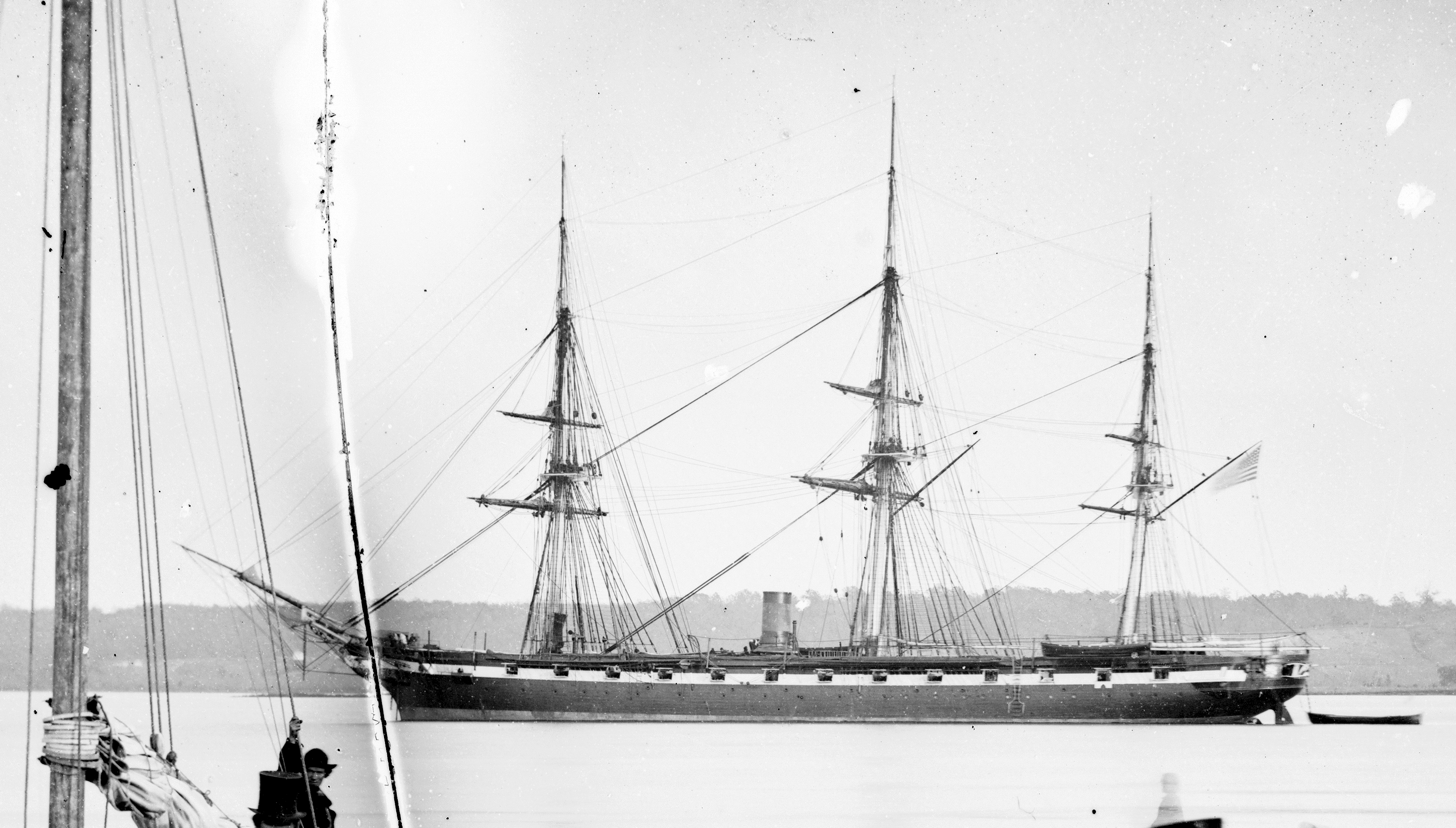
The Pensacola moored at Alexandria in 1861

In the post-midnight blackness of January 12, the U.S.S. Pensacola slipped her mooring, and Captain Henry W. Morris and his sailors prepared to run the gauntlet. Morris had received his instructions four days earlier--from Secretary of the Navy Gideon Welles himself--ordering him to take the 3,000 ton screw steamer to Fort Monroe in Hampton Roads, where he would then be ordered south to the Gulf of Mexico to blockade New Orleans and other ports there. "It is important that every precaution should be made to pass the Rebel batteries on the Potomac with safety to the vessel and those under your command," Welles had written Morris. "The Department relies upon your skill and upon such means as your judgment may dictate to accomplish this object."

Since November, Confederate batteries along the lower Potomac in Prince William and Stafford Counties had made traffic to the capital by river too risky. A single shot from the large guns in the right place could send any ship to the bottom with a fiery explosion. The Pensacola was one of the Navy's top ships in 1862 and was needed to stem the tide of Confederate trade in the Gulf states.

Unlike the hodge-podge of ships that made up the local Potomac Flotilla, the Pensacola had been built by the Navy for warfare, and had been completed in late 1859, only just before the war. She had been laid up in the Washington Navy Yard for two years while additional machinery was installed, and had only been fully ready in September 1861. She had then sat off Alexandria, drilling her crew, and waiting for orders, which were delayed because of the lack of any ports to which she could return for supplies and repairs in the American South. Around the turn of the year, Welles decided to utilize Key West as a base for the Gulf Squadron, since its Southern-sympathizing residents had failed to evict its garrison, and set to work building it.

The Pensacola was a natural fit. She wasn't the fastest, able to make nearly 10 knots, which was good for its day, but with her steam screws she could do it in all weather, if required. She also carried 16 9-inch Dahlgren guns, at the time a massive broadside, each of which required 16 men to operate and could fire a 90-pound shot (though they more often fired exploding shells). By comparison, this was twice the amount of weight that could be fired by the 52 cannons on the vaunted U.S.S. Constitution (only taken off active battle stations in 1855). To cap it off, the Pensacola was equipped with a singe 11-inch Dahlgren gun that pivoted, and could fire a massive 166-pound shot almost two-thirds of a mile.

To get this warship there, however, Morris was going to have to navigate down the Potomac in darkness, past the Confederate batteries. The Pensacola drew 19 feet of water, meaning she had to stay within a very narrow pathway or risk running aground and making an easy target for Confederate gunners. To prepare, Morris moved his ship to White House Point, part of the already historic Belvoir plantation of the Fairfaxes [now part of Fort Belvoir] and anchored at low tide. The first battery he had to pass was at Cockpit Point, on the bluffs above the north side of Quantico Creek. The channel ran close to the bluffs, in those days, making it necessary to slip by after the moon had set, but Mattawoman Creek, which emptied into the Potomac on the Maryland side just north of Cockpit Point, dumped (and still does) massive amounts of silt into the river, creating dangerous mud flats that could ruin Morris's ship.

Monday, December 26, 2011

Stopping Rat-Holes

A collection of post-Christmas odds and ends
..........................................................................................................................................

"Brother Jonathan Stopping the Southern Rat-Holes" (Harper's Weekly)
Below are some good reads for your holiday reading. But first a few items from the capital area that occurred 150 years ago.

On December 26, tragedy struck the government stables located on the grounds of the Naval Observatory. Between 150 and 200 horses were killed when a fire broke out. 102 of the horses belonged to Massachusetts regiments stationed in the area, of which only 11 survived the fire.

On December 27, Congressman Alfred Ely of New York arrived in Washington from Richmond. Ely hadn't been visiting or on a diplomatic mission, he had been captured on the Warrenton Turnpike during the Union route at Bull Run, where he had accompanied a New York regiment to watch the action. Ely had been exchanged on Christmas for Charles James Faulkner. Faulkner, a former Virginia Senator, had been President Buchanan's ambassador to France and stayed on to negotiate an arms deal for the Confederacy. But the new U.S. charge had ordered him arrested in August. The exchange was Faulkner's idea, and he had negotiated the entire project himself.

Finally, also on December 26, one of Pete Longstreet's brigades lost its commander. Brig. General Philip St. George Cocke was a cotton planter in Powhatan County when Virginia seceded. Cocke had been alarmed by John Brown's raid, which stoked the ancient Southern paranoia about slave-revolts, and set to work raising, equipping, and training a local militia. Cocke had been to West Point as an artillery officer, and had become adjutant of the 2nd U.S. Artillery before he grew tired of military life and returned home to his plantation.


Sunday, December 25, 2011

As Far As Possible, A Merry Christmas

Celebrating in no-man's land
.................................................................................................................................

"There is a tremendous pressure being brought to bear on McClellan," Brig. General George Meade had written his wife on December 22, "And there is no telling how long he can or will stand it."

Meade was writing her a follow-up letter to give her more details on the minor battle that had occurred at Dranesville a few days earlier in which he had had a tiny supporting role (kudos to Ron for a fantastic write-up). It was a tumultuous crossroads for Washington's war policies, when decisions were being made that would effect the shape of the conflict for the next few years.

In Congress, the Joint Committee on the Conduct of the War was committing itself to a course of partisan activism through the decision to focus on Charles P. Stone. Heading the War Department, Simon Cameron had decided earlier that month to cast his lot with anti-slavery forces and support the enlistment of black soldiers, probably because he would otherwise become a target of the Joint Committee's investigations for his corrupt awarding of contracts. Consequently, Lincoln was being forced to make a decision about whether to publicly rebuke his top military adviser or endorse a similar anti-slavery position himself.

Both Lincoln and Cameron were meanwhile leaning on general-in-chief Maj. General George McClellan to provide a victory to sooth the erupting political turmoil, which meant McClellan had to decide whether to launch a winter offensive or have his men continue building shelters. Everything was overshadowed by the ongoing Trent Affair, wherein the seizure of two Confederate envoys off a British civilian ship had led to an ultimatum from Great Britain to return the men or to face war. An invasion force was readying in Canada to prove it was no bluff.

"No one can predict the future for twenty-four hours," Meade had advised his wife, "and all we can do is to endeavor to be ready for all contingencies. Good-by! God bless you all and give you a happy and as far as possible a merry Christmas!"

It was Christmas 1861, and the war continued, despite the holiday. Soldiers both North and South did their best to celebrate the holiday, which was at the time (as it is now) both a pious holy day and a raucous good time. As well documented at All Not So Quiet Along the Potomac the 3rd Pennsylvania Reserves of Meade's brigade had a feast on care packages sent from home. Their brigade commander's thoughts turned to home too, when he wrote to his wife that "though absent from you in body, that I am with you and my dear children in spirit and thought."


Friday, December 23, 2011

Public Shot

The further adventures of Charles P. Stone's foot in his mouth
.......................................................................................................................

Charles P. Stone was furious when he sat down to write on December 23. Just a few days earlier, his own State's senator, Charles Sumner (R-MA), had denounced him on the Floor of the U.S. Senate. Angry that the Lincoln Administration and the War Department were forcing Massachusetts soldiers to comply with the Fugitive Slave Act, Sumner's thundering denunciation of the policy dragged Stone to the center of the fight between anti-slavery Republicans and the conservative prosecutors of the war. Sumner had sarcastically said that:
Brigadier General Stone, the well-known commander of Ball's Bluff, is now adding to his achievements there by engaging ably and actively in the work of surrendering fugitive slaves. He does this, sir, most successfully. He is victorious when the simple question is whether a fugitive slave shall be surrendered to a rebel.
If Sumner dragged Stone into the middle of the national spotlight, it was Stone who nailed himself to the ground so firmly there was no escaping. When a friend gave Stone a copy of Sumner's remarks, transcribed in the local papers, Stone sat down to angrily rebut the Senator's criticism. He argued that it was his orders and his responsibility to enforce the laws of the nation, including the fugitive slave law, and that only a strict respect for property rights of loyal civilians as understood before the war began would lead to a quick end and a reunion of the country (in fact, he had sent the commander of the expedition to Ball's Bluff with standing orders to shoot any soldier who plundered).

But if Stone's self-confidence was his greatest virtue, the arrogance it bred was his greatest vice. And his fury at Sumner's perceived mangling of his carefully considered position brought out the worst in Stone. The letter he wrote on December 23 was the first time since Ball's Bluff when he addressed anyone other than personal friends about the hot water he had found himself in outside of the official military channels, a major breach of personal decorum for Stone. Worse, he concluded his letter with words meant to insult:
Please accept my thanks for the speech in which you use my name... There can hardly be better proof that a soldier in the field is faithfully performing his duty than the fact that while he is receiving the public shot of the enemy in front he is at the same time receiving viterpuration [sic] of a well-known coward from a safe distance in the rear.
Never politically savvy, Stone probably did not realize he was making himself Enemy No. 1 of the group of Republicans that would come to be known as the Radical Republicans (a name full of baggage and not contemporary to 1861, so I'll avoid it for now). Sumner took the letter immediately to Lincoln, when he received it. Sumner and his allies believed that Stone's actions at Ball's Bluff had been either gross mismanagement or outright treason, and that Lincoln's good friend, Senator Edward Baker, had paid the price to either save Stone's debacle or thwart Stone's malfeasance. The letter's conclusion seemed to offer proof that Stone was malicious.

Lincoln, who had closely interviewed Stone about Baker's death, was deeply disturbed, but told Sumner that though he would not have written such cruel words himself, he believed Stone was probably within his rights after the harsh treatment Sumner had given him on the Floor. Not recorded is what Lincoln responded to Sumner's original speech, considering it was his Administration's policy that Sumner was following.

Whatever Lincoln's feelings, Sumner also took the letter to Senators Benjamin Wade (R-OH) and Zachariah Chandler (R-MI), the top two members of the newly formed Joint Committee on the Conduct of the War. The investigation into what happened at Ball's Bluff now had a principal subject of investigation.

Saturday, December 17, 2011

Rec: I Expose My Neck. UGH!

My favorite things I read this week
..................................................................................................................

OLD SECESH. "While I cover my Neck, I expose my Feet, and if I cover my Feet, I expose my Neck. Ugh !"(Harper's Weekly)

Before proceeding to a heaping helping of recommendations, a report from a minor skirmish today in history:
Headquarters One hundred and fifth Pa. Vols.
Camp Jameson, Va
December 19, 1861

Sir: In obedience to your orders, I left this camp at 9 pm of the 18th instant with a force consisting of the regiment under my command, a squadron of the New Jersey Cavalry, under Captain Jones, and two sections of artillery, under Lieutenant Monroe, New Jersey Volunteers, and arrived at Potter's house within half a mile of the extreme outposts of our pickets on the right near 11:30 pm. I found that the pickets had been undisturbed, and immediately proceeded to distribute my force as would best support the pickets and preserve the force itself, should we be attacked. No demonstration was made by the enemy during the night. I left Potter's house for Pohick Church about three quarters of an hour after daybreak, having been detained that long in developing a movement to capture some of the enemy, but which proved abortive.

We arrived at Pohick about 9 am; was informed that the previous day the enemy had there a force of 200 cavalry and also a regiment of infantry concealed in the woods to the west of the village. Remained at Pohick about two hours; sent a party down the Telegraph road and discovered about a mile distant a rebel picket 6 or 8 strong; fired at them and they fled, but did not pursue as my instructions did not allow me to proceed beyond this point. Left Pohick Church between 11 and 12 am, and returned to camp at 3:30 pm. Came by the village of Accotink, and was there informed that no rebel forces had been in the village for over a month.

Respectfully submitted,
A.A. McKNIGHT,
Colonel, One hundred and fifth Regiment Pa. Vols.

Colonel Amos A. McKnight had led his small detachment out on a heavy patrol, because his division commander, Brig. Gen. Samuel P. Heintzelman, had suspected Confederate activity around the remains of Pohick Church (which his men had ransacked in November). McKnight had raised the men himself from around the Pittsburgh area in August, after completing his own service as Captain of Company I, 8th Pennsylvania, a 90-day unit that had not done much of anything under Robert Patterson while Joe Johnston sneaked off to help clobber McDowell at Bull Run.

McKnight would continue with the regiment into the spring, before being severely wounded and missing almost a year of fighting. He would return for two battles, before being killed at Chancellorsville.

***

Disunion managed two entire good articles this week. First, the most suspenseful read I've had in awhile, when an LSU professor recounts the story of two Tigers condemned to death. Then the story of "The Picket Guard", a forgotten poem whose popularity still influences us today, most famously through the English-language title of Erich Maria Remarque's famous war novel (oh, and also some blog out there).

Speaking of Ron, he covered one of those courts-martial that George Meade spent so much of November and December complaining about.

This week I featured some stories about the Confederate right, including the Aquia District, led by Theophilus Holmes. By coincidence, here's his resignation letter from the U.S. Army. People believe handwriting tells a lot about people. It's probably not true, but if it was, this would say all you need to know about ol' Theophilus.

The Atlantic had an interesting piece contrasting how the Civil War was remembered 50 years ago to today, called "Not Your Grandfather's Civil War Commemoration."


And introducing one of my new favorite blogs, which covered the Irish Brigade in Winter Quarters.

It was a good week for reading.

Wednesday, December 14, 2011

Ice on the Potomac

Wherein either Hooker exaggerates or global warming is real
........................................................................................................................................

The cold weather of December had brought a warming, rather than a cooling of tensions on the Lower Potomac. From the headquarters of the Department of Northern Virginia in Centreville, General Joseph E. Johnston was preparing his Southern army for a battle that he expected, even this far into the winter. While winter campaigning was something that no army enjoyed, it certainly wasn't unusual. Writing to his subordinate commanders about the situation, Johnston would have been well aware that Union forces were on the offensive in the Western Virginia mountains and that Brig. Gen. Thomas "Stonewall" Jackson was playing a cat and mouse game with two Union forces in what is today the West Virginia panhandle.

On December 5, Johnston had written to Brig. Gen. William H.C. Whiting, commanding his right flank at Dumfries about the eventuality of an attack by the Union army and his plans for a Confederate response.
My Dear General... I want to know precisely what roads are open and which closed. Please inform me The enemy's movements might be such as to tempt me to go in your direction first. It is necessary to be prepared to do so at all events... Should we go against your enemy it ought to be in two columns on those two routes. 
And, referring to the way he had tricked Union Maj. Gen. Robert Patterson before Manassas into thinking his army was at Winchester when it was in fact on the way to turn the battle's tide, he added a line that would have brought a shout of triumph to Professor Thaddeus Lowe: "The infernal balloon may interfere with such success as we had with Patterson."

Meanwhile, Johnston was also in a letter battle with Richmond over orders issued by Secretary of War Judah P. Benjamin that he immediately create two brigades of only Mississippi troops, which Johnston scornfully refused to do in several hundred words, especially because two of his Mississippi regiments were with Whiting.
The forces as now arranged are perfectly familiar with their respective positions, officers and men have become accustomed to each other, are acquainted with the nature of the ground they occupy, &c. The execution of Orders No 252 would work a complete revolution in the organization of the army, and necessitate a change of position of all the regiments from Leesburg to Dumfries, and from this position to Dumfries and Leesburg. Should the enemy attack us whilst these changes of station are in process, an event by no means improbable, it would be almost impossible to avert disaster to our arms.
Benjamin, naturally, wrote back expressing President Jefferson Davis' "desire" that Johnston should simply send the 13th, 17th, and 18th Mississippi regiments from Leesburg (where they had been crucial at Ball's Bluff) to Whiting as reinforcements, "to whose brigade they belong". Johnston could then move any other brigade to take their place at Leesburg, never mind that the last major troop movement at Leesburg had prompted a battle.

Tuesday, December 6, 2011

A Bitter Secessionist and Bad Men

In which George Meade forages in Great Falls
.....................................................................................................................

The major drama of December 1861 revolved mostly around the ongoing saga of the Trent Affair, an international incident caused when a U.S. Navy vessel boarded a British vessel and removed two Confederate diplomats. The actual combat in the Potomac Watershed, meanwhile, was largely constrained to cavalry skirmishes in the no-man's land between the two rival Armies of the Potomac and daily harassment of shipping on the Potomac by batteries at Evansport [Quantico]. But skirmishes were not the full extent of operations occurring. December 6 provides a good example.

Brig. General George Meade spent the first few days of December contemplating horses. "The most important piece of intelligence I have to communicate is that I have bought another horse," he wrote to his wife on December 2. "He is a fine black horse that was brought out to camp by a trader, for sale. I bought him on the advice and judgment of several friends who pretend a knowledge in horse flesh, of which I am entirely ignorant."

Sunday, December 4, 2011

Old Ravensworth

In which a skirmish occurs near Burke
....................................................................................................................................

A quick programming note: the internet has been almost unusable at home (it's Comcastic!) and work has kept me from having much time to write anyway, so we've missed several events in the area. Most importantly, in the "now" of 150 years ago, Congress was back in session. Disunion turned to Ted Widmore to not embarrass itself too badly and cover the event.

As November turned to December, the agitated calm that had characterized the relationship between the two armies continued unabated. On December 2 and December 4 two more skirmishes broke out in the no-man's land between the two armies, an arc of territory that ran from Dranesville on the Potomac, down to Vienna, on to Burke's Station, then Springfield Station, and finally followed the course of Pohick Creek back to the Potomac [the mouth of which is today at Ft. Belvoir].

For approximately five miles on either side of that line, cavalry patrols roamed. After that, the pickets of both armies were stationed, ready to run or ride back to the main armies if a sizable force appeared. Both sides' leaders assumed that any day a massive army would drive them in for a major attack, and both sides' leaders knew they wouldn't be ready for an attack until the spring. So the fighting was confined to cavalry patrols riding until they found the enemy's pickets, charging, then returning to their lines with prisoners to try to collect intelligence.

Central to this campaign of pickets and patrols were the fields of old Ravensworth. In 1650, Virginia's colonial governor (Sir William Berkeley) had made a land grant to Colonel William Fitzhugh, a wealthy Englishman, of a massive internal tract of land in the little settled tributaries of the Potomac. Today, this area is North Springfield, Annandale, Burke, and the surrounding area. Fitzhugh called this estate Ravensworth, after his family estate in England, but it would be another twenty years before he ever saw it. Even then, Fitzhugh preferred to live in King George County, though with the money he was making cultivating tobacco at Ravensworth, he was able to become one of the richest and most influential men in America. The road his property managers built to roll his tobacco hogsheads down to Accotink Creek is a link to this history. Today it is Rolling Road, evolved from the Ravensworth Rolling Road.

Sunday, November 27, 2011

Two More Cavalry Skirmishes

Wherein you're set up with a self-guided tour for Dranesville and Fairfax
..........................................................................................................................................

Well, yesterday worked out a little different than I expected and I won't have time to put together a post for the morning. But there were two cavalry skirmishes that occurred 150 years ago today. One at Dranesville, between the 1st Pennsylvania Cavalry from George McCall's Division, on the one side, and J.E.B. Stuart's 1st Virginia Cavalry and some South Carolina infantry on the other; and the other at Fairfax Court-House [City of Fairfax] between the First New York Cavalry from William Franklin's Division and an unspecified Confederate command. Unlike the skirmishes near Vienna and Fall's Church, a Confederate after-action report does not exist, making it a little less fun to blog as well.

Saturday, November 26, 2011

Skirmish on the Road to Hunter's Mill

Wherein a young captain tries to make his name
..................................................................................................................................

As the excitement (or misery, depending on your point of view) of the Grand Review of the North's Army of the Potomac at Bailey's Cross-Roads wore off, things were getting back to normal in the division of Brig. General Fitz John Porter. Porter, one of general-in-chief Maj. General George McClellan's favorites, had played a prominent role in the review, only a day after men in his division had come under attack by Confederate cavalry near Fall's Church. The men had done well and driven off the scouting expedition of cavalry before they could determine more about his force structure, but it certainly must have underscored for Porter the need to be more vigilant himself.

So he stepped up patrols by his own cavalry. In 1861, the prevailing opinion on cavalry was that it was for intelligence gathering or counterintelligence work, and for timely attacks on your opponent's flanks or rear. So McClellan had split his cavalry (and artillery, too) up among his divisions, to give each division commander a scouting force. Porter had two regiments of Pennsylvanian horsemen, the 3rd and the 8th, who divided up responsibility for scouting beyond the picket line (the extent of the area considered "safe" Union territory, called colloquially "the lines").

Mostly men from Philadelphia and eastern Pennsylvania, the 3rd Regiment was commanded by Colonel William W. Averell. When the 3rd had been formed originally, it had been deemed a Kentucky regiment. Pennsylvania had exceeded its quota for sending troops to the Federal government, and some of Pennsylvania's excess troops had been bled off by assigning them to represent states' whose loyalties were questionable, such as Kentucky. But after Bull Run, the regiment had been reclaimed by Pennsylvania, and mustered into Federal service as the 3rd Pennsylvania (though in the Keystone State itself it would confusingly be known as the 60th Pennsylvania, because of a decision not to enumerate cavalry and infantry in separate sequences on the state books).

Averell was a U.S. Army cavalry officer and a former cavalry instructor, and had been asked by Pennsylvania Governor Andrew Curtin to take command of the rowdy unit and instill some discipline. Averell grouped the companies of the 3rd into squadrons of two each, helping him more tightly rule the regiment with an iron fist. At Camp Marcy, located a few miles south of Chain Bridge, the 3rd Pennsylvania learned discipline the hard way. Remembered the regiment historian, a member of Company B, "Our drills, mounted and dismounted, were incessant. Mutterings of dissatisfaction because of these were loud and unceasing."

Thursday, November 24, 2011

All In Confidence

Wherein George Meade shares his personal thoughts on the war
............................................................................................................................................

Happy Thanksgiving everyone. In 1861, Thanksgiving was not a Federal holiday, but was still widely celebrated in America in November. But we're not commemorating the 150th Anniversary of that today, because the dates didn't line up that way.

Instead, recognizing everyone is busy, including me, here's a letter from George Meade to his wife sharing his thought on the war from Fall 1861:


Camp Pierpont, Va
November 24, 1861

There is but little new here. My duties at the court occupy me nearly all day, and in the afternoon, towards evening, I take a ride through the guards to see that they are on the alert and vigilant. The enemy do not show themselves nearer than eight miles, where they have their pickets. Now and then they make a dash at some part of the line with their cavalry, and drive ours in, killing and wounding a few, when they retire again to their old lines.

In today's papers we have Jeff Davis's report to the Confederate Congress. A careful perusal of it leads me to think it is more desponding and not so braggadocio a document as those we have hitherto had from him. I have no doubt the blockade and the heavy expenditures required to maintain their large armies are telling on them, and that sensible people among them are beginning to say "cui bono," and where is this to end? If such should be the case, it proves the sagacity of our policy in keeping them hemmed in by land and sea, and forcing them to raise large forces by threatening them at many different points. You know I have always told you this would be a war of dollars and cents, that is, of resources, and that if the North managed properly the South ought to be first exhausted and first to feel the ruinous effects of war. In other words, to use my familiar expression, it was and is a Kilkenny cat business, in which the North, being the biggest cat and having the largest tail, ought to have the endurance to maintain the contest after the Southern gentleman was all gone. In the meantime, we at the North should continue the good work of setting aside such men as Fremont, and upholding such sentiments as those of Sherman, who declares the private property of Secessionists must be respected. Let the ultras on both sides be repudiated, and the masses of conservative and moderate men may compromise and settle the difficulty.

Today has been raw and disagreeable; this afternoon we had a slight spit of snow. Camping out in such weather is very hard upon the men and the health of the army is being seriously impaired. I fear no amount of personal energy or efforts to do what is right will ever make these volunteers into soldiers. The radical error is in their organization and the election of officers, in most cases more ignorant than the men. It is most unsatisfactory and trying to find all your efforts unsuccessful, and the consciousness of knowing that matters grow daily worse instead of better is very hard to bear. The men are good material, and with good officers might readily be moulded into soldiers, but the officers as a rule, with but very few exceptions, are ignorant inefficient and worthless. They have not control or command over the men, and, if they had, they do not know what to do with them. We have been weeding out some of the worst, but owing to the vicious system of electing successors which prevails, those who take their places are no better. I ought not perhaps to write this to you, and you must understand it is all in confidence, but you have asked me to tell you everything freely and without disguise, and I have complied with your request.

I had a visit to day from Mr Henry of the Topographical Bureau, who says he saw the review on Wednesday and thought our division looked and marched the best of all.

Saturday, November 19, 2011

More Bravery Than Federal Troops Usually Exhibit

In which we go for a ride along on a cavalry scout
....................................................................................................................................

The late fall of 1861 is portrayed in history books as a time of squandered opportunity and stagnation, as both Northern and Southern Armies of the Potomac slouched into winter quarters. This, however, is a hindsight only possible with the knowledge that no major campaign would begin until March. At the time, both armies were restless and planning. On November 19, Confederate General G.T. Beauregard sent orders to Colonel Nathan "Shanks" Evans defending an outpost at Leesburg that clearly anticipated an imminent Union attack. "You should leave, under proper guard," Beauregard told him, "at or about Carter's Mill [Oatland Plantation] all the heavy baggage not already sent back to Manassas and not required by your brigade in a more advanced position." Sending away the baggage, or the wagons and supplies contained that an army relied on for sustenance was the Civil War equivalent of a "red alert."

Beauregard was equally concerned about his other flank at Dumfries, while McClellan's writing shows a concern for his flank divisions of Nathaniel Banks at Point of Rocks and Joe Hooker in Charles County, Maryland. But all the maneuver and concern about the edges of the army, didn't mean that the center was any more settled. On November 18, one of the many skirmishes around the center of the line took place, but this one is rare in that the official reports of both sides survived the war and is printed in the Official Records.

Thursday, November 17, 2011

Division Of This Army

Wherein Dumfries is of strategic importance
..........................................................................................................................

With winter coming, General Joe Johnston, commanding the Department of Northern Virginia from his headquarters at Centreville, had two priorities: first, was to provide clothing, food, and dwellings for his men so they could survive the coming winter; second, was to make sure their defensive position was strong enough to defend against an attack by the Northern forces venturing further and further out from their defenses. Neither priority was close to being accomplished, but today we'll focus on defense.

By fiat from Richmond, Johnston's unified command had become three parts. His left-most flank was the Valley District, commanded by Maj. General Thomas Jackson, who people had taken to calling "Stonewall." Jackson, who Johnston had come to rely upon in their pre-Manassas days in the Shenandoah Valley and who he had high hopes for as a division commander, left the Army of the Potomac the first week of July to take over the rowdy militia of the Valley. Not surprisingly, a few days later his old brigade followed him, depriving Johnston of one of his best units. Richmond had also sent Jackson two brigades from across the Alleghenies along with their division commander William Loring, underscoring the importance of the Valley.

On his right-most flank was the second carve-out from Johnston's command, the Aquia District under Maj. General Theophilus Holmes. Stretching from Powell's Creek [Lake Montclair] to the Potomac to the Rappahannock, the district had resulted from the desire to keep Holmes in an important position. But it meant that Johnston's right-wing was effectively an independent force from his main body, the Army of the Potomac. Richmond intended that army to be the District of the Potomac, commanded by General G.T. Beauregard, but Johnston intended to command that army himself in battle, and had long-ago agreed to Beauregard's preference that he command the army's First Corps, with the Second led by Maj. General G.W. Smith.

All this mattered especially in the beginning of the third week of November because the Confederates had become well-aware that the Union Army of the Potomac had moved a division of soldiers opposite the Aquia District's batteries at Evansport [Quantico]. Though Holmes had known about the movement for several days already, it was a subordinate of G.W. Smith's who touched off the powder keg on November 16.

Sunday, November 13, 2011

Rec'd: Etiquette & Personal Dignity

In which we go through some of my favorite recent articles
.......................................................................................................................................................

Harper's Weekly failed on cartoons this week, but here's a lovely picture of Massanutten Mountain in the Valley
November 13, 1861 is the anniversary of one of the most famous incidents of the early war, McClellan's snub of Abraham Lincoln. Here is the story, as told by Doris Kearns Goodwin in Team of Rivals (p. 383):
On Wednesday night, November 13, Lincoln went with Seward and Hay to McCellan's house. Told that the general was at a wedding, the three waited in the parlor for an hour. When McClellan arrived home, the porter told him the president was waiting, but McClellan passed by the parlor room and climbed the stairs to his private quarters. After another half hour, Lincoln again sent word that he was waiting, only to be informed that the general had gone to sleep. Young John Hay [Lincoln's secretary] was enraged... To Hay's surprise, Lincoln "seemed not to have noticed it specially, saying it was better at this time not to be making points of etiquette & personal dignity."
No record exists in McClellan's own accounts or among his letters (in fact, there was no letter to Mary Ellen that night), so no explanation for the behavior. McClellan was particularly critical of his men drinking alcohol, but because of the effect on discipline, not out of any tee-totaling principles, so maybe he had enjoyed the wedding too much. On the other hand, of the many criticisms of George McClellan that exist, the frequent general-bashing accusation of "drunkard" is not one. Whatever the reason for the slight, it might have remained overlooked if McClellan had been on better behavior later on.

All Not So Quiet follows up on who led Longstreet's Brigade after Longstreet moved on to lead a division (hint: it's Dick Ewell) and checks in on the Vermont Brigade encamped at Lewinsville, the sickliest brigade in the Union army.

Disunion checks in on Cump Sherman, who was on leave from the army in November, possibly from a mental breakdown, and covers the big national and international story, the Trent Affair.

The Confederate battery at Evansport [Quantico] made due with the artillery they were able to scrounge up, but To The Sound Of The Guns ventures south to Georgia to look at what a real Confederate coastal defense position would be armed with.

And Joel Achenbach of the Washington Post blogged and wrote about Ball's Bluff, just like the Evening Star did 150 years ago. Well maybe not just like.

How can we close without a little bit of Hooker? Before McClellan headed off to his wedding, he would have been advised by his adjutant of a report from the commander of his extreme right-wing, Brig. General Joe Hooker. The report was even thicker than usual for Hooker, because it contained the report of the 74th New York Infantry's expedition to Mathias Point on the Virginia side of the Potomac. Colonel Charles Graham had taken about 400 men from the regiment and transported them on the Island Belle and Dana, two ships from the Potomac Flotilla, during the night of November 9.

Graham and men had shot some pickets and captured some Confederate prisoners, while at the same time determining that no batteries had yet been erected at Mathias Point (though they thought they saw evidence of preparations to make some). They then returned to the north shore in triumph. But the unusual thing is that Hooker had no idea this raid was taking place.
I inclose herewith the report of Colonel Graham of his descent on Mathias Point, as it contains reliable information of the condition of that much talked of point. The expedition was projected without my authority or even knowledge. As it appears to have had no unfortunate sequence so far as I have learned, I shall not censure him, but in future no operations will be projected without my sanction; otherwise my command may be dishonored before I know it.
Hooker probably knew that the expedition had been planned by his subordinate and Graham's superior, Dan Sickles. Unfortunately for the army, making dangerous military moves without informing his superior would become a habit for Sickles.

Friday, November 11, 2011

John Dahlgren and the Union Aircraft Carrier

Wherein we go afloat and end up aloft
...........................................................................................................................................

Map of Rebel batteries (left) on the Potomac River, beginning of November
"Between 9 and 11 o'clock a.m.," Brig. General Joe Hooker informed the Army of the Potomac headquarters on November 11, "some of the rebel batteries were in active operation."
Three schooners passed up the river under a six knot breeze without the slightest injury, although thirty-seven heavy guns were discharged to dispute their passage. The crews seemed to entertain a just appreciation of the batteries, for they sailed along with as much unconcern as they would to enter New York Harbor. They do fire wretchedly. Whether it is owing to the projectiles or to the guns I am not informed. Several of the pieces are rifled, but they seem to throw more wildly if possible than the smooth bores. From what was witnessed to day and on previous occasions, I am forced to the conclusion that the rebel batteries in this vicinity should not be a terror to any one.
Despite Hooker's conclusions, he had been sent there two weeks earlier in order to work with the U.S. Navy's Potomac Flotilla to eliminate the potential threat that the batteries caused to Union shipping. At the order of the Secretary of the Navy, Gideon Welles, river traffic had been reduced to a fraction of the usual shipping required to sustain the capital, and almost all supplies were coming down the B&O Railroad from Confederate-sympathizing Baltimore.

Hooker knew a good thing when he had it, though, and was content to ride out the winter with his division over a day's march from Washington and therefore from George McClellan, his staff, and anyone else who might outrank him. Not nearly as content with his situation was Commander Thomas Tingey Craven, the head of the Potomac Flotilla. As early as October 23, Craven had declared the mission of the flotilla to control the river a lost cause and suggested removing the guns from his ships and setting up batteries on the Maryland side that could exchange fire with the Confederates (his plan was partially put into action, the guns from the Pensacola had been used by Hooker to establish his one operating battery at Budd's Ferry).

"Feeling that my position here in command of the flotilla can be of no further benefit," Craven wrote Welles, "I most respectfully request to be detached from the command and appointed to some seagoing vessel."