Showing posts with label Scott. Show all posts

Wednesday, November 2, 2011

Seeing the Old Man Off

Wherein we bid farewell to Winfield Scott
...............................................................................................................................

Harper's Weekly cover announcing the retirement of Winfield Scott. A depiction of the last Cabinet meeting.
Before dawn on November 2, in the midst of a heavy rainstorm, retired Bvt. Lt. General Winfield Scott left his headquarters on F and 17th Street near the White House and rode to the B&O Railroad Station, located at the site of today's Union Station. It was still dark, and Scott was trying to leave town before anyone had time to call on him about his retirement the night before. The New York Times recorded:
A drenching rain was falling at the time, and this fact prevented Gen. McClellan and staff, with an escort of cavalry, from accompanying him on the route thither. A numerous assemblage, in view of the hour and the unpropitious state of the weather, had gathered at the depot, among whom were nearly a dozen ladies.
His staff accompanied him; Colonels George W. Cullum, Henry Van Rennselaer, and Edward H. Wright, all aides-de-camp to Scott, and his chief of staff, Colonel Edward D. Townsend. All four were career military men who had enjoyed many years of good fortune under the longest-serving commander of the Army in U.S. history (a record that still holds) and who had earned the respect and praise of the man now leaving in the middle of a gloomy downpour. His replacement would also be his arch enemy, who the Scott staffers had spent the last three months helping the old general attempt to thwart. Their futures were bleak, and it would take the fall of McClellan to fully rehabilitate their army careers.

Tuesday, November 1, 2011

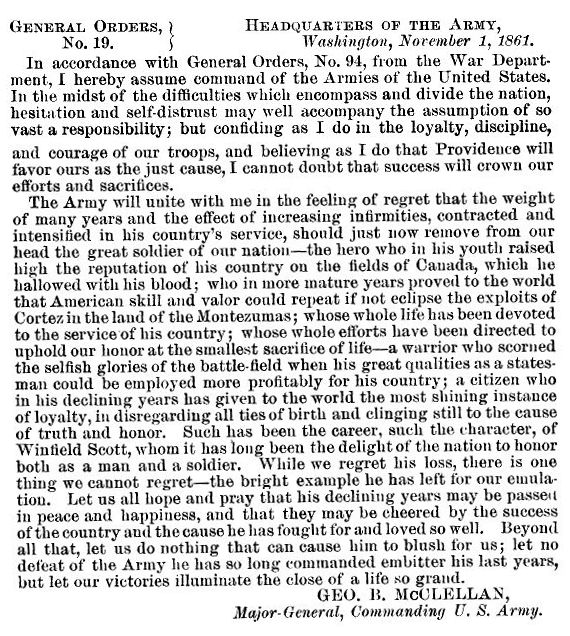
A Life So Grand

In which Winfield Scott is at last deposed
........................................................................................................................................

On November 1, the long war that had burned since the end of July at last came to a close. Maj. General George Brinton McClellan became the U.S. Army's general-in-chief. McClellan and the army's outgoing general-in-chief, Bvt. Lt. General Winfield Scott had been at each others' throats for months. Back during the summer Scott had asked the President to put him on the retired list to try to force him to reign in the ambitious young McClellan, who was circumventing Scott to talk strategy with Cabinet members directly and who refused to give Scott any details about his army. Lincoln had ignored Scott's retirement gambit after only a minor rebuke of McClellan, and the campaign had simmered. Then Scott had tried to catch McClellan disobeying a lawful order, a scheme in which the younger man happily obliged, but Secretary of War Simon Cameron had done nothing to punish him. So Scott had renewed his request to be placed on the retired list and on October 31, the president had finally complied. By having his name added to the retired list, Scott would receive a full pension, but be ineligible to command troops any longer. Characteristically, Lincoln informed Scott that his suggestion was accepted gently, telling him he would still call on him for advice, but not too often so he could properly enjoy his retirement.

Wednesday, October 19, 2011

Making Them Abandon Leesburg

Wherein McClellan sends the Pennsylvania Reserves to check on a key spot on the Potomac
..............................................................................................................................................

"It seems pretty well settle that I will be Comdr in Chf within a week," Maj. General George B. McClellan crowed to his wife, Mary Ellen, writing from Lewinsville, Virginia on October 19, where he was spending time with the division of "Baldy" Smith. McClellan had heard the results of  a secret cabinet meeting the day before, where the President had determined to act on the offer to resign by his general-in-chief, Bvt. Lt. General Winfield Scott, which had been pending for months now.

Secretary of the Navy Gideon Welles recorded the meeting in his diary:
The Presdt. read to us a draft to a letter to Gen S. (delicately and handsomely written) importing that Gen S. had expressed a wish to be retired, under the act, and only witheld [sic] it at the Presdt.'s request; that he would no longer object--That he would still, sometimes, need his advice--not so often as to burden him--and was disposed to deal generously by the Genl.'s military family...
Scott's military family meant the officers he had helped promote and whose careers he had helped advance, such as Brig. General Irvin McDowell. But foremost in Scott's mind would have been Henry Wager Halleck. Halleck was nicknamed "Brains" because of his intellectualism and Scott became enamored of him because of his translations of French military strategy and efforts to turn the rough American army into a leader in the realm of military science. When the Civil War broke out, Scott made sure that Halleck was made a major general in the regular army, fourth in rank behind himself, McClellan, and John C. Fremont. Then Scott sent Halleck to Missouri to clean up the mess Fremont had made.

"Genl Scott proposes to retire in favor of Halleck," McClellan told Mary Ellen. "The Presdt & Cabinet have determined to accept his retirement, but not in favor of Halleck. The old ____'s [sic] antiquity is wonderful & lasting." Welles wrote down no such comment about Halleck, but hindsight suggest McClellan's information was correct. By tradition, the general-in-chief was always the longest serving major general, anyway, so to name Halleck to the position while McClellan and Fremont were still on active duty would be unprecedented.

"The enemy have fallen back on Manassas--probably to draw me into the old error," McClellan added, almost as an afterthought. "I hope to make them abandon Leesburg tomorrow."

"I had just seated myself down to write you a nice long letter," George Meade had written his wife on the evening of October 18, "when orders came to march to-morrow, requiring me to stir about and give the requisite directions."

Thursday, October 13, 2011

The Campaign Continues

Wherein the fighting of Fall 1861 continues, over policies and tents
................................................................................................................................

As the sun rose higher in the sky on October 13, George McCall's Pennsylvania Reserves waited for a Confederate attack that wasn't coming. Other than driving in of the pickets on the evening of October 12, there was no hostile activities by the Southerners. In all likelihood some Confederate cavalry had been ordered to ride up to the picket line around the newly created camps to get an idea of the new position. The pickets had followed their orders and retreated back to tell their commanders the Confederates were testing their lines and commanders itchy for a fight had seen the signs they wanted to see.

One of these commanders had been the commander of the Army of the Potomac, George B. McClellan. By the time of his daily letter on October 13 to his wife (who had just given birth), he was back at his headquarters at the Wilkes House on 19th and Pennsylvania, NW, after having spent the night in anticipation with the division of "Baldy" Smith in Lewinsville, nearby the Reserves. McClellan was on to other things already. He wrote Mary Ellen:
I am firmly determined to force the issue with Genl Scott--a very few days will determine whether his policy or mine is to prevail--he is for inaction and the defensive, he endeavors to cripple me in every way--yet I see that the newspapers begin to accuse me of want of energy. He has even complained to the War Dept of my making the advance of the last few days [of McCall and Smith's divisions]. Hereafter the truth will be shown & he will be displayed in his true light.
But while McClellan was off to other battles, the Pennsylvania Reserves and Smith's Division had to keep waiting for theirs, as the sun continued to creep across the sky.

Tuesday, October 4, 2011

Scott Strikes Back

Wherein the blue-on-blue violence continues
.................................................................................................................................

On October 4, Winfield Scott launched his counterattack. The 75 year old general-in-chief of the U.S. Army had been sidelined by his subordinate, the ambitious 35 year old George McClellan. Scott, responsible for winning the war, and McClellan, responsible for defending Washington, were originally at odds about the best strategy and about the nature of the threat to Washington. It quickly became a personal battle, and the two men became consumed by their dislike of each other.

On September 16, Winfield Scott had set a trap for McClellan, to give him a legitimate grievance to take to the civilian leadership. Scott had issued two orders through his chief of staff, both aimed at McClellan's most common offenses. The first ordered all officers in the army to use the proper chain of command for communications. So McClellan had to communicate to Scott, and Scott to Secretary of War Simon Cameron (and Cameron to the President). The second ordered McClellan to send Scott a detailed description of the units in the Army of the Potomac.

Tuesday, September 27, 2011

Good Morning, General Scott

In which McClellan and Scott are no longer friends
......................................................................................................................................

We all have priorities, and mine tonight was watching the Redskins and the Cowboys embarrass professional football. So I give you all only a short post today, with little commentary about a Cabinet meeting held on September 27, 1861, nominally to discuss strategy with the North's top two generals. Secretary of the Navy Gideon Wells noted in his diary that it was an "unpleasant interview" in which Scott harangued McClellan for circumventing him and speaking directly to the Cabinet while ignoring all requests for information.

As an offering to you for having wasted my own time, here is McClellan's account of the ordeal to Mary Ellen in his nightly letter.
He [the President] sent a carriage for me to meet him & the Cabinet at Genl Scott's office. Before we got through the General "raised a row with me." I kept cool, looked him square in the face, & rather I think got the advantage of him. In the course of the conversation he very strongly intimated that we were no longer friends. I said nothing, merely looked at him & bowed assent. He tried to avoid me when we left, but I walked square up to him, looked him fully in the eye, extended my hand & said "Good Morning, General Scott." He had to take my hand, & so we parted. As he threw down the glove & I took it up, I presume war is declared--so be it. I do not fear him. I have one strong point: that I do not care one iota for my present position.

Print Source:

  • Sears, 100-101.

Friday, September 16, 2011

By Command of Lieutenant-General Scott

Wherein the old boy gets his second wind
........................................................................................................................

View from Ft. Marcy, completed in late September 1861 by W.F. "Baldy" Smith's brigade


On September 16, George McClellan got an order transmitted by Lt. Colonel Edward Townsend, chief of staff for the general-in-chief of the U.S. Army, Winfield Scott.
The commanding general of the Army of the Potomac will cause the position, state, and number of troops under him to be reported at once to general headquarters, by divisions, brigades, and independent regiments or detachments, which general report will be followed by reports of new troops as they arrive, with the dispositions made of them, together with all the material changes which may take place in said army.
"By command of Lieutenant-General Scott," Townsend helpfully signed it, opting for a more military valediction than his typical "your obedient servant". Winfield Scott was at last striking back.

Almost since McClellan had arrived in Washington (and certainly since Scott had poo-pooed his intelligence that an attack by over 100,000 Confederates was imminent), the junior general had attempted to circumvent the elderly general-in-chief. He had decided that Scott had become too senile or too stuck in his ways to take the bold actions needed to save the Union. And Scott was affecting a cadre of senior officers from the old Army. Only by breaking the stranglehold of the same military leaders that had let the South secede, take Federal property, and win at Bull Run and Wilson's Creek, could McClellan save the Union.

Sunday, September 11, 2011

Perfect Order and Excellent Spirits

In which Stuart and Stevens earn their stars.
...............................................................................................................................

George McClellan, major general commanding the Army of the Potomac, had a great deal to crow about on September 11, but somehow it didn't work its way into his daily letter to his wife Mary Ellen. Instead, he groaned to her in boredom about his previous day visiting the Pennsylvania Reserves in Tenleytown. Pennsylvania Governor Andrew Curtin had come down to see his pet unit and deliver regimental flags paid for by the state, since he hadn't had time to before with the rapidity of their mobilization. He also had delivered a stirring speech, not unexpected for the nation's most hawkish governor.
All our material wealth, and the life of every man in Pennsylvania, stands pledged to vindicate the right, to sustain the Government, and to restore the ascendency of law and order. You are here for that purpose, with no hope of acquisition or vengeance, nor from any desire to be enriched by the shedding of blood. God forbid! Our people are for peace. But if men lay violent hands on the sacred fabric of the Government, unjustly spill the blood of their bretheren, and tear the sacred constitution to pieces, Pennsylvania is for war--war to the death!
"It was long and fatiguing," was the extent of McClellan's assessment to Mary Ellen. The historian of the Pennsylvania Reserves didn't pick up on his disinterest, instead relating his generosity to Curtin, Reserves commander George McCall, President Lincoln, and Secretary of State William Seward. "At the close of the ceremonies the distinguished visitors repaired to General McCall's tent and partook of a bounteous collation, prepared for them by the commanding general."

McClellan did make sure to note for his wife "how the men brighten up now, when I go among them--I can see every eye glisten. Yesterday they nearly pulled me to pieces in one regt. You never heard such yelling. I did not think the Presdt liked it much." He also took time to respond to one of Mary Ellen's previous letters with shock that his friends Simon Bolivar Buckner and Gustavus W. Smith had joined the Confederate army.

Thursday, September 8, 2011

Informing Secretary Cameron

In which it becomes apparent the author has read too many McClellan letters
..................................................................................................................................

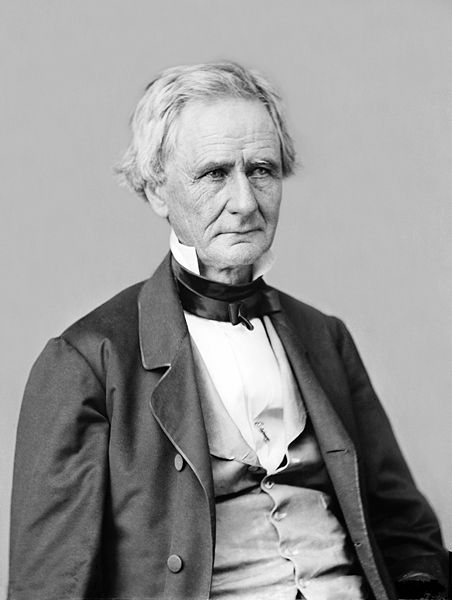
Secretary of War Simon Cameron
Secretary of War Simon Cameron knew that the commander of the Department of the Potomac, encompassing most of Virginia, Maryland, and all of the nation's capital, was not pleased with the U.S. Army's commander, Bvt. Lt. General Winfield Scott. In fact, Maj. General George McClellan was in something of a cold war with Scott at the moment, avoiding confrontation with him by pretending he didn't exist. For his part, Scott had still refused to withdraw his request to be placed on the retired list, effectively a resignation, but without sacrificing the gratitude the nation's longest-serving soldier expected to receive when he completed his career.

On September 7, Cameron decided the best way to make amends in the Union high command was to assuage McClellan's paranoia about a lack of support from the Lincoln Administration and the War Department. Assured, the younger general would then be able to give Scott the deference the older man thought he deserved. So he sent McClellan a carefully crafted note.
It is evident that we are on the eve of a great battle--one that may decide the fate of the country. Its success must depend on you, and the means that may be placed at your disposal. Impressed with this belief, and anxious to aid you with all the powers of my Department, I will be glad if you will inform me how I can do so.
Cameron was surely pleased with his little bit of diplomacy. It gave credence to McClellan's obsessive insistence that the Confederates were on the verge of attacking (which Scott continued to ridicule) and signaled that the War Department was eager to give McClellan what he felt he needed.

Sunday, September 4, 2011

Aiming Too High

In which the troops no one wanted are bombarded at Great Falls
..........................................................................................................................

Governor Andrew Curtin (Matthew Brady)
At approximately 8:30 in the morning of September 4, the attack came. Confederate cannon opened up on the 7th Pennsylvania Reserves stationed at Great Falls, just like Colonel Elisha B. Harvey had been warned.

Harvey had been preparing for the attack since August 24, when a message from the commanding officer of the Army of the Potomac, Major General George McClellan, had been transmitted to his brigade commander that a Confederate attack was imminent at Great Falls. The general - Brigadier General George A. McCall - had immediately sent Harvey to Great Falls with his regiment of infantry, a company of cavalry and a few artillery pieces to make sure a crossing couldn't occur without him knowing about it. Since then, Harvey had waited for the attack to begin.

McCall was part of a cordon McClellan had established along the Potomac River, reaching from Washington City to the division of Major General Nathaniel P. Banks at Harper's Ferry. Fittingly, the general commanding the most upstream brigade of the cordon was Charles P. Stone, the beleaguered then-colonel who had tried to cover the entire length of that distance during the Rockville Expedition with less than an eighth of the soldiers now assigned to the task. Back in Poolesville, Stone now only had to cover the distance from Point of Rocks down to Seneca Mills. To the east, the cordon was connected to the defenses of Alexandria County by a brigade under Brigadier General William Farrar Smith, better known as "Baldy" Smith, headquartered at the Chain Bridge.

Sunday, August 14, 2011

Hell Reigns

In which three Union regiments try to end the war
.......................................................................................................................................
Return of the 69th New York Militia from the Seat of War

 "Hell reigns in the 13th today, and has all day," wrote Samuel Partridge to a friend. Partridge was a young man in Company F of the 13th New York, who had fought at Bull Run as part of Cump Sherman's brigade.He was only a private on August 14, but he would rise to the rank of lieutenant as the regiment's adjutant and quartermaster by the time it finally went home in two years -- and that was the problem.

Company F, like all but three of the 13th New York's companies, was raised in Rochester. The men had pledged two years of service to the State of New York under its militia law, but under Federal law the Lincoln administration could only accept their service for 90 days. The 13th New York marched to Washington and were sent to Fort Corcoran, in present-day Rosslyn, and began a very unhappy period under then-Colonel Sherman.

Friday, August 12, 2011

Status Quo Ante

Wherein the fallout of the McClellan/Scott feud brings us back to where we were
.....................................................................................................................................

The nation's capital in the second week of August was filled with false alarms about imminent Confederate attacks, but the most damage to the Union cause kept coming from the Union men themselves. On August 8, commander of the Military Division of the Potomac, Major General George McClellan, had deliberately tried to embarrass General-in-chief of the U.S. Army, Bvt. Lt. General Winfield Scott. On August 10, Abraham Lincoln's efforts to quash the feud paid off.

McClellan offered the olive branch in a letter addressed to Lincoln:
The letter addressed by me... to Lieutenant General Scott... was designed to be a plain and respectful expression of my views of the measures demanded for the safety of the Government... It is therefore with great pain that I have learned from you this morning... that my letter is unfavorably regarded by him... Influenced by these considerations, I yield to your request, and withdraw the letter referred to... I will only add that as you requested my authority to withdraw the letter, that authority is hereby given, with the most profound assurances of respect for General Scott and yourself.
It was not a moment too soon, because that evening word came from Missouri that Brigadier General Nathaniel Lyon's army had been defeated and the general had been killed, raising the specter that all of Missouri would fall into its pro-secessionist governor's control. Scott worked tirelessly with the Adjutant General's office to make sure Major General John C. Fremont would get the reinforcements he needed to stave off disaster.

Which is why it took him until August 12 to throw a wrench in Lincoln's peace negotiations with his own missive to Secretary of War Simon Cameron (up the proper chain of command, unlike McClellan's).
...I was kindly requested by the President to withdraw my letter to you of the 9th, in reply to one I had received from Major-General McClellan of the day before... I deeply regret that, notwithstanding my respect for the opinions and wishes of the President, I cannot withdraw the letter in question...
First, McClellan's original letter "seems to have been the result of deliberation between him and some members of the Cabinet" (by which Scott probably meant Salmon Chase or Montgomery Blair), who had been influencing decisions on the conduct of the war "without resort to or consultation with me, the nominal General-in-Chief of the Army." Further, the Military Division of the Potomac had been reinforced with a number of three-years regiments, which McClellan had brigaded and encamped, not "not one of these movements has been reported to me (or anything else) by Major-General McClellan." Scott, however, was positive that the Cabinet had been told.

Second, McClellan was talented, Scott acknowledged, and he didn't cherish spending his days "filing daily complaints against an ambitious junior." And third, Scott insisted that he was still old and sick and he "should unavoidably be in the way at headquarters, even if my abilities for war were now greater than when I was young." Also, there was the small matter that McClellan had sent a copy of his letter to Scott, unsigned and with only a blank piece of paper for a cover note. "This slight was not without its influence on my mind," Scott noted.

Lincoln chose at this juncture to be too busy with the problems in Missouri to take any further action on Scott's request to be ordered into retirement, and McClellan chose to celebrate August 12 with a letter to the Secretary of the Navy about an imminent Confederate attack across the mouth of the Potomac, and urging him to transfer warships from Newport News to Aquia Creek.

Monday, August 8, 2011

WAR!

Wherein the old and new Fuss and Feathers blast each other to pieces
.....................................................................................................................................

George B. McClellan
"How does he think that I can save this country when stopped by Genl Scott?" George McClellan fumed to his wife, Mary Ellen, in his nightly letter after a frustrating meeting with Secretary of State William Seward.

I do not know whether he [Scott] is a dotard or a traitor! I can't tell which. He cannot or will not comprehend the condition in which we are placed & is entirely unequal to the emergency. If he cannot be taken out of my path I will not retain my position, but will resign & let the admn take care of itself. I have hardly slept one moment for the last three nights, knowing well that the enemy intend some movement & fully recognizing our own weakness.
The trouble should hardly have been a surprise. Too alike in temperament, the aged Brevet Lieutenant General Winfield Scott and the ambitious Major General George McClellan had grown tired of each other in less than two weeks. Each was a man obsessed with professionalism, each believed himself a master of grand strategy, and each regarded everyone as a threat to his own special mission to save the Union.

Thursday, August 4, 2011

The Two Napoleons

Wherein McClellan follows the usurper's example
.............................................................................................................................................

Prince Napoleon, in 1860
On August 3, after a grueling morning presenting his new strategy to the Cabinet and a busy afternoon of memo writing, George McClellan joined the President for a state dinner in honor of Prince Napoleon Joseph Charles Paul Bonaparte. Prince Napoleon, as he was known, was the cousin of Napoleon III, the reigning Emperor of France, and the grandson of the brother (Jerome) of the renowned Napoleon Bonaparte, to whom McClellan was often compared in the North (and G.T. Beauregard in the South). For McClellan, it was an opportunity not to be missed.

"I dined at the Presdt' yesterday," he wrote his wife, Mary Ellen. "I suppose some 40 were present--Prince Napoleon & his staff, French Minister, English ditto, Cabinet, some Senators, Genl Scott & myself."

Today the French are the butt of jokes about their military prowess, but in 1861 they were regarded as the world's premier fighting nation. Only a generation before, the French had fought a coalition of nearly every European country, conquering all of them (though the British will insist that the Treaty of Amiens was not an admission of defeat, merely a cease-fire). It was the triumphant campaigns of Napoleon as interpreted by his admirer and former aide Henri Jomini that American cadets studied at West Point (to the degree they studied anything beyond engineering), and it was these Napoleonic strategies and tactics that would guide the decisions of nearly all generals in the war, both North and South (today, military thinkers prefer Prussian Carl von Clausewitz to Jomini, but while On War had been published already in 1861, it had not yet been translated to English and wouldn't win the attention of Americans until after the Prussians decimated the French in 1870).

Tuesday, August 2, 2011

A Carefully Considered Plan

Wherein McClellan heroically sticks his nose in other people's business
.....................................................................................................................................................
The object of the present war differs from those in which nations are usually engaged, mainly in this: that the purpose of ordinary war is to conquer a peace and make a treaty on advantageous terms; in this contest it has become necessary to crush a population sufficiently numerous, intelligent, and warlike to constitute a nation; we have not only to defeat their armed and organized forces in the field but to display such an overwhelming strength, as will convince all our antagonists, especially those of the governing aristocratic class, of the utter impossibility of resistance.
McClellan's Headquarters, the house of George Wilkes
on 19th Street and Pennsylvania Ave, NW
The sentiment would not have been out of character for a zealous Republican supporter of President Lincoln, such as Senator (and Colonel) Edward Baker the day before in the U.S. Senate, but the author of those words on August 2 was Major General (only twenty-four hours before officially officially) George B. McClellan. McClellan could not be criticized for a lack of effort in the week since he had taken command of the Military Division of the Potomac, encompassing the Departments of Washington and Northeastern Virginia.

"I was in the saddle nearly 12 hours yesterday," he wrote his wife on the evening of August 1 about yet another day of riding from camp to camp seeing his men and surveying the ground around Washington. "I broke down your Father [Randolph March, who McClellan has made chief of staff] and sent Seth [Williams, his adjutant] home... neither of them having been out all day." McClellan's trips had more purpose than gloating over his father-in-law and assistant, though. He was preparing an army to fight a great war being envisioned in his head.

Saturday, July 30, 2011

The General and the Congressman's Wife

In which the score is Chestnut 1, McClellan 0
................................................................................................................................

East Front of the Capitol in 1861 (AOC) The Senate
Chamber is closest to the camera.
On July 30, Major General George McClellan visited the Senate for his first time since being named commander of the Military Division of the Potomac. During that day the Senate failed to end debate and take action on a tariff bill, a bill on the "suppression of insurrection", a bill on armored ships (soon to be known by the nickname "ironclad"), and the perennial resolution approving Presidential acts before Congress came into session. They even failed to vote in favor of adjourning at the end of the day (then did so automatically when they lost a quorum).

McClellan found none of this worth noting to his wife, Ellen, but did relate that "it seems to strike everybody that I am very young."
When I was in the Senate Chamber today and found those old men flocking around me; when I afterwards stood in the library looking over the Capital [sic] of our great Nation, & saw the crowd gathering around to stare at me, I began to feel how great the task committed to me.
He left her with the closing anecdote that "I learn that before I came on they said in Richmond, that there was only one man they feared and that was McClellan."

Wednesday, July 27, 2011

McClellan Comes to Town

Wherein we get to know one of the best known generals of all time
............................................................................................................................................

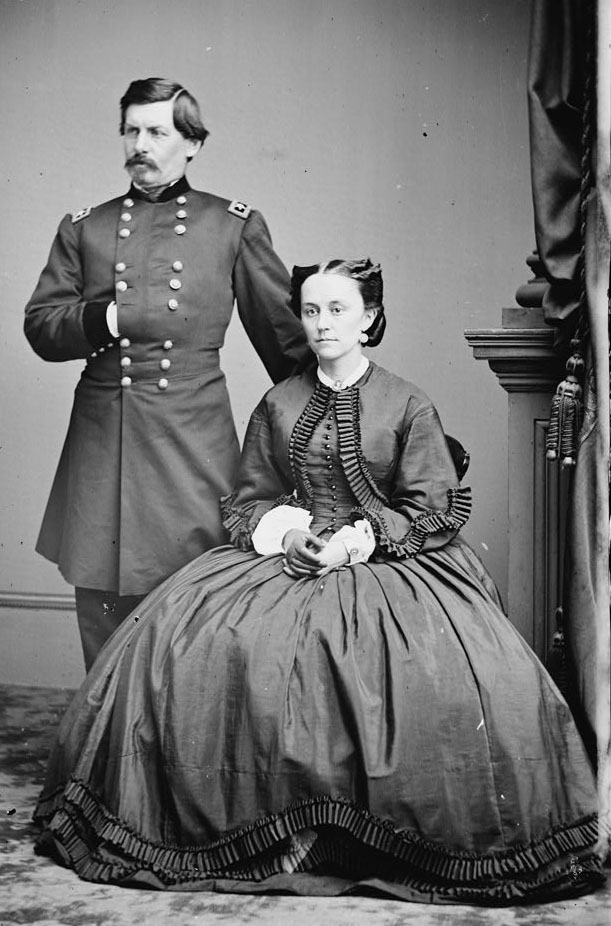
George and Ellen McClellan
Some names are associated indelibly with the Civil War in popular conception: Lincoln, Lee, Grant, Sherman, Stonewall. Each has their supporters and detractors, usually along geographic lines. But one name earns near universal scorn: McClellan. The great villain of countless Lincoln stories, fired twice for gross incompetence (not actually true, the first time he remained in charge of the Army of the Potomac but half the army was transferred to the Army of Virginia) only to reappear as the Apollo Creed presidential opponent in 1864 who wanted to throw in the towel on the war (also untrue, McClellan repudiated his party's peace platform) only to be defeated by the plucky Lincoln at the last minute.

It's hard for us today to remember that on July 27, 1861 people felt much different about the man. The New York Herald editorialized about George Brinton McClellan the following morning:
There is a charm in this name which will yet work as a talisman upon the American heart... This appointment is highly important. The man seems to have loomed up in the moment of need when he was most wanted. We did not know the best man before, but events have displayed his ability and brought him to light. It is so in all revolutionary convulsions—the best men are thrown on the surface... 

But a new era has opened upon us. We have been awakened from a dream of fancied conquest without the necessary preparation to achieve it. A man has arisen equal to the times. Like the legions of France under Napoleon, the troops of the American republic under McClellan will be invincible, and the shameful rout of Bull Run will be forgotten in the glory of his victories.
[NewsInHistory.com has this and a number of other amusingly breathless exhortations of McClellan]

Monday, July 25, 2011

Starting Anew

In which U.S. leaders decide to get back on the horse
...........................................................................................................................

Burnside (center) and the leadership of the 1st Rhode Island, back home
On July 25, Colonel Ambrose Burnside reluctantly formed up the 1st Rhode Island and prepared to lead them out of Washington for the last time. Because Burnside had pulled them back to Matthew's Hill to rearm rather than send them up Henry Hill, the regiment was in considerably better condition than most in the army. Burnside reported 13 killed, 39 wounded, and 39 missing. But their 90 days of Federal service had been reached, so it was back to Rhode Island, where the men would return to their homes and Colonel Burnside would again become a private citizen.

They left behind a capital trying to get back on track after the shock of their defeat on the hills overlooking Bull Run. The attempts to reconstitute the Northern war effort began immediately as the first troops stumbled through the terrible storm back to their fortified positions, but on the 25th it finally began coalescing into something like concrete changes.

Sunday, July 24, 2011

Thaddeus Lowe's Excellent Adventure

In which a balloonist convinces the President by nearly getting himself killed
.....................................................................................................................................

Colonel W. Tecumseh Sherman was dispirited on the morning of July 24 as the 79th New York Volunteer Infantry Regiment marched away from Fort Corcoran to join a new commander. But he had another guest at Fort Corcoran he was ecstatic to see go.

T.S.C. Lowe, by Matthew Brady
Thaddeus Sobieski Coulincourt Lowe had taken up residence at 8:00 pm on July 22, drenched by the pouring rain, with his balloon in tow. Lowe had been cut out of McDowell's advance on Manassas Junction by a staffer who ordered him to let a competitor fill his balloon first. But the competitor's balloon had town on the trees on the Warrenton Turnpike near Centreville, and became useless for assisting with the battle.

Lowe attempted to bring his own balloon to Manassas, even though it was late in the day, but by the time he reached Fairfax Court House, McDowell's army was streaming past him. It was too dark to see further, and the next morning the storm started, so he reluctantly packed up to return to the capital, making it to Fort Corcoran before seeking shelter.

But at 5:30 am on July 24, he was ready to try again, acting on a rumor that the Confederates were marching on Washington to seize the capital. If he could bring back proof either way, it would be the boost he needed to get a lucrative government contract for aerial surveillance. Lowe's account from his memoirs:

Saturday, July 23, 2011

In the Camps of the Defeated

In which Sherman tells a lie and our blogger returns to his post.
.........................................................................................................................................

A quick note before beginning: after over 10,000 words written from July 18 to July 21 a few days off were necessary. But no days off occurred for our historical neighbors. While Living in the Past was off: in Manassas, Joe Johnston resumed command of the combined force and arranged for burial of the dead and feeding of the living, both equally challenging. Throughout Northern Virginia, Confederate brigades fanned out again to seize strategic points, and Johnston and Beauregard began a debate on the next proper course of action. In Washington, Abraham Lincoln resisted the urgings of Winfield Scott to send his family away from Washington until the city could be secured. Before McDowell even returned to Arlington House, Scott had sacked Robert Patterson and ordered George McClellan to leave his army with his second-in-command and come to Washington. The ends of battles are never as neat as the restrictions of publishing demand.

***

At Fort Corcoran in Rosslyn, Cump Sherman's brigade was reeling from the battle. The 69th New York had lost 192 men killed, wounded, or captured (collectively referred to as "casualties", that number of men lost for further operations), including the fort's namesake, Colonel Corcoran who now sat in a Confederate jail, and his second-in-command, shot dead by a Louisiana Tiger shortly after the regiment forded Bull Run. The 79th New York lost 198, including Colonel James Cameron, the Secretary of War's brother, who was killed on Henry Hill. The 2nd Wisconsin had 115 casualties and the 13th New York had a relatively light 58 casualties. It all added up to 564 men out of Sherman's 3,400, or 16.6 percent casualties (by comparison, Americans landing at Omaha Beach on June 6, 1944 suffered 10 percent casualties, though with a much higher percentage confirmed killed or wounded).