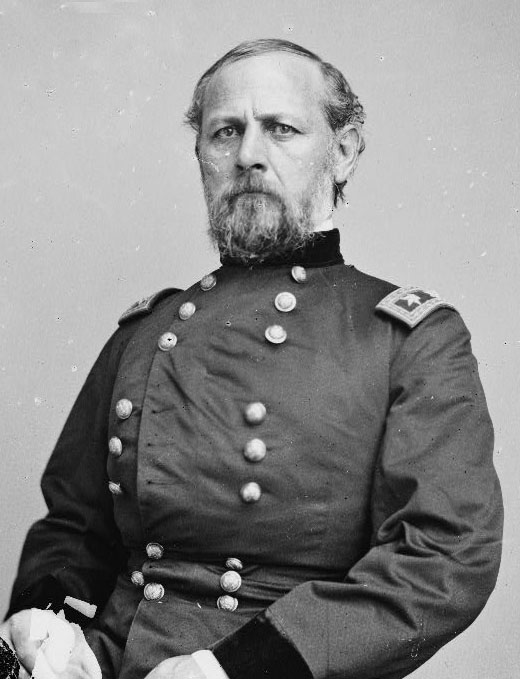
Wherein Hooker and McClellan don't really help each other
......................................................................................................................
The noose was beginning to tighten around Maj. General George B. McClellan, general-in-chief of the U.S. Army, and commander of the Army of the Potomac. President Abraham Lincoln had clearly become unhappy with the course of the war, appointing a new Secretary of War, Edwin Stanton, and using his commander-in-chief powers to
issue a general order for all armies to begin operations by February 22. McClellan was uncertain if Lincoln himself--who McClellan called "the original gorilla" in private, a nickname invented by Stanton a few months before he joined the administration--was the source of the pressure, or if he was responding to the Radical Republicans in Congress, who had convened the Joint Committee on the Conduct of the War
to drum out "traitors" from the war effort, a word they considered synonymous with "Democrats". They had already
claimed their first victim, Charles P. Stone, who was imprisoned without charge in Fort Lafayette in New York Harbor, but McClellan knew that he was their real target.
In his own Army, there were generals conspiring to replace him. Brig. General Irvin McDowell, who had appeared to see his career as a commander of troops crushed with the loss at Bull Run, was experiencing a resurgence thanks to his willingness to tell the Joint Committee and Lincoln his proposal for a repeat attack on Manassas Junction. Another division commander, Brig. General Samuel Heintzelman, appeared to be in league with McDowell,
ordering reconnaissances along his proposed lines of attack. On the distant right, the senior division commander, Maj. General Nathaniel P. Banks, was requesting McClellan allow him to march his division from Frederick, Maryland, to Winchester, Virginia, almost daily, insisting he could bounce the Confederate force under
"Stonewall" Jackson out of the Shenandoah Valley with virtually no losses. To the right of Banks, Brig. General Frederick Lander had been making similar requests with such impertinence that McClellan ordered Banks (through whom his messages were routed) to tell him that the general-in-chief "might comment very severely on the tone of his dispatches, but abstain[s]."
And worst of all for McClellan, other generals were winning successes that he didn't seem able to convince Lincoln were thanks to McClellan's leadership in Washington. His old friend Ambrose Burnside had seized Roanoke Island in North Carolina, providing another base from which to threaten Gosport Shipyard [Norfolk Naval Shipyard], the home port for the new ironclad the Confederates had built out of the scuttled remains of the U.S.S.
Merrimack. McClellan might have been due some credit for that operation, but the success in Tennessee against Fort Henry and Fort Donelson by troops under the ultimate command of McClellan's top rival, Maj. General Henry Halleck, looked ominous for Little Mack's tenure.
McClellan had to somehow satisfy Lincoln's insistence, without sacrificing his grand scheme to transport the Army of the Potomac to the Rappahannock and march on Richmond directly. He would need at least a month for the troop ships from Burnside's expeditions to return in order to ferry another army. For McClellan, Joe Hooker provided the solution.