Tuesday, August 28, 2012

1pm: Jackson tries to lure Yanks to trap at Brawner's Farm

................................................................................................................................................


Gainesville

Meade’s brigade of Reynolds’ Pennsylvania Reserves was having trouble pushing back Bushrod Johnson’s skirmishers. The problem was the battery of smoothbore’s responding to Johnson’s two rifled guns couldn’t reach the Confederates. After suffering under the intermittent fire, a battery of 10-pounder Parrotts was at last brought forward and Meade began to make progress at pushing the Confederates back. Wrote Meade later:
The brigade was then formed in line of battle under the direction of the general commanding the division [Reynolds], with Cooper’s [Parrott] battery in the center, supported by the Third and Fourth Regiments on the right, the Seventh and Eighth on the left, and the First Rifles (Bucktails) in advance as skirmishers.
Johnson’s skirmishers began to fall back, trying to draw Reynolds down the Warrenton Turnpike [US 29] where Taliaferro and Ewell could pounce.

Following behind Reynolds with King’s division, McDowell was still concerned about connecting his troops with Sigel’s corps. Accordingly, while Reynolds pushed back the Confederates, McDowell took advantage of the opportunity and turned King’s Division south at Gainesville, down the Gainesville-Manassas Junction Road [Wellington Road] to spread out in the farmer’s fields. Ricketts’ division, however, turned north on hearing Percy Wyndham’s report from Thoroughfare Gap.

Lower Fords

Meanwhile, John Pope rode with Phil Kearny at the head of a line of over 40,000 men in blue. Heintzelman’s Third Corps, Army of the Potomac was getting ready to cross the fords on Bull Run where the first battle had begun, followed closely by Jesse Reno’s Ninth Corps, and Franz Sigel’s First Corps, Army of Virginia, and, so Pope thought, Fitz John Porter’s Fifth Corps, Army of the Potomac. This last one was instead settling in for a night at Bristoe Station.

Stony Ridge

At his headquarters on the ridge running above the unfinished railroad, Jackson received a copy of McDowell’s General Orders No. 10, probably captured by Bushrod Johnson. In his official report, Johnson laments that his messenger had been captured himself when delivering the captured information, but perhaps he sent a second rider. There was little opportunity outside of Johnson’s to capture the order, which was obsolete already anyway, thanks to Pope’s change of plans.

Thoroughfare Gap

In the Gap, Percy Wyndham’s New Jersey boys were facing stiffer opposition, but still holding. Ricketts had been notified just a few miles west of Gainesville, and was said to be hurrying to reinforce. But Wyndham’s bravado was beginning to be proven ill-informed, since Longstreet had not yet begun to seriously contested the Gap.

12pm: Yanks under fire in Gainesville, Pope plans to attack Centreville now

.......................................................................................................................................


Manassas Junction

As the sun reached its zenith, John Pope was nearing his too. Still utterly confident that he had Jackson in his hands, Pope rode into Manassas Junction with Kearny and smugly learned that he had him on the run. His official report shows that he was no closer to the truth of the situation even after plenty of free time for reflection:
I reached Manassas Junction with Kearny’s division and Reno’s corps about 12 o’clock in the day of the 28th, less than an hour after Jackson in person had retired. I immediately pushed forward Hooker, Kearny, and Reno upon Centreville, and sent orders to Fitz John Porter to come forward to Manassas Junction. I also wrote to McDowell, and stated the facts, so far as we were then able to ascertain them, and directed him to call back the whole of his force that had come in the direction of Manassas Junction and to move forward upon Centreville.
Pope had planned to smash Jackson against Bull Run at Manassas Junction. Now he would smash him at Centreville instead.

A few miles south of Manassas Junction, Sigel’s missing corps received orders directly from Pope (which he conveniently forgot in his official report) to march straight for Centreville.

Gainesville

Unaware that Sigel was not only no longer on his left, but not even moving towards the same destination anymore, John Reynolds continued to lead his division up the Warrenton Turnpike [US 29] towards the old battlefield. He reported
On arriving in Gainesville the head of my column was fired upon by two pieces of the enemy in position on the heights above Groveton and to the left of the Turnpike, which were immediately replied to by Ransom’s battery, and Meade’s brigade rapidly thrown into line of battle by that general.
Reynolds was receiving fire from batteries commanded by Confederate Marylander Bushrod Johnson, of Jackson’s Division. Johnson’s brigade had been placed by Taliaferro on the steep hill above the crossroads of Groveton that morning with several pieces of artillery and the 1st Virginia Cavalry to guard against an advance from Manassas Junction. But by happy coincidence, he had captured one of McDowell’s aides, with a copy of General Order No. 10, and recognized his difficult situation immediately.

He flipped the orientation of his force from facing the Sudley Road to facing Gainesville, and moved several regiments down the Turnpike with his only two pieces of rifled artillery. It was a race with Reynolds’ vedettes.
Riding forward, I got on a high hill to the right of the road and discovered the enemy in force, their skirmishers pushing rapidly on me. I instantly brought up the rifled pieces and Forty-eighth [Virginia], and after a race beat the enemy to the hill and opened on them, driving in their cavalry and skirmishers…
 John Gibbon, whose brigade was following as part of King’s division, had been sent down a country lane south of the Turnpike when the firing started and told to form up into a line of battle to prepare for an attack. Gibbon was a blunt, unpleasant, man who had brought strict discipline to his brigade when he assumed command, as well as outfitted them with distinctive black Hardee Hats. Gibbon had been raised in the south, and three of his brothers were Confederate officers, but he was staunchly loyalist. His is the classic story of the crusty regular army artillerist brought in to whip a ragtag group of misfits into order, but since they had only marched back and forth from Fredericksburg to Catlett’s station since the previous summer, it was not yet clear whether these Black Hats would become the heroes the clichéd story wanted them to be.

After a few hours of waiting on the country road, Gibbon had ridden back to McDowell and the other senior officers to get a firmer grasp on what was going on. Looking over the countryside with their field glasses, they saw heavy clouds of dust in the east, the tell-tale sign of troops moving. Gibbon recorded in his memoirs that:
I began to think that McDowell’s prediction of the night before that “something was bound to break” today was about to be verified…Still we did not move and as the day wore on our men began to get hungry. We had but few provisions along, except beef on the hoof, and some of the Regimental officers asked permission, if we were to be here long enough, to kill some of the cattle and cook the beef. I could obtain no definite information in regards to our probable stay, and after hesitating some time I gave orders to have the beef killed and cooked.
Brawner’s Farm

Not at all in Centreville, Jackson responded to Bushrod Johnson’s engagement of Reynolds with enthusiasm. Assuming Pope had responded to the bait of A.P. Hill’s division at Centreville, he issued orders to Taliaferro and Ewell to prepare to leave their protection on the railroad, and strike Pope’s left flank.

ForTaliaferro, the flank was represented by Reynolds’ division at Gainesville, currently exchanging artillery fire with Johnson. “I accordingly pushed the First, Third, and Fourth Brigades in that direction, being followed by Major-General Ewell.”


11am: Longstreet held up at Thoroughfare, Jackson picks an unfinished railroad for defense

.................................................................................................................................................


East of Warrenton

Sigel had finally cleared out of Reynolds’ way, and the Pennsylvania Reserves could begin marching up the Warrenton Turnpike [US 29] towards the old battlefield. But Reynolds was barely underway before it became obvious that Sigel had seriously botched his job. Pickets began to report that there were no Union troops to the right of the Reynolds’ men.

Over the course of the several hours it took Reynolds and McDowell to figure out what happened, Sigel marched his entire corps south and formed it up to the right of the O&A tracks, rather than marching with his right-most brigade on the railroad. This left a massive gap between McDowell’s corps and Sigel’s, though how massive would not be immediately apparent. Thinking that Sigel must be only a mile or two separated, McDowell gave orders to the senior brigadier of King’s Division to follow behind Reynolds on the turnpike, but send out flankers to look for Sigel.

Thoroughfare Gap

For a little over an hour the advanced scouts of Longstreet’s Wing had been cautiously trying to determine what force was felling trees in the gap. With nearly all of the cavalry commanded by Stuart and east of Bull Run Mountain, Longstreet couldn’t reconnoiter like he should have.

Had he been able to, he would have learned that the only Union force opposing him was the First New Jersey Cavalry, once again under the ludicrous Sir Percy Wyndham. Always reckless, Colonel Wyndham had decided that he would hold the Gap, and sent messengers to McDowell to hurry infantry reinforcement while his cavalry cut down trees and hid themselves throughout the narrow gorge.

Unfinished Railroad

Despite the delay of McDowell and Sigel, Pope was moving much too quickly for Jackson to strike him at Manassas Junction, so he pulled his men back to the line of an unfinished railroad. Alternating cuts and banks, the railroad line had been dug by the owners of the Manassas Gap Railroad to avoid the exorbitant fees the O&A owners were charging them for running traffic from Alexandria to Manassas Junction. The line was supposed to diverge from Gainesville and travel north through Fairfax Court-House to Jones Point in Alexandria, where a terminus would have directly served a wharf on the Potomac River.

But the Panic of 1857 had effectively killed the project, drying up capital for its construction, which had ended in 1858, even though the rails for the line had already been purchased and were sitting in Alexandria. Traveling over the rolling Piedmont of Virginia, the railroad had been overwhelmed by the price of cuts and embankments needed to maintain a suitable grade for rail traffic, but it was those cuts and embankments that now offered a solution to Stonewall Jackson.

He placed his division, under Taliaferro, behind the unfinished railroad behind the Brawner family farm, and Ewell’s Division between the farm and the Sudley Road. The railroad bed provided natural cover, behind which the extent of his force could be hidden from Union scouts, and the large, downward sloping plain in front of them provided a perfect killing field if the scouts happened to find them anyway.

It would become the defining geography of the battle.

South of Manassas Junction

Reno had made good time, and the Ninth Corps was now directly behind Hooker’s division. Pope rode at the lead, in good humor with Phil Kearny, closing in on Jackson.

10am: Yanks on march west from Warrenton, Rebs from Valley

.....................................................................................................................................................

South of Warrenton
At last, Sigel’s First Corps, Army of Virginia had started marching. Reynolds still waited for it to take its position so he could start his own men.

Bristoe StationThe sleepy railroad depot had had a busy morning. Shortly after dawn, the Third Corps, Army of the Potomac (detailed to the Army of Virginia) had departed for Manassas Junction. Not long afterwards, the Union Ninth Corps had marched through, in transit to Manassas Junction. And at 10:30, the Fifth Corps, Army of the Potomac (also detailed to the Army of Virginia) had arrived. Fitz John Porter, its resentful commander, had no intention of moving it further that day. His men had been run from one side of northern Virginia to the other hunting Jackson’s elusive men, and he was determined to provide them some long-needed rest. As they filed into the fields surrounding the railroad, he ordered them to set up camp for the evening.

West of CentrevilleA.P. Hill’s men had been marching and fighting for over twenty-four hours with no more than a few minutes of sleep stolen here and there. The Light Division had reached Centreville around dawn, and ransacked the small amount of supplies while obstructing the Turnpike there. Then it had started marching west down the Turnpike towards Stone Bridge.

Around 10:00, Hill received a message from Jackson from the “Battlefield of Manassas”, written at 8:00 am. It said “that the enemy were in full retreat, and to move down to the fords and intercept him…” Hill wrote in his report:
But having just seen two intercepted dispatches from Pope to McDowell, ordering the formation of his line of battle for the next day on Manassas Plains, I deemed it best to push on and join General Jackson.
West of Thoroughfare GapWhen Lee reached Longstreet’s headquarters, the latter gave the order to march. D.R. Jones, a veteran of First Manassas, led his division first, followed by John Bell Hood, Cadmus Wilcox’s, and James Kemper. Somewhere behind them was the forgotten hero of that first battle, Shanks’ Evans with his independent South Carolina brigade. Only Dick Anderson’s Division of Longstreet’s Wing remained far behind, still guarding the fords on the Rappahannock.

3am - 9am: Pope tries to trap Jackson at Manassas, he's gone already


 .........................................................................................................................................


Warrenton

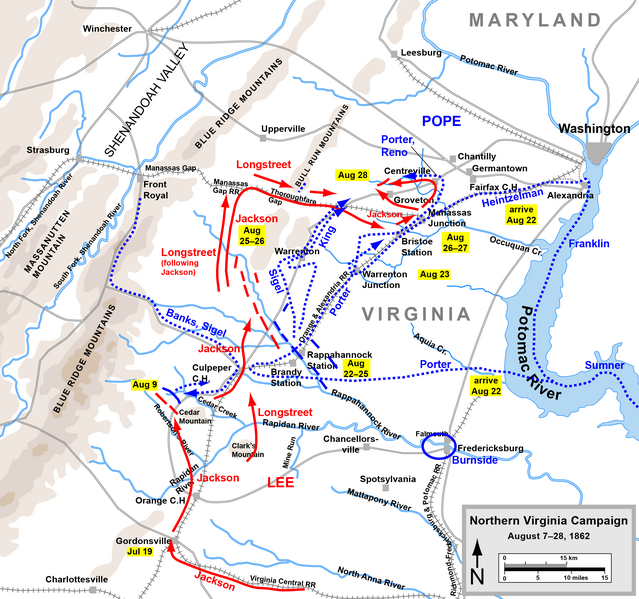
Irvin McDowell, responsible for the left wing of Pope’s army, finished his orders shortly after midnight and sent them to the division commanders of his own corps and of Franz Sigel’s corps. Pope planned to trap Jackson’s Wing of the Confederate Army of Northern Virginia at Manassas Junction, separating it from Longstreet’s Wing still in the Valley and smashing it against Bull Run. McDowell was responsible for bringing the over 20,000 men he had stretched from Warrenton to Warrenton Junction west, following two corps led by Sam Heintzelman; two waves crashing onto the Stonewall only a few miles south of his greatest triumph.

To accomplish this, McDowell ordered Sigel’s First Corps, Army of Virginia to march straight on Manassas Junction, his right-most brigades marching on the Orange and Alexandria Railroad. Sigel’s men were to be augmented by John F. Reynolds’ Pennsylvania Reserves from his own Third Corps, Army of Virginia on the left, marching down the Warrenton Turnpike [US 29]. Sigel plus Reynolds would form a giant squeegee, sweeping any Rebels in front of them.

McDowell’s other two divisions were to follow the turnpike as well. Rufus King, who had not been confined to an ambulance since his seizure at Rappahannock Station about two weeks earlier, nonetheless was given the responsibility of guarding the flank, by deploying his men north of the Turnpike for the march. With their leader confined to bed, McDowell decided to make his personal headquarters with his old division.

James Ricketts, commanding the final division for McDowell, was to follow along the Turnpike in reserve as far as Gainesville, where he would determine if Longstreet’s Wing was attempting to cross through Thoroughfare Gap. If so, he would go relieve the cavalry units watching the Gap. If not, he would move into position to King’s left and act as a cork for any of Jackson’s forces that might think they could escape the bottle Pope planned to put them in.

Issued as General Orders No. 10, McDowell sent off the orders and, predictably, they immediately went awry. Sigel either couldn’t or wouldn’t get his men moving in time, and Reynolds’ fumed while dawn broke, and the sun rose in the sky with no movement made.

West of Thoroughfare Gap

Robert E. Lee had left Salem in Page County before dawn and rode with his staff towards White Plains [The Plains], where he would meet with James “Pete” Longstreet. By afternoon they hoped to have Longstreet’s wing of the army through Thoroughfare Gap, where it could join with Jackson’s to confront Pope.

Bristoe Station

With Hooker’s division bloodied from the day before [at Kettle Run], Sam Heintzelman started Phil Kearny’s division first up the O&A Railroad towards Manassas Junction, he and John Pope riding along. Not surprisingly, Kearny stepped off exactly on time, with Hooker close behind him.

Manassas Junction

Jackson’s men had spent a busy night. The encounter with Hooker the day before had alerted him that he had run out of time for raiding, and it was time for the battle. But Pope had pursued with more skill than Stonewall had expected, and his divisions were in poor position for a fight.

Jackson decided to move north of the Warrenton Turnpike [US 29], the ideal position to meet a force marching from Manassas Junction while being reinforced from Thoroughfare Gap. Ewell’s Division was already almost there, having pulled back to the Manassas Gap Railroad after fighting with Hooker at Kettle Run.

The supplies he couldn’t carry with him, Jackson torched around midnight, and began marching with his division, under the leadership of William Taliaferro, up the Sudley Road to take up position at the old battlefield, perhaps to gain inspiration. A.P. Hill’s Light Division, along with Fitzhugh Lee’s brigade of cavalry, he sent north on the Centreville Road, with orders to destroy the O&A track east of that town, to prevent Pope’s reinforcement by McClellan from Alexandria.

Greenwich

Jesse Reno’s Ninth Corps was adjusting to command under Pope. They started their move down what is today (more or less) Vint Hill Road to Bristoe Station, reaching the sight of the fight on August 27 not long after Heintzelman had vacated it, and following them up the O&A.

Monday, August 27, 2012

Live Blogging Second Manassas (or Bull Run, if you prefer)

Wherein you can live the worst decision of my blogging career
.....................................................................................................................

Good people, for the past month and a half I have been involved in an all-consuming project of creating hourly updates for the entirety of the second battle fought at the intersection of Route 29 and Sudley Road. Having carried out a similar exercise for the first, I thought this would be no big deal and there'd be plenty of time on the side to build the story lines through northern Virginia on this blog. I was wrong. This battle was much more complex, and amounted to 45,000 words to tell the story when all was said and done. Over the next few days, I submit it to you, hour-by-hour.

Some resources to guide you through:

For your key media needs, including maps, I recommend the Civil War Trust's website:
http://www.civilwar.org/battlefields/second-manassas.html

For a strategic overview, Wikipedia serves you well:
http://en.wikipedia.org/wiki/Second_Battle_of_Bull_Run

Wikipedia is again useful for both orders of battle:
http://en.wikipedia.org/wiki/Second_Bull_Run_Union_order_of_battle
http://en.wikipedia.org/wiki/Second_Bull_Run_Confederate_order_of_battle

In addition to the wonderful sources listed in the books section, many of which were used, invaluable assistance was provided by:
  • John Hennessy's Second Manassas Battlefield Map Study, available at the Manassas National Battlefield Park visitor's center, that comes with 16 nifty maps and served as my framework
  • Peter Cozzen's John Pope: A Life for the Nation, which like Cozzen's other books provides a remarkably fair look at someone history has justly written off. Just because history is right, doesn't mean the guy doesn't deserve a book. You can (and should) purchase it here, or at other fine book-selling establishments.
Make sure to read about the Battle of Kettle Run that acts as a prelude to this fight, and did a lot to influence how deployments were made on the first day, and occurred 150 years ago at the very moment I am posting this.

Lastly, due to important life events I am unable to provide the full linkage, cross referencing, and photo posting that a blogger should. I consider those events a lot more important and fun, plus I know everyone can use Google, so you're not Gouverneur Warren sitting along above Groveton.

I hope you enjoy.