Tuesday, August 28, 2012

7pm: Brawner's Farm, Black Hats become the Iron Bgd, courtesy of lead from Stonewall Bgd

...........................................................................................................................................
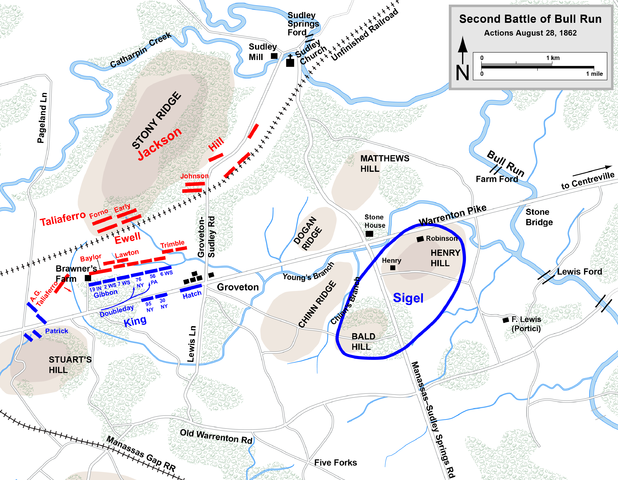

Brawner’s

The fight at Brawner’s Farm had metastasized into something primitive. The green men of Gibbon’s brigade stood in their black Hardee hats and took the fire from the storied Stonewall Brigade and Lawton’s Georgia Brigade standing less than half a football field away, returning it shot for shot. It was more like something out of the American Revolution, when primitive musketry made aiming a futile exercise.

With the 6th Wisconsin, isolated by several hundred yards on the far left, Major Rufus Dawes, future brigade commander, described the madness up and down the line:
Our men on the left loaded and fired with the energy of madmen, and the 6th worked with equal desperation. This stopped the rush of the enemy and they halted and fired upon us their deadly musketry. During a few awful moments, I could see by the lurid light of the powder flashes, the whole of both lines. The two ... were within ... fifty yards of each other pouring musketry into each other as fast as men could load and shoot.
Jackson, determined to turn the tide, directed Ewell to Isaac Trimble’s brigade against the 6th Wisconsin. The hardscrabble Dick Ewell chose to accompany them himself. With Trimble’s 12th Georgia, on the far left of the brigade, Ewell scampered down into a ravine, where it was suddenly swept by a crossfire. Ewell scouted ahead and dropped under the cover of a cluster of pine trees to look for the source. Suddenly a bullet struck his knee, splitting in kneecap. The general writhed in pain, and—either at his direction or because of the heat of battle—was left behind.

Trimble’s men surged forward, threatening to overwhelm the 6th Wisconsin, but Doubleday’s two regiments of reinforcements arrived in time to drive them back. Gibbon now had a thin, uninterrupted line of six regiments stretching from the Brawner Farmhouse to a small creek connected to the ravine Dick Ewell had been wounded in. George Noyes, a junior officer in Doubleday’s brigade described the scene:
The shadows of night gradually descended and it seemed to me that I saw at least a mile of lightning leaping from rebel muskets, while a perfect deluge of rebel thunderbolts went crashing into the woods, or came shrieking like fiends over and among us. The rattle of musketry was terrible and continuous—the air seemed full of lead.
On the far end of this deluge was John Gibbon, having placed himself at the weakest point of the line, his open left flank. Resting on the Brawner Farmhouse, the 19th Indiana had no recourse if the Confederates moved in the gap between an intermittent stream and the farmhouse. They had already placed horse artillery on the other side of the ravine and were raining down shot on the Hoosiers.

The colonel of the 19th ordered two companies to redeploy at a right angle and open fire on the nearby horse artillery. In Union accounts, this forced the guns to relocate. In the account of John Pelham, the battery commander, the fire was ineffective and his gunners kept firing throughout. Either way, Gibbon had to deal with a bigger problem, the arrival of a brigade under the command of Alexander Taliaferro, the uncle of division commander William Taliaferro.

Gibbon ordered the 19th's colonel to form an oblique angle with his regiment so it could fight the Stonewall Brigade and Taliaferro’s advancing brigade. But the colonel decided instead to move his regiment back several dozen yards behind a rail fence, so that Taliaferro’s angle of attack in the dark would allow the Hoosiers a shot at his flank instead. It was a dangerous move to perform with rookie soldiers facing nearly 3:1 odds, but it worked perfectly, even after Taliaferro ordered his men to charge and prevent them from executing the maneuver.

In the middle of Gibbon’s line, the Confederates tried to breakthrough too, with regiments of the Stonewall Brigade and Lawton’s Georgia Brigade advancing and falling back throughout the hour and a half of heavy fighting. During one, the commander of Jackson’s Division, William Taliaferro, took a bullet to the leg and had to be carried off the field, further confusing an already confusing situation. With Ewell and Taliaferro both gone, Jackson was giving orders to brigade commanders and sometimes regiments himself, and showing the limitation of his tactical imagination to enduring frontal pummeling, followed by all-out charges.

It was time for the latter tactic. About 7:30 Jackson sent at least two of Lawton’s Georgia regiments and perhaps the 2nd Virginia (who surely did not feel kindly towards the Georgians) in an all out charge against the 2nd Wisconsin just to the right of the 19th Indiana, the rebel yell rolling over the battlefield above the din of muskets and boom of cannon. The Badger State men stood firm and fired into the incoming mob, then endured the crash of hand-to-hand combat.

Meanwhile, two regiments to the right, the 76th New York from Doubleday’s brigade took advantage of the momentary relaxation on their front caused by the charge. Their colonel bellowed for his men to reform at a sharp angle from the line, facing the flank of the charging Confederates and open fire. One member of the regiment wrote:
It seemed like one gun… When the smoke cleared away a little, the few left of that mass of human beings who had so rapidly left the woods a few minutes before had disappeared, but the ground was literally covered with their dead and wounded.
The charge repulsed, the 76th's colonel ordered his men to fix bayonets and prepare for a countercharge.

Sudley Springs

Closer to Sudley Springs along the unfinished railroad, Powell Hill received a message from Jackson to send reinforcements. He had advanced three of his brigades into the open plain in front of the railroad where they had been nothing more than target practice for the distant Union gunners of Franz Sigel’s corps (who really should have been directing their fire closer to Brawner’s Farm). It was an ignoble mission, so Hill was happy to recall them, sending one south to reinforce Ewell (not knowing Ewell was wounded and missing) along with another that hadn’t been subject to the bombardment.

6pm: Brawner's Farm, Rebs swarm over Yanks

..........................................................................................................................................


Brawner’s

Dusk was rapidly settling in, and John Gibbon was beginning to understand that he did not have a small rear guard in front of him. But since Jackson was still assumed to be at Centreville, what his men were shooting at, he had no idea: "As the enemy appeared to be now heavily re-enforced, the Sixth and Seventh Wisconsin were both ordered into line, and I sent repeated and earnest requests to division headquarters for assistance."

But nobody could find Rufus King (who was in fact undergoing an epileptic seizure). So Gibbon began asking his other brigade commanders for assistance. Patrick remained holed up on Stuart’s Hill and couldn’t or wouldn’t respond. Hatch had set up the artillery on a hill overlooking Groveton, but kept his infantry under cover. Doubleday had promised help when the two had conversed in person, but since he had left no additional regiments had come.

Meanwhile, on Jackson’s direct orders, Ewell had rushed one of his brigades forward to support the Stonewall Brigade on its left and threaten Gibbon’s right flank. Alexander Lawton’s Georgia Brigade moved into position, slightly behind and to the Stonewall Brigade’s left. In the gathering darkness, the 26th Georgia opened fire on the 2nd Virginia and no amount of screaming could stop the nervous Georgians. Several Virginians tried to sprint back to explain the error, but they were shot down in the process. The Virginians pressed themselves to the ground and waited for their compatriots to figure out the mistake.

The error corrected, the two brigades began a coordinated assault on Gibbon’s men. Lawton began moving his Georgians to threaten the exposed Union battery. Unable to secure help from Hatch, Gibbon shifted the 6th Wisconsin to protect it, setting it alone against several Georgia regiments.

As the sun set fifteen minutes before 7:00 pm, Doubleday at last dispatched two regiments to assist Gibbon.

Thoroughfare Gap

Ricketts, it was becoming clear, was outmanned and outgunned at the Gap. He could delay Longstreet, but it was becoming doubtful that he could remain in position throughout the night. He sent some of Percy Wyndham’s Jersey cavalry to make contact with George Bayard’s cavalry brigade in preparation for a retreat.

5pm: Jackson ambushes Yanks on Turnpike by Brawner's Farm

................................................................................................................................................


Thoroughfare Gap

While the low-intensity conflict in the Gap continues, Robert E. Lee and his staff joined a Mr. Robison for dinner. Lee had ridden forward to see the conflict when it first began, but confident that Longstreet would easily have the Gap cleared, had returned to headquarters soon thereafter.

Groveton

Unaware that Pope had changed his orders yet again, King’s lead brigade under John P. Hatch marched quickly up the Turnpike. Infantry marching behind the 1st Rhode Island cavalry, they had passed the Brawner Farm and crossed through a small wood immediately to its east. The sun was low in the sky and it was apparent that the climactic battle would not occur that day.

Suddenly the staccato burst of musket fire sounded off to the side of the brigade, followed by the boom of cannon. Hatch ordered his men to lie down in the road, whose steep embankments near Groveton would help protect them from artillery fire. Unaware of where the threat came from, he deployed skirmishers around and sent for division artillery immediately.

Brawner’s

The musket fire had come from Jackson’s Division under Taliaferro. Jackson himself had given the orders, as remembered by a staff officer later.
Jackson rode out to examine the approaching foe, trotting backwards and forwards along the line of the handsome parade marching by, and in easy range of their skirmish line [the 14th Brooklyn], but they did not seem to think that a single horseman was worthy of their attention… Presently General Jackson pulled up suddenly, wheeled, and galloped towards us. “Here he comes, by God,” said several, and Jackson rode up to the assembled group as calm as a May morning and, touching his hat in a military salute, said in a soft voice as if he had been talking to a friend in ordinary conversation, “Bring out your men, gentlemen.”

Taliaferro’s division cheered and stormed out of the woods. With Ewell’s men close behind, the Stonewall Brigade opened up on the 14th Brooklyn of Hatch’s brigade, moving in the field to the north of the Turnpike, there to spoil exactly this sort of surprise.

Captain Nadenbousch, the senior officer in the Stonewall Brigade’s 2nd Virginia by the time it was over, reported on the hellish scene after the initial volleys: ()
We were then ordered to advance, when our column moved steadily forward in full view of the enemy’s lines. On descending a knoll some 150 or 200 yards from the enemy our line was opened upon with a most terrific and deadly fire of musketry from the enemy’s lines stationed in the edge of woods and behind a fence. Our men stood the fire like veterans, many falling killed and wounded. They returned the fire promptly and vigorously, and in a few moments the line of the enemy was broken and fled. We then advanced to the edge of the woods, where the enemy, being reinforced, poured in upon our lines the most terrific fire.
The unlucky brigade opposite the Stonewalls was led by John Gibbon,

“I directed the men to lie down in the road, and ordered up Captain Campbell with a battery,” Gibbon wrote afterwards.
In the meantime, I found that two of the enemy’s pieces had been planted to our left and rear and were firing on Doubleday’s brigade, which was behind us… [I] supposed that this was one of the enemy’s cavalry batteries, and ordered the Second Wisconsin to face to the left and march obliquely to the rear against these pieces to take them in flank. As it rose an intervening hill it was opened upon by some infantry on its right flank. The left wing was thrown forward to bring the regiment facing the enemy, and the musket firing became very warm. The Nineteenth Indiana was now ordered up in support and formed on the left of the Second Wisconsin, whilst the Seventh Wisconsin was directed to hold itself in reserve.
The following brigade of Abner Doubleday lay under cover in the road, while Gibbon’s three regiments of Midwesterners tried to rescue it from a brutal artillery fire. Doubleday, like Gibbon an artillery officer before the war, left orders to keep his men as safe as possible from the shells and scampered forward to find Gibbon to figure out what they should do.

On Turnpike West of Brawner’s

Marsena Patrick, leading the rear-most brigade of King’s division, pulled his men back to beyond the high ground of Stuart’s Hill, south of the Warrenton Turnpike [US 29]. He sent his aides to find Rufus King, and secure orders for what to do.

Lower Fords

John Pope, while planning the moves of his army the following day, heard the booms of the Confederate artillery firing on King’s division. He ignored them and continued planning for his pursuit of Jackson.

Henry Hill

Sigel had arrived at the old battlefield late in the afternoon, and managed to set up his corps facing northwest, the correct direction. But when he too heard the cannon firing, he made no effort to reconnoiter what was happening.

Northwest of Manassas Junction

John Reynolds was on the Sudley Road marching north towards the old battlefield when he heard the artillery fire begin. McDowell’s messenger had found him nearly to Manassas Junction with the orders to return to the Warrenton Turnpike [US 29], so Reynolds had turned north onto Sudley Road. By coincidence, he happened to fall in behind the stragglers of Sigel’s regiment, who had frustrated his departure that morning. Going off McDowell’s last communiqué, he assumed that the artillery must be Sigel firing on Jackson’s retreating men, and moved his men hastily to join the battle.

Manassas Junction

McDowell himself, meanwhile, had arrived at the Junction to find it sparsely guarded. No one there had any idea where Pope was, and McDowell now had no idea where his own men were. Undoubtedly hearing the cannon, the man who had been defeated at Manassas thirteen months before, turned around with his staff and began to retrace his path.

4pm: Yanks hold at Thoroughfare against half Reb army

............................................................................................................................................


Stony Ridge

Less than a mile north of the Warrenton Turnpike [US 29], with a nearly unimpeded view of it, lay Jackson’s three divisions in wait behind the unfinished railroad. A messenger arrived from Lee that Thoroughfare Gap was clear of Union troops and that Longstreet would join him in the morning. Satisfied, Jackson found a fence post to his liking and sat down to take a nap. Near the end of the hour, he was woken by an aid, who reported a Union division marching up the Turnpike towards Centreville.

Thoroughfare Gap

In the very uncleared Gap, the battle raged on.

G.T. Anderson formed up his brigade and made a counterattack against Ricketts’ lead brigade:
Having thus formed my line and advanced my skirmishers to the front, I ordered the line to advance, which was done in the most gallant manner, the men climbing the rough mountain-side on their hands and knees to reach the enemy, occupying the crest of the hill, and delivering a murderous fire in their faces as they made the perilous ascent. From the nature of the ground and the impenetrable thickets of laurel and brush none of the regiments except the First Georgia obtained a favorable position, but the regulars succeeded in getting a good position and inflicted a very severe chastisement on the superior force of the enemy. Captain Patton brought down 5 with his pistol, killing 3 of them.
Meanwhile Ricketts had managed to get his artillery into action, giving his men an advantage over the Confederates that Anderson failed to remember a few months later when he wrote his report. The epicenter of the struggle was Chapman’s Mill in the Gap, which Confederate sharpshooters had taken over and refused to be dislodged from.

Longstreet, meanwhile, was faced with a difficult situation. The Gap must be cleared, but Ricketts’s men could hold the narrow entrance indefinitely, with their artillery. Forfeiting the planned rest, he sent his men into action almost as soon as they came up. A second of Neighbor Jones’ brigades climbed the side of the mountain to the right of Anderson, while another brigade of a different division attempted to scale the mountain to the left of Anderson, guided (not very well) by the local Mr. Beverley, future owner of Chapman’s Mill.

Perhaps more promisingly, Longstreet ordered the division of Cadmus Wilcox south to the Hopewell Gap with Anderson’s useless artillery.

Haymarket

Jeb Stuart’s cavalry had been split and split and split again over the course of the previous days. But when General Order No. 10 had been captured, he had asked Jackson for permission to ride towards Haymarket to “do what I could with the two fragments of brigades I still had.”
I proceeded to [Haymarket], capturing a detachment of the enemy en route. Approaching the place by a by-path, I saw indications of a large force there prepared for attack. About this time I could see the fight going on at Thoroughfare Gap, where Longstreet had his progress disputed by the enemy, and it was to establish communication with him that I was anxious to make this march. I sent a trust man with the dispatch to the right of Hay Market [sic]. I kept up a brisk skirmish with the enemy without any result until in the afternoon…

Centreville

Phil Kearny’s division arrived at the head of their huge line to find only a few cavalry vedettes. Jackson, Pope decided when the message reached him, must be falling back by Sudley Springs Ford and the Warrenton Turnpike [US 29]. Ordering Kearny to secure Centreville for the night, Pope set up his headquarters for the night near Blackburn Ford. He ordered Hooker and Reno to bivouac for the night along the road between Manassas Junction and Centreville, and sent the chronically late Franz Sigel with his corps north to the old battlefield.

3pm: Battle for Thoroughfare Gap

...............................................................................................................................


Thoroughfare Gap

Robert E. Lee and James "Pete" Longstreet arrived at Thoroughfare Gap to receive word that it was clear. Delighted, Lee dashed off a message to Jackson that he should prepare for the two wings of the army to be united in the morning and should initiate a battle. The delay would be needed so that Longstreet’s Wing could pass through the Gap well-rested and as one, since elements trailed all the way back to White Plains [The Plains].

Longstreet ordered D.R. “Neighbor” Jones to post his division in the Gap to keep it clear. Jones sent his lead brigade, whose brigadier gave a vivid account:
I ordered Colonel Beck with his regiment (Ninth Georgia), in advance and to send forward two companies as skirmishers. Moving in this order, the brigade was halted by order of General Longstreet some half mile from the Gap and Colonel Beck ordered to proceed through the Gap on reconnaissance. Proceeding cautiously, he drove a mounted picket before him, killing 3 of them, and cleared the pass, moving some quarter of a mile beyond, and held his position until attacked and driven back by a whole brigade and a battery.
The brigade was one of the four of James Ricketts, who had arrived in the nick of time and sent them in to relieve Percy Wyndham and the New Jersey horsemen. But Ricketts was still laboring to get into position, thanks in a large part to Percy Wyndham
The road was entirely obstructed by felled timber, which delayed bringing the batteries into position; the Third Brigade in advance, then commanded by Colonel Stiles…supported by the First and Fourth Brigades, the Second Brigade being held in reserve. The men moved forward gallantly, but owing to the nature of the ground, the strongest positions being already held by the enemy, we were subjected to severe loss, without any prospect of gaining the Gap…

South of Gainesville

Ricketts’ superior, Irvin McDowell, meanwhile, had called another halt for King’s division. This time it was because he had finally received John Pope’s order of midday to advance directly on Centreville. Frustrated, McDowell ordered King’s senior brigadier to march the division back to the Warrenton Turnpike [US 29], the direct road to Centreville, and sent off an aide to intercept Reynolds en route to Manassas Junction and put him on a course to Centreville too. Then McDowell set off on his own with his staff to find Pope, who he assumed must be near Manassas Junction.