Friday, May 11, 2012

Why Was There A Valley Campaign?

Wherein we examine failures of intelligence
.............................................................................................................................................

The first of two posts on mistakes by the North the first week of May 1862.

May 8, 1862, was the date of the Battle of McDowell, the beginning of Stonewall Jackson's legendary Valley Campaign. Much has justly been written about Jackson's operational-level brilliance and an equal amount has unjustly been written about his rather mundane tactics. Only in recent years, have reevaluations of the campaign been conducted, most notably in Peter Cozzens fantastic Shenandoah 1862 which acknowledges the immense personal cost to the soldiers of Jackson's army and, in the words of the friend who gifted the book to me, "bothers to examine the Yankee sources."

The Valley, though technically in the Potomac watershed, has simply been beyond the capacity of your blogger to post on, which means the area that drains directly into the Shenandoah has usually been beyond the scope of this blog. But Jackson's campaign deeply threatened the area we usually cover, and ended up being the strategic center of gravity for the entire Virginia theater. Without Jackson's operation, Joe Johnston, hundreds of miles away on the Virginia Peninsula, would have been unable to fend of McClellan's army, and Richmond would have been scrambling to find defenders in fall 1862 instead of Washington.

Edwin Stanton
It was largely planning mistakes made in Washington at the strategic level from May 8 to May 17 that allowed Jackson to conduct his famous campaign. This post focuses on the first part of those mistakes, the failure in intelligence collection and analysis.

With the demotion of McClellan in March, Secretary of War Edwin Stanton became the Administration's principle war planner. Unlike his predecessor, Simon Cameron, Stanton believed the Secretary should be active in decisions about the prosecution of the war, rather than only concerned with supplying and administering the armies. Stanton signaled this when he added Peter H. Watson as a second Assistant Secretary of War as a condition of joining the Administration himself. Watson was appointed to straighten out and manage the contracts the Department made to supply the army, which was usually a tightly held responsibility of the Secretary in order to bestow political favors.

Sunday, May 6, 2012

Before It's Too Late

Wherein the end of the war is imminent
.........................................................................................................................................

On May 6, 1862 nowhere was the imminent Union victory in the Civil War more apparent than in Northern Virginia, and no one in Northern Virginia was working harder to put the final nail in the Confederacy than the man who had botched up the whole thing ten months earlier. Maj. General Irvin McDowell, commander of the Department of the Rappahannock was working night and day to repair both the historic Potomac Path [U.S. 1] and the Fredericksburg and Richmond Railroad to allow a full advance towards Richmond.

McDowell can be forgiven for being swept up into the prevailing opinion that the end of the war was months away. In the West, several armies had been united under the command of Maj. General Henry Halleck in what we would call an "Army Group" today, with the purpose of capturing Confederate strongholds on the Mississippi and, by controlling the continent's great river, slicing the Southern nation in half and crushing their internal economy. Halleck's armies were drawing tight around Corinth, the key to defending Memphis, and General P.G.T. Beauregard, in command by accident after the death of the preferred Albert Sidney Johnston, appeared out-manned, out-gunned, and out-generaled.

At the other end of the Mississippi, Tennessee native and loyal Unionist Commodore David Farragut had completed a daring operation in cooperation with Maj. General Benjamin Butler and captured New Orleans, providing an ideal harbor for the Gulf Blockade Squadron as well as closing the best blockade-running port for cotton transited south from the cotton-growing Confederate heartland. With major Northern armies present in Pensacola, Port Royal, and Roanoke, too, the South was being dissected.

And in Virginia, McClellan was finally on the move. By May 6, word had arrived that the siege at Yorktown on the Virginia Peninsula was over, and McClellan was on the heels of Joe Johnston's army as it bolted back towards Richmond. Lincoln and his Secretaries of War, Navy, and the Treasury had taken the revenue cutter Miami the evening of May 5 to Fort Monroe to view the collapse of the major army defending Richmond personally. While they did so, Johnston had made a stand at Williamsburg, where after a brutal day of fighting for Joe Hooker's division, the Army of the Potomac had triumphed [Johnston's army had belatedly and at last assumed its famous name, the Army of Northern Virginia].

Saturday, May 5, 2012

Happy Cinco de Mayo

As you tip back your Corona or Dos Equis or maybe even Tecate to celebrate Cinco de Mayo, save a moment of sympathy for Secretary of State William Seward.

On May 5, 1862, Seward had reached a low point in his term as Secretary of State. In 1860, despite being the front-runner, he had failed to secure the Republican nomination, then he had made a failed last ditch effort in the lame-duck Senate to appease Southerners and keep the Union together that had been viewed as a betrayal by his anti-slavery supporters. Nonetheless, Seward had insisted he would be prime minister to the yokel Lincoln, ensuring that wise judgment prevailed. But Lincoln had publicly contradicted Seward, and in recent days appeared to be relying more on Stanton than his Secretary of State.

Seward had been a flop diplomatically as well. France and Great Britain had declared neutrality, opening their ports to Southern shipping. And during the Trent Affair his abrasive approach to diplomacy had led to the mobilization of British soldiers in Canada to prepare for an invasion of the United States. And most significantly, the British and French had taken advantage of the U.S. Civil War to send troops to Mexico in order to demand the Juarez government repay its foreign debts.

By April, the British had realized that the French Emperor had much greater intentions than securing repayment. The French had assembled an army designed for occupation. William Seward had fruitlessly invoked the Monroe Doctrine, but with no ships or troops to enforce it, the French were free to conquer Mexico.

But 150 years ago today, the Mexican Army shocked the world and beat the French at the Battle of Puebla. Seward wouldn't find out for a few more days, but it temporarily solved a problem for him. The French would be back, and Seward would eventually begin covertly supplying them in order to boost U.S. coffers and prevent French recognition of the Confederacy, leading to three years of French occupation before the end of the American Civil War allowed Phil Sheridan to "lose" several tens of thousands of surplus rifles on the border and the Mexicans were finally able to drive out the French.

But surely when he first found out, Seward must have enjoyed a drink.

Thursday, April 26, 2012

Vive le President!

Wherein Lincoln almost loses his head to the French
..................................................................................................................................


The New York Times ran the story on April 27, a full day before the local Evening Star.
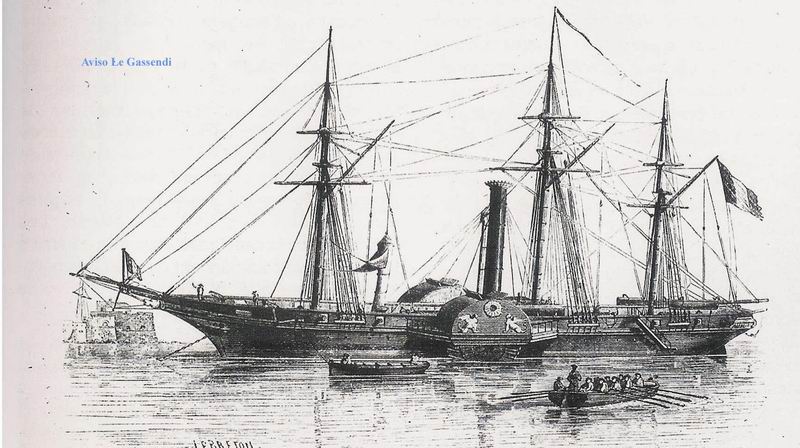
The President's visit to the French frigate Gassandi this afternoon was an event of historical importance; it was the first time a President of the United States ever went on board of a foreign vessel of-war that ever came to Washington. 
On Saturday, April 26, 1862, Lincoln had done a bit of diplomatic relations, inextricably tangled with his natural curiosity. Things had been tense with the French since the Trent affair, when the Emperor Napoleon III had sided with the British in demanding the return of Confederate diplomats. The French had declared themselves neutral in the American Civil War, a step for which Secretary of State Seward had lambasted them. But Seward's warm welcome of the kinsmen of the exiled King Louis-Philippe, the Prince de Joinville and his two nephews (both of whom were on the Peninsula serving as aides-de-camp to George McClellan), had equally infuriated the French.

And now, there was a multi-national force of British, French, and Spanish soldiers in Mexico to force the Juarez government to repay its debts, despite Seward's futile protests about the Monroe Doctrine. With the rebellion of the Southern states there was no credible threat he could make to keep the Europeans out of the Western Hemisphere. News hadn't made it to Washington yet, but the British and Spanish had realized the French had even greater ambitions in Mexico and begun withdrawing their forces.

The French Ambassador, Henri Mercier, had called on the President a few days earlier to invite him to the Gassandi for an official visit. The ship had just returned from Hampton Roads, where it had been moored when the CSS Virginia had dueled the USS Monitor, its crew having received front row seats for the historic battle. Lincoln was ravenous for news about the battle and Seward thought he recognized an olive branch opportunity, so the two were off, along with Seward's son Frederick.

Monday, April 23, 2012

Aquia Creek

Wherein we learn the strategic value of a forgotten tributary
...................................................................................................................................................

On April 20, 1862, the Revenue Cutter Miami sat in Aquia Creek. The Miami was a sleek, 150 foot craft with a schooner-rigged screw-driven steamship that looked like a glamorous luxury yacht. She was. The Revenue Service (one of the forerunners of today's Coast Guard) had purchased her in January from Arthur Leary, owner of one of the largest lines of merchant vessels in the world (briefly in business with Sir Edward Cunard, son of the founder of the Cunard Line--to sneak a Titanic centennial in here, the unsinkable ship was built by White Star in response to Cunard's building of the Lusitania). Like the Harriet Lane, which had become the flagship of the Potomac Flotilla, the Revenue Service had outfitted the Miami for war.

Her arrival at the Navy Yard to receive her guns and ordnance the first week of April had drawn crows of admirers, including Abraham Lincoln, who insisted on a cruise to Alexandria with his family in her. On April 20, Lincoln was again on board, but this time with a more serious purpose. Secretary of War Edwin Stanton, Secretary of the Treasury Salmon Chase, and a gaggle of staff of various ranks were with him, all on their way to visit the Army of the Potomac on the Virginia Peninsula.

Lincoln had stopped at Aquia Creek to confer with the commander of the Department of the Rappahannock, Maj. General Irvin McDowell. McDowell had captured Fredericksburg the day before, the latest in a series of Union victories occurring everywhere except for the Virginia Peninsula (as a city on the Rappahannock, Fredericksburg is outside of the purview of this blog, but there is a remarkably exciting collection of official reports relating to the capture that are worth a read, if you like such things).

Wednesday, April 11, 2012

The Anchored Weighed, The Engines Put In Motion

Wherein Hooker misses out [but not really]
...........................................................................................................................................

On April 11, Hooker's old brigade at last arrived in Hampton Roads and were treated to a sequel of March's paradigm-shifting battle. Martin Haynes of Company I, 2nd New Hampshire Infantry, and later the regimental historian, recalled:
As if it had been specially arranged to give the regiment a view of the whole outfit, it was not long before the Merrimack was seen coming down from Norfolk, accompanied by two large steamers and swarms of tugs. It was her first appearance since the famous combat in Hampton Roads, and all was excitement in anticipation of another big fight. Every vessel that could not fight struck out into Chesapeake Bay, while the war ships came in and took position to contest the passage of the rebel fleet.
The whole thing turned out to be a bit of a dud.
As the South America went out, she passed the frigate Minnesota coming in--a gallant show, with her men at the guns and her decks cleared for action; yet, alone, she was no match for the rebel monster, and the hop of successful battle rested with that uncanny little raft and turret [the Monitor] which had once sent the Merrimack crippled, back to her den. A half-dozen shots, perhaps, were exchanged at long range between the Merrimack and the Riprap battery, when the rebel procession headed back for Norfolk and disappeared behind Sewell's Point.
Though not entirely, since the ex-Merrimack captured three merchant ships, events that apparently were not memorable to Haynes, or were at least not in comparison to the lack of battle. The feeling of missing out was probably pretty strong among the New Hampshire men, and not just them but their fellow brigade members.

Reconnaissance on the Potomac (Frank Lesley's Illustrated Newspaper)
The division of Brig. General Joseph Hooker had spent a cold, isolated winter in Charles County, Maryland, suppressing secessionist inhabitants and plotting to end the activities of a series Confederate batteries that was shutting down traffic on the Potomac. The 2nd New Hampshire had marched there with him as part of his brigade, then been turned over to its senior colonel when Hooker was elevated to command the division that included then-Brig. General Dan Sickles' Excelsior Brigade. A third brigade of New Jersey regiments was added (called the "Second New Jersey Brigade" to avoid confusing them with their more famous brethren commanded by Phil Kearny) about midway through the winter.

Wednesday, April 4, 2012

Entirely Secure

Wherein Lincoln turns to McDowell to defend Washington...again
.............................................................................................................................................

On Tuesday, April 1, 1862, Maj. General George B. McClellan had sailed away from Alexandria en route to the Virginia Peninsula. On Wednesday, April 2, 1862, Secretary of War Edwin M. Stanton moved to banish him from the capital region for good.

Stanton, like Winston Churchill, was a pedantic, obnoxious, arrogant, unlikable, borderline sociopath, without whom the world as we know it today would not exist. Like Churchill, Stanton's highest loyalty was to his own ideas, and the resulting wild shifts in political affiliations led to accusations of opportunism. Both men were beyond stubborn, and held no beliefs loosely, and had become fanatically devoted to ideas they had hatched that proved disastrously wrong. Both also got the most important question of their lifetime right, and their single-minded devotion to seeing it achieved saved democracy for their countries.

For Stanton, that idea was the primacy of the Union, which required the full efforts of a dominant Federal government to establish and sustain. Stanton was a lawyer from Ohio, who had dropped out of Kenyon College when his father died and completed his studies reading with a lawyer in his home town. He was relentless in his cases, and early on earned a reputation for ruthlessness or dedication, depending on which side of the court room one sat. He earned national fame when he defended then-Congressman Daniel Sickles from charges of murder when he shot District of Columbia U.S. Attorney Philip Barton Key (son of the author of the Star Spangled Banner) to death in Lafayette Park. Sumner argued successfully for the first time in an American court room that Sickles had become temporarily insane because of Key's affair with the Congressman's wife (in the opinion of this blogger the defense was a lie; Sickles was permanently insane).

In 1858, Attorney General Jeremiah Black sent Stanton to California, deputized to settle land disputes. Stanton's well-known anti-slavery Democratic politics made him appealing to the Buchanan Administration, which was trying to split the difference between its Northern and Southern wings. His popularity at getting the Democrat Sickles off in what had become a very political celebrity trial made his appointment a victory of sorts for Northern Democrats, who felt they were losing out by Buchanan's gentle treatment of Southerners. But in California, Sickles turned his formidable intellect and pit bull personality on the land disputes and uncovered a massive conspiracy to defraud the Federal government. On top of his celebrity, he had turned out to be useful.

In December 1860, Buchanan's Northern Democrat Secretary of State resigned in protest, because the President had refused to deploy the U.S. Army to defend Federal property in South Carolina after it announced secession. Buchanan quickly asked Black to serve in the position. Black advocated a less confrontational approach: reinforce Fort Sumter, but let the South Carolinians cool down and then reengage diplomatically. Stanton was appointed Attorney General to replace Black.

If Buchanan thought Stanton might support his administration's balanced approach to session, he was disastrously wrong. Stanton instead almost single-handedly dragged Buchanan to condemn secession, and thundered about the need for immediate military action. When it became clear Buchanan would not do so, and that Secretary of War John Floyd was secretly supplying information to the South Carolinians, whipping for secession votes in his home state of Virginia, and making it easy for secessionists to seize arsenals in the South, Stanton decided to begin supplying information to President-elect Lincoln and general-in-chief Winfield Scott. It's largely thanks to Stanton that the Lincoln Administration had even limited ability to respond to the secession crisis when it was sworn in in March.

The new Secretary of War, Simon Cameron, was clearly in way over his head, at best. At worst, he may have been a corrupt war profiteer. Either way, Lincoln asked Stanton to stay on as a special counsel at the War Department. In that role, Stanton befriended fellow Ohio Democrat George McClellan, who had come to the capital after Bull Run to make things right. Or so McClellan thought. Stanton, like the famous paraphrase of Lord Palmerston's remarks to Parliament, had no friends, only interests. When it became clear that Cameron was tragically inept, Stanton made use of McClellan (who at least could recognize good ideas) to push for the organization of an army strong enough to impose Federal will on the rebellious states.

When Lincoln told Cameron he was resigning, Stanton was brought in to root out the corruption at the War Department. With fanatical zeal he turned his brain to ungumming the bureaucracy and creating an efficient machine for the administration of what later generations of Americans would learn to call total war. But with himself in the driver's seat and able to depress the gas pedal fully, McClellan had become the impediment to reinstating the Union as quickly and thoroughly as possible. And so, Edwin Stanton turned his relentless talents towards destroying McClellan.

It was probably Stanton who was responsible for Lincoln's change of heart towards his role as commander-in-chief. During Cameron's time at the War Department, the President had believed war was best left to general-in-chief Scott and his replacement, McClellan. But since January, the President had issued orders for all armies to advance, had forced McClellan to step down as general-in-chief, had created corps for the Army of the Potomac, and had set conditions for McClellan to meet before his plans could receive approval. Stanton had probably convinced him that  the first word of commander-in-chief had real meaning. At the very least, Stanton had empowered him to act on beliefs he had developed himself.

Stanton had also decided to balance McClellan's dominance of the new upper echelon of the Army created by the promotion of his favorites to brigadier generals of U.S. Volunteers, by elevating prominent members of the old pre-war Army. At the operational level, four were now McClellan's corps commanders, much to his irritation. At the national-strategic level, Stanton pulled Adjutant General Lorenzo Thomas out of the dusty corner he had been confined to by McClellan, and reinstated as a major general Ethan Allen Hitchcock, to be a special advisor to the Secretary. Both men had been born around the turn-of-the-century, and both men had had senior roles in the army before the Mexican War. They were perfect for Stanton's scheme of pitting experience against the youthful "genius" of McClellan.

On April 2, Stanton turned to them to exorcise the ghost of McClellan from the capital. He submitted a request to the two men to review five papers he provided and "report to me whether the President's order and instructions have been complied with in respect to the forces to be left for the defense of Washington and its security and at Manassas."

First up was the President's General War Order No. 3, issued on March 8, which forbade shifting the base of operations of the Army of the Potomac until McClellan and all four corps commanders certified Washington was safe. The second document was that certification, with the Fourth Corps' Erasmus Keyes, the Third's Sam Heintzelman, and the First's Irvin McDowell, all further stipulating that if all the forts on the Virginia side of the Potomac were garrisoned, then only 25,000 men would be needed. The Second Corps' Edwin Sumner calculated differently, saying a total force of 40,000 men would be needed, but still agreed the city was safe under McClellan's plan. The unanimous agreement had shocked and irritated Stanton, who believed the capital needed a significantly larger force to defend it.

Third, was Stanton's own concurrence with the plan approved by the corps commanders, further stipulating that not only must Washington be secure, but Manassas Junction must be secured for the duration of the war. It's unclear how much Stanton did this to secure the line of communication that had caused disaster in July 1861 when the Valley Confederates and the Northern Virginia Confederates were able to support each other, and how much Stanton did this to move the goal posts on McClellan. It managed to accomplish both.

Fourth was McClellan's own report written on board the Commodore on April 1 as he was departing. It left under the military governor of Washington, Brig. General James Wadsworth, 18,000 men for the forts and the city, as well as under Maj. General Nathaniel P. Banks 55,456 men for defending the Valley, Warrenton, Manassas, and Charles County on the Lower Potomac.

Finally, the April 2 report from Wadsworth that precipitated Stanton's request from Thomas and Hitchcock, showing 20,000 men under his command, but complaining that he had, in fact, far less, since McClellan had ordered him to send nearly half to places Banks was supposed to defend. Stanton would have had McClellan's report, which Wadsworth did not, and know that the defense scheme called for Banks to replace Wadsworth as soon as he was done finally putting an end to Stonewall Jackson in the Valley, but it was Wadsworth's other charge that the troops under him were untrained and the worst of the regiments brought in during the winter that angered him and gave him an opportunity to eliminate the deliberate, limited war waging McClellan.
I deem it my duty to state that, looking at the numerical strength and character of the force under my command, it is my judgment entirely inadequate and unfit for the important duty to which it assigned. I regard it very improbably that the enemy will assail us at this point, but this belief is based upon the hope that they may be promptly engaged elsewhere and may not learn the number and character of the force left here.
 Hitchcock and Thomas made a reply the very same day. On examining the documents they determined that 55,000 men would be necessary total to accomplish, with 30,000 men manning the forts (every fort, unlike McClellan's scheme to man only the Virginia forts) around Washington and 25,000 in a mobile corps, that could engage launch counterattacks. So far, so good, for McClellan. He even received unexpected support when they declared Stanton's order about Manassas Junction unnecessary, since "as the enemy have destroyed the railroads leading to it it may be fair to assume that they have no intention of returning for the reoccupation of their late position...."

But when comparing Wadsworth's report to McClellan's, Thomas and Hitchcock struck the coup de grace. McClellan had double counted a brigade of Wadsworth's men as defending Washington and defending Manassas Junction. Since the men couldn't be in both places, no matter what their quality, McClellan's report was inaccurate. An argument can be made that the commanding general was exhausted from the long hours loading his army for transport and simply made a mistake, but Stanton was happy to claim perfidy.

Thomas and Hitchcock gave him the conclusion he needed:
In view of the opinion expressed by the council of the commanders of the army corps of the force necessary for the defense of the capital, though not numerically stated, and of the force represented by General McClellan as left for that purpose, we are of opinion that the requirement of the President that this city shall be left entirely secure, not only in the opinion of the General-in-Chief, but that of the commanders of all the army corps also, has not been fully complied with.
It took until April 4 for Stanton to take action, he first had to convince Lincoln to interfere with the plan McClellan had made and that all his corps commanders had approved. But finally the president agreed, and Lorenzo Thomas issued an order by telegraph the day that McDowell's First Corps had been scheduled to board transports in Alexandria: "By direction of the President, Gen. McDowell's army corps has been detached from the force under your immediate command, and the general is ordered to report to the Secretary of War."

It would take several days for the letter Thomas also mailed explaining that the detachment was because of the insufficiency of forces to defend Washington, but by that point McDowell's First Corps had been officially turned into the Department of the Rapphannock, with authority from its namesake river to the Patuxent River in Maryland, and west to the Blue Ridge Mountains, where the new Department of the Shenandoah under Nathaniel Banks picked up. Both former subordinates of McClellan now reported directly to Stanton, and McClellan's authority was at last confined only to the troops within his army.